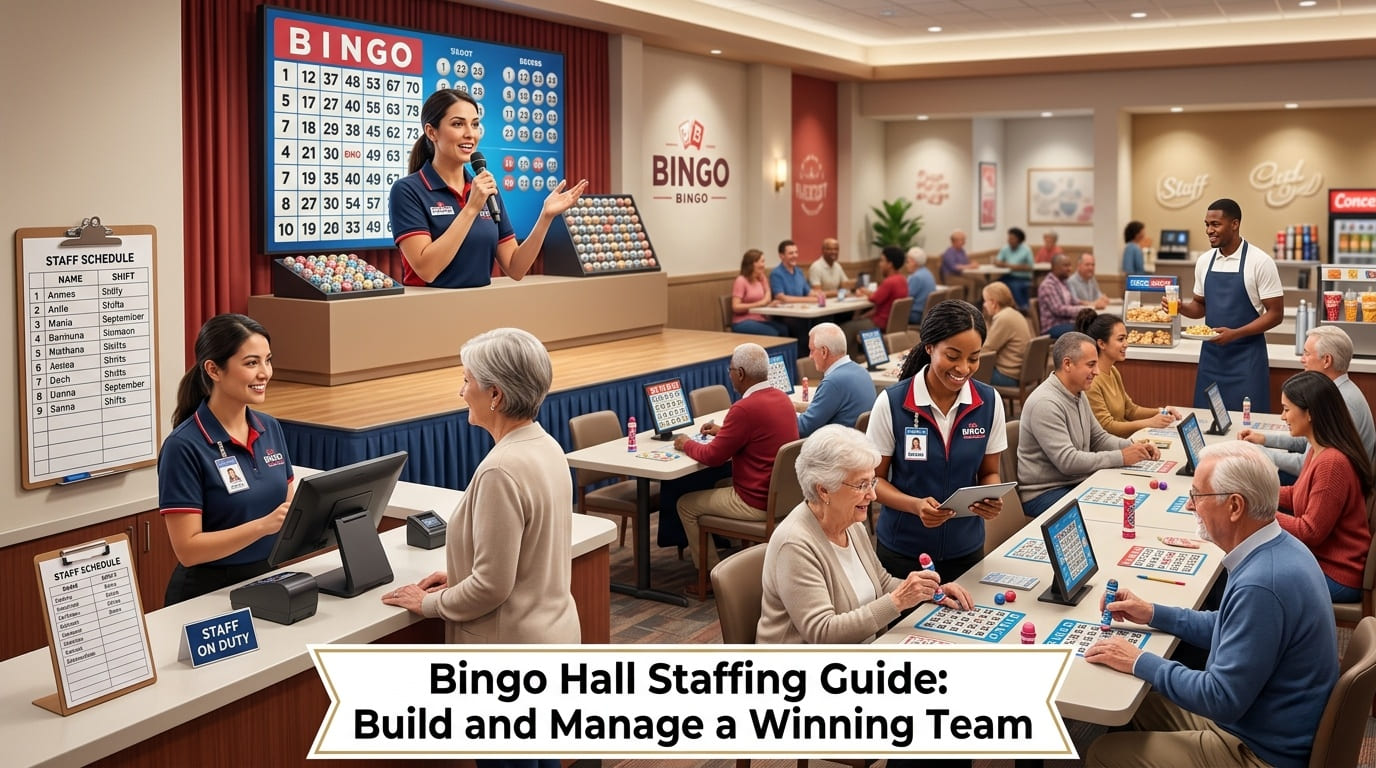
Your staff can make or break your bingo hall. Friendly, efficient employees keep players coming back. Understaffing leads to long lines and frustrated players. Overstaffing eats into your margins. This guide covers everything you need to know about bingo hall staffing, from optimal ratios and key roles to scheduling, training, and retention.
The Problem: Staffing Is a Constant Challenge
You know the struggle:
- Friday night hits, and you're scrambling to find enough callers.
- Lines at the concession stand are too long because you're short‑handed.
- A great employee quits, and you're back to square one.
You're not sure if you're overstaffed or understaffed, just that it never feels right.
Staffing a bingo hall is unique. You need:
- Callers who can keep the energy up
- Cashiers who are fast and accurate
- Runners who move quickly between players
- Supervisors who can handle problems
- Volunteers (if you're a charity hall) who need coordination
Get it right, and everything runs smoothly. Get it wrong, and players notice.
Step 1: Understand Key Roles
Essential Roles in a Bingo Hall
| Role | Responsibilities | Typical Pay | Full‑Time or Part‑Time |
| General Manager | Overall operations, budgeting, compliance, staff management | $45K‑$75K/year | Full‑time |
| Assistant Manager | Shift supervision, customer issues, opening/closing | $35K‑$50K/year | Full‑time |
| Bingo Caller | Calling numbers, engaging players, maintaining energy | $15‑$25/hour + tips | Part‑time (evenings/weekends) |
| Cashier | Selling game cards, handling money, check‑in | $12‑$18/hour | Part‑time |
| Floor Runner | Checking cards, delivering prizes, assisting players | $12‑$15/hour + tips | Part‑time |
| Concession Staff | Food and drink service | $12‑$15/hour | Part‑time |
| Security | Ensuring safety, checking IDs, handling disputes | $15‑$20/hour | Part‑time |
| Maintenance/Cleanup | Cleaning between sessions | $12‑$15/hour | Part‑time |
| Volunteer Coordinator | Managing volunteers (charity halls) | $18‑$25/hour or volunteer | Part‑time |
Optional/Specialized Roles
| Role | When You Need It |
| Marketing Coordinator | Running promotions, social media, SMS campaigns |
| IT Support | Managing software, check‑in tablets, kiosks |
| Trainer | Onboarding new staff, ongoing training |
| Event Coordinator | Special events, tournaments, fundraisers |
Step 2: Determine Staffing Ratios
General Staffing Ratios
| Role | Recommended Ratio | Example (200 players) |
| Callers | 1 per session | 1‑2 (depending on session length) |
| Cashiers | 1 per 75‑100 players | 2‑3 |
| Runners | 1 per 75‑100 players | 2‑3 |
| Concession | 1 per 100‑150 players | 1‑2 |
| Security | 1 per 200‑300 players | 0‑1 |
| Supervisor | 1 per session | 1 |
Sample Staffing by Attendance
| Attendance | Callers | Cashiers | Runners | Concession | Security | Supervisor | Total |
| 50 players | 1 | 1 | 1 | 0‑1 | 0 | 1 | 4‑5 |
| 100 players | 1 | 1‑2 | 1‑2 | 1 | 0‑1 | 1 | 5‑7 |
| 150 players | 1‑2 | 2 | 2 | 1 | 1 | 1 | 8‑9 |
| 200 players | 1‑2 | 2‑3 | 2‑3 | 1‑2 | 1 | 1 | 9‑11 |
| 300 players | 2 | 3‑4 | 3‑4 | 2 | 1‑2 | 1‑2 | 12‑15 |
Note: Guidelines only. Actual needs vary based on hall layout, session length, and technology.
Step 3: Create Effective Schedules
Factors to Consider
| Factor | Impact on Staffing |
| Day of week | Weekends need more staff than weekdays |
| Time of day | Evening sessions busier than matinees |
| Special events | Tournaments, holidays require extra coverage |
| Player demographics | Older crowds may need more assistance |
| Technology | Self‑check‑in kiosks reduce cashier needs |
Scheduling Best Practices
| Practice | Why It Matters |
| Post schedules 2‑3 weeks in advance | Staff can plan their lives |
| Use scheduling software | Avoid conflicts, track availability |
| Have a backup list | Reliable subs for call‑offs |
| Cross‑train employees | Runners can cashier, cashiers can run |
| Consider split shifts | Cover peak times without overstaffing all night |
| Respect preferences | Some staff prefer weeknights, others weekends |
| Plan for breaks | Schedule overlap so people can eat |
Sample Schedule (Friday Night, 200 players)
| Role | 5‑6 PM (Setup) | 6‑7 PM (Check‑in) | 7‑9 PM (Session) | 9‑10 PM (Cleanup) |
| Supervisor | 1 | 1 | 1 | 1 |
| Caller | 0 | 0 | 2 | 0 |
| Cashier | 1 | 3 | 2 | 1 |
| Runner | 0 | 0 | 3 | 2 |
| Concession | 1 | 2 | 2 | 1 |
| Security | 0 | 1 | 1 | 1 |
| Total | 3 | 7 | 11 | 6 |
Step 4: Recruit and Hire Effectively
Where to Find Candidates
| Source | Pros | Cons |
| Current staff referrals | Already vetted, culture fit | Can create cliques |
| Online job boards (Indeed, etc.) | Large reach | Many unqualified applicants |
| Local colleges | Energetic, available nights/weekends | Seasonal, may lack experience |
| Retirees | Reliable, good with people | May not want late nights |
| Hospitality industry | Customer service skills | May have scheduling conflicts |
| Bingo players | Understand the game | May be too casual |
Interview Questions for Bingo Hall Staff
| Question | What It Reveals |
| "Have you ever been to a bingo hall?" | Familiarity with environment |
| "How would you handle an angry player?" | Customer service skills |
| "Are you comfortable handling cash?" | Trustworthiness |
| "Can you work nights and weekends?" | Availability |
| "How do you stay focused during repetitive tasks?" | Attention to detail |
| "Tell me about a time you helped a team succeed." | Teamwork |
Background Checks
| Check Type | Why It's Important |
| Criminal background | Safety, especially with cash handling |
| Reference checks | Verify experience, work ethic |
| Drug screening | Some halls require (check local laws) |
| Credit check | For cash‑handling roles |
Step 5: Train Thoroughly
New Hire Training Checklist
| Topic | Covered? |
| Hall tour and introduction to team | ☐ |
| Bingo basics (how games work, terminology) | ☐ |
| Role‑specific training (cashier, runner, etc.) | ☐ |
| Software training (check‑in, POS, etc.) | ☐ |
| Cash handling procedures | ☐ |
| Customer service standards | ☐ |
| Compliance rules (opt‑ins, minors, etc.) | ☐ |
| Emergency procedures | ☐ |
| Shadowing experienced staff | ☐ |
| Quiz or practical test | ☐ |
Ongoing Training
| Topic | Frequency |
| New features in software | As needed |
| Refresher on compliance | Annually |
| Customer service skills | Annually |
| Cross‑training for other roles | Ongoing |
Step 6: Retain Your Best People
Why Bingo Hall Staff Leave
| Reason | Solution |
| Low pay | Competitive wages, tips, bonuses |
| Inconsistent hours | Stable schedules, advance notice |
| No advancement | Career paths, promotions |
| Burnout | Reasonable hours, breaks, rotation |
| Better opportunity elsewhere | Make this a great place to work |
Retention Strategies
| Strategy | How It Works |
| Pay competitively | Research local rates, stay in top quartile |
| Share tips fairly | Clear tip pool policy |
| Recognize good work | Employee of the month, shout‑outs, small bonuses |
| Offer flexibility | Swap shifts, accommodate school schedules |
| Create career paths | Runner → Cashier → Caller → Supervisor |
| Invest in training | Staff feel valued when you invest in them |
| Ask for feedback | Exit interviews, stay interviews |
| Celebrate together | Staff parties, holiday bonuses |
Step 7: Manage Volunteers (For Charity Halls)
Volunteer Management Best Practices
| Practice | Why It Matters |
| Have a volunteer coordinator | Someone owns the relationship |
| Train volunteers thoroughly | They represent your charity |
| Show appreciation | Volunteer dinners, recognition events |
| Schedule in advance | Respect their time |
| Have backup plans | Volunteers sometimes don't show |
| Track hours | Some grants/requirements need reporting |
| Don't over‑rely | Balance volunteers with paid staff |
Step 8: Use Technology to Reduce Staffing Needs
| Technology | Staffing Impact |
| Self‑check‑in kiosks | Reduce cashier needs by 30‑50% |
| QR code sign‑up | Less manual data entry |
| Online player portal | Players check points, no staff time |
| Automated SMS campaigns | No need for marketing staff to send manually |
| Digital point redemption | Players redeem at kiosk, not at counter |
| POS integration | Auto points, no manual entry |
Frequently Asked Questions
How many staff do I need for a typical session?
For 150‑200 players, plan on 8‑11 staff including callers, cashiers, runners, concession, and a supervisor.
Should I pay callers hourly or by the session?
Both work. Hourly is simpler. Some halls pay a base plus tips or a bonus per session.
How do I handle tips?
Common approaches: keep your own tips, pool and split equally, or pool with weight for roles. Be transparent.
What's the biggest staffing mistake bingo halls make?
Understaffing cashiers. Long lines at check‑in frustrate players before they even sit down.
How do I find good callers?
Look for performers – people with energy, a good voice, and stage presence. Retired radio DJs, teachers, and entertainers often excel.
Can I have staff work multiple roles?
Yes – cross-training is excellent. A runner can cashier during slow moments. A cashier can run during breaks.
How do I handle no‑shows?
Have a standby list. Cross-train so others can cover. Consider a "no‑call/no‑show" policy with consequences.
What's the best way to schedule?
Use scheduling software. Post schedules 2 weeks out. Allow shift swaps with approval.
Staffing Budget Calculator
| Role | # Needed | Hours/Week | Rate | Weekly Cost | Monthly Cost |
| General Manager | 1 | 40 | $25/hr | $1,000 | $4,000 |
| Assistant Manager | 1 | 30 | $20/hr | $600 | $2,400 |
| Callers | 2 | 15 | $18/hr | $540 | $2,160 |
| Cashiers | 3 | 15 | $15/hr | $675 | $2,700 |
| Runners | 3 | 15 | $14/hr | $630 | $2,520 |
| Concession | 2 | 15 | $14/hr | $420 | $1,680 |
| Security | 1 | 15 | $16/hr | $240 | $960 |
| TOTAL | $4,105 | $16,420 |
Adjust based on your actual attendance, hours, and local wages.
Ready to Build Your Dream Team?
Your staff is your most important asset. Get the right people, train them well, and treat them right.
Book a Demo – See how JustKonnect software makes staffing easier.
View Pricing – All features included.