Many nonprofits believe they already have a donor retention strategy because they use a donor CRM.
They track donations.
They store supporter records.
They generate reports.
They send occasional emails.
And yet donor retention still struggles.
Recurring giving remains inconsistent.
One-time donors disappear.
Event attendees stop returning.
Supporters gradually disengage.
This creates a frustrating reality for nonprofit organizations:
Despite investing in CRM software, long-term donor loyalty often remains weak.
The problem is not necessarily the CRM itself.
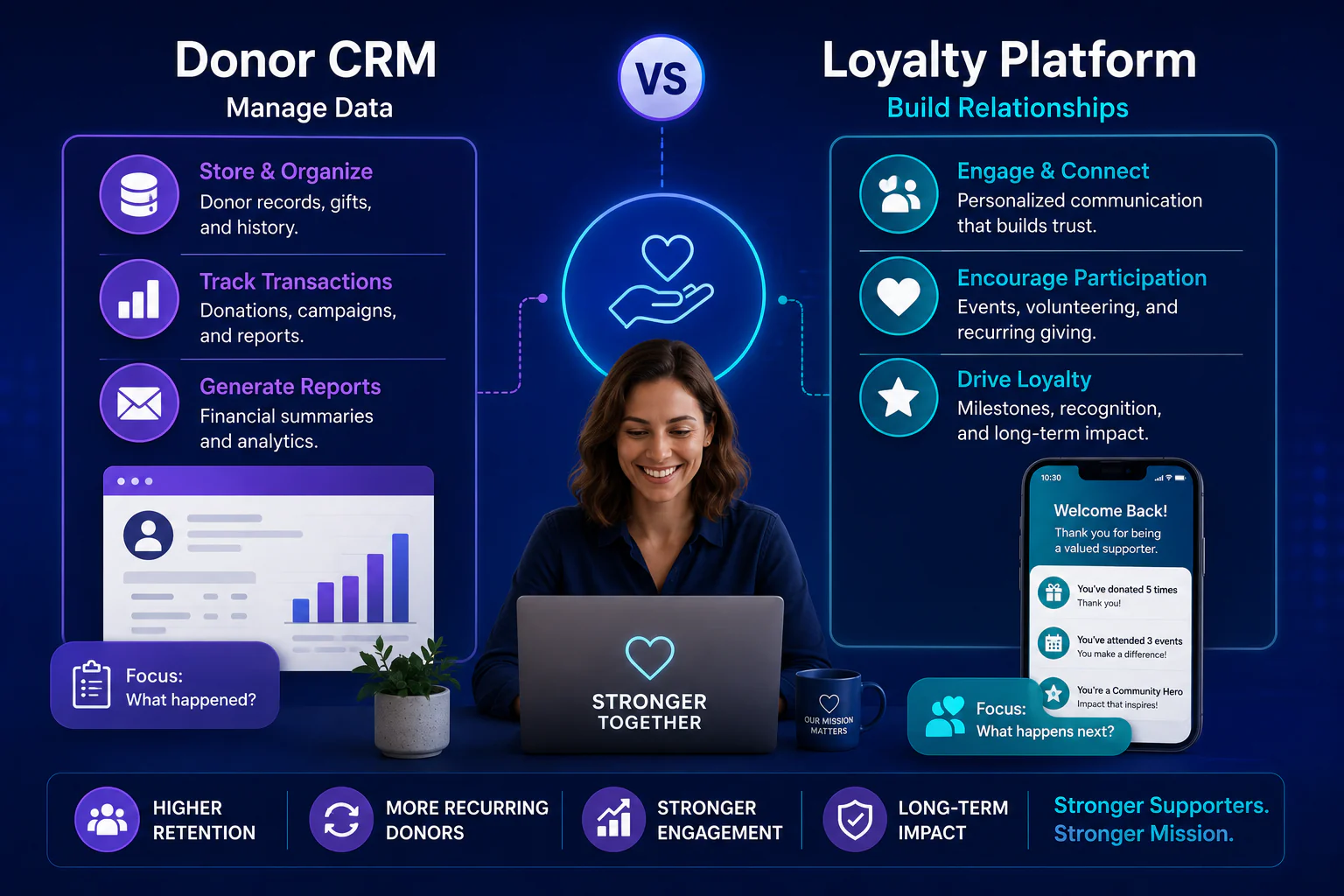
The problem is that donor CRMs and nonprofit loyalty platforms solve very different problems.
Understanding that distinction is critical for nonprofits trying to build sustainable donor relationships and recurring support.
Why Donor Retention Is the Real Fundraising Challenge
Acquiring donors is expensive.
Organizations spend significant resources on:
- Fundraising campaigns
- Paid advertising
- Community outreach
- Events
- Social media promotion
- Grant-funded awareness efforts
But many nonprofits lose a large percentage of first-time donors after the initial gift.
This creates constant fundraising pressure:
- Acquire donors
- Lose donors
- Replace donors
- Repeat
It becomes operationally exhausting.
Long-term sustainability depends on retention—not just acquisition.
That is why nonprofits are increasingly shifting toward donor engagement systems focused on loyalty, recurring participation, and long-term supporter behavior.
What Most Donor CRMs Are Actually Designed To Do
A donor CRM primarily functions as a database and administrative management system.
Its core purpose is organizing information such as:
- Donor records
- Contribution history
- Contact information
- Campaign tracking
- Reporting
- Financial summaries
CRMs are excellent at:
- Recordkeeping
- Operational visibility
- Donation management
- Administrative workflows
But this creates an important distinction:
A donor CRM manages donor data.
A loyalty platform manages donor behavior.
That difference changes everything.
Why Nonprofits Confuse CRM Functionality With Retention Strategy
Many organizations assume:
“If we have a CRM, we have donor engagement.”
But storing donor information is not the same as building donor loyalty.
A CRM may know:
- When someone donated
- How much they contributed
- Which campaign do they support
But retention depends on:
- Emotional connection
- Ongoing engagement
- Personalized communication
- Participation habits
- Community involvement
Most CRMs are not designed to actively shape these behaviors.
What a Nonprofit Loyalty Platform Actually Does
A nonprofit loyalty platform focuses on strengthening long-term supporter engagement through automated interaction and behavioral retention systems.
Instead of simply storing records, loyalty platforms actively encourage:
- Recurring participation
- Event attendance
- Volunteer involvement
- Repeat donations
- Ongoing communication
- Supporter habit formation
The goal is not just administration.
The goal is retention.
The Core Difference: Transaction Management vs. Relationship Management
This is the most important distinction.
A donor CRM is primarily transactional.
It answers questions like:
- Who donated?
- How much?
- When?
- To which campaign?
A loyalty platform is relational.
It focuses on:
- How often do supporters engage
- Whether participation is increasing
- Which communication improves retention
- How to prevent donor disengagement
One manages records.
The other manages relationships.
Why Retention Requires Behavioral Engagement
Most donors do not become recurring supporters automatically.
People become loyal supporters because organizations consistently:
- Communicate with them
- Recognize participation
- Reinforce emotional connection
- Encourage repeat engagement
- Personalize interaction
Behavioral engagement creates donor habits.
This is where loyalty platforms outperform traditional CRMs.
How Loyalty Platforms Improve Donor Retention
1. Automated Engagement Workflows
Most nonprofits struggle with inconsistent follow-up.
After a donation, communication often fades.
Loyalty platforms automate:
- Thank-you campaigns
- Event reminders
- Volunteer invitations
- Recurring giving prompts
- Impact updates
- Re-engagement campaigns
This keeps supporters continuously connected.
2. Donor Lifecycle Management
Not all donors require the same communication.
Loyalty platforms segment supporters by:
- First-time donors
- Recurring contributors
- Volunteers
- Event attendees
- Lapsed supporters
- High-engagement advocates
This allows nonprofits to personalize engagement throughout the donor lifecycle.
3. Attendance and Participation Tracking
Traditional CRMs usually focus heavily on donations.
But donor loyalty is often built through broader participation:
- Fundraising events
- Volunteer work
- Community involvement
- Advocacy participation
Loyalty platforms track these behaviors to measure real engagement.
4. SMS and Real-Time Communication
Modern donor engagement increasingly depends on communication visibility.
Email inboxes are crowded.
Social algorithms are unreliable.
SMS marketing improves:
- Reminder visibility
- Event attendance
- Recurring giving engagement
- Response speed
Many loyalty platforms integrate SMS automation directly into supporter engagement workflows.
5. Personalized Recognition Systems
Recognition strengthens retention.
Loyalty platforms automate milestone engagement, such as:
- Anniversary messages
- Attendance milestones
- Volunteer recognition
- Recurring donor appreciation
- Community achievement tracking
These interactions strengthen emotional loyalty.
Why Generic CRM Workflows Often Feel Transactional
Many donor CRMs unintentionally create communication patterns that feel administrative rather than relational.
Typical CRM communication includes:
- Tax receipts
- Donation confirmations
- Generic newsletters
- Campaign appeals
Supporters may feel like entries in a database instead of valued community members.
Loyalty platforms shift communication toward relationship-building.
The Biggest Retention Mistake Nonprofits Make
Many nonprofits believe donor retention problems are caused by:
- Lack of fundraising campaigns
- Insufficient outreach volume
- Weak acquisition marketing
But often the real issue is:
- Inconsistent engagement after the first interaction
Retention depends less on initial fundraising success and more on what happens afterward.
Why Recurring Donors Need More Than Donation Tracking
Recurring supporters are not simply “repeat transactions.”
They are ongoing relationships.
Successful recurring donor programs depend on:
- Consistent communication
- Emotional reinforcement
- Community participation
- Visibility into supporter behavior
- Personalized engagement
Most donor CRMs were not designed to manage these dynamics deeply.
The Rise of Loyalty-Based Nonprofit Engagement
The nonprofit sector is increasingly moving toward relationship-centered fundraising models.
Organizations are realizing:
- Retention drives sustainability
- Engagement predicts recurring giving
- Participation matters beyond donations
- Automation improves consistency
This is why nonprofit loyalty platforms are becoming more important alongside traditional CRM systems.
CRM and Loyalty Platforms Are Not Competitors
An important clarification:
A donor CRM and a loyalty platform are not necessarily replacements for one another.
They solve different operational needs.
Many organizations use:
- CRMs for administrative management
- Loyalty platforms for engagement automation and retention
Together, they create a more complete donor ecosystem.
Signs Your Nonprofit Needs a Loyalty Platform
Organizations often need loyalty infrastructure when:
- First-time donors rarely return
- Recurring giving remains low
- Event attendance declines
- Communication feels inconsistent
- Donors disengage after campaigns
- Engagement data is limited
- Retention reporting is weak
These are relationship management challenges—not database problems.
Key Features Nonprofits Should Prioritize
When evaluating nonprofit loyalty and donor engagement software, organizations should prioritize:
- Donor lifecycle automation
- SMS engagement tools
- Attendance tracking
- Event participation management
- Behavioral segmentation
- Personalized communication workflows
- Recurring donor engagement tools
- Volunteer engagement tracking
- Re-engagement campaigns
- Retention analytics dashboards
These features directly support long-term donor relationships.
The Future of Nonprofit Fundraising Is Retention-Centered
The nonprofit organizations that grow sustainably over the next decade will not simply be the best fundraisers.
They will be the best relationship builders.
The future of donor engagement is shifting toward:
- Continuous communication
- Personalized automation
- Loyalty-based engagement
- Community participation tracking
- Behavioral retention systems
Fundraising campaigns still matter.
But retention infrastructure matters more.
Final Thoughts
Many nonprofits mistakenly assume donor CRMs alone can solve donor retention challenges.
While CRMs are essential for managing donor records and operational reporting, they are not inherently designed to build long-term supporter loyalty or recurring engagement.
Nonprofit loyalty platforms fill this gap by focusing on behavioral engagement, automated communication, recurring participation, and relationship-building throughout the donor lifecycle.
The organizations that successfully combine donor management with loyalty-driven engagement systems will be the ones that transform one-time donors into recurring supporters, long-term advocates, and sustainable community partners.