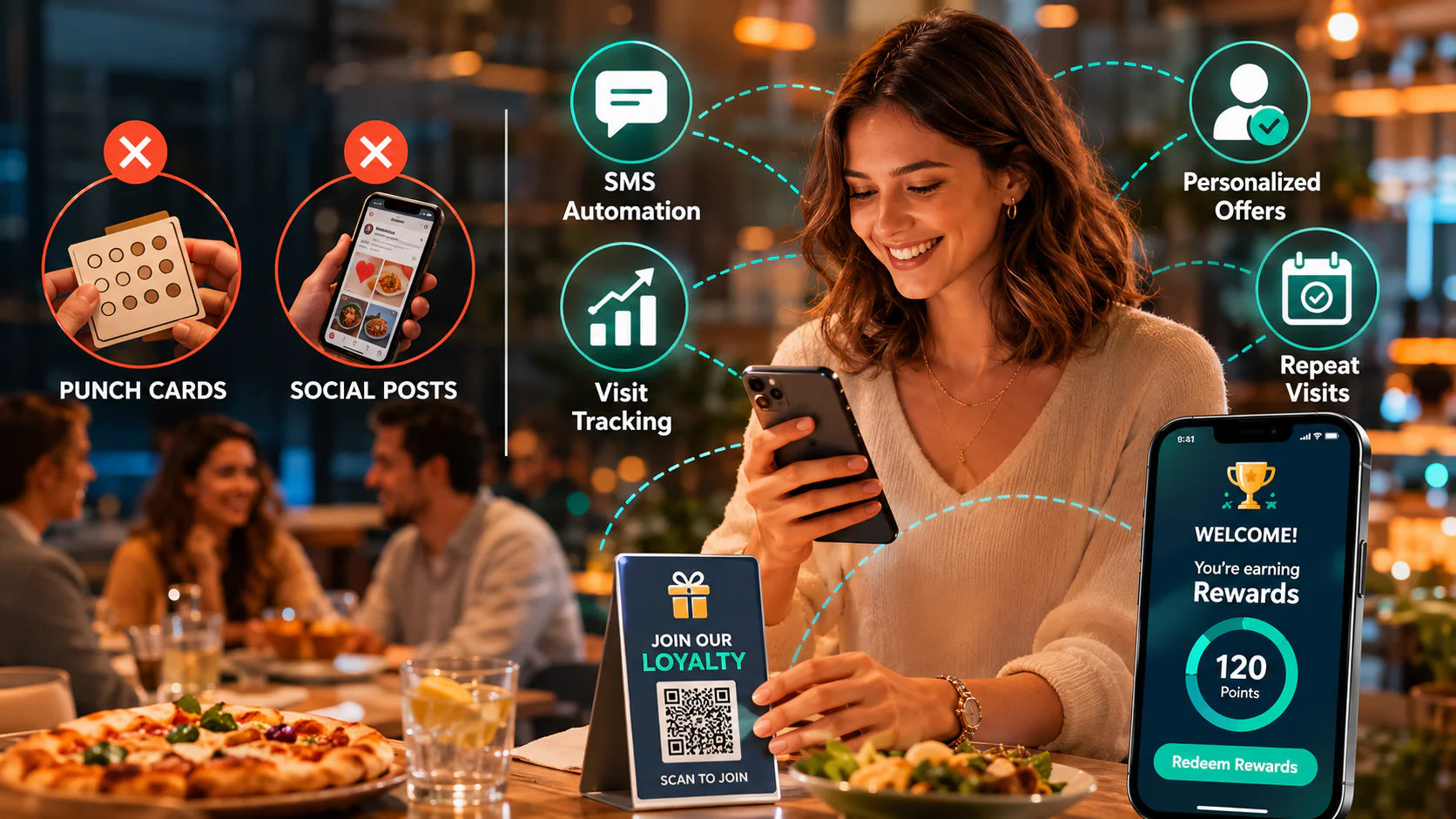
And it is not always pricing. For years, restaurants have relied on the same loyalty tactics:
- Paper punch cards
- Occasional Facebook posts
- Random discounts
- “Buy 10, get 1 free” offers
And while these methods may create occasional engagement, they rarely build long-term customer retention.
Most restaurants still struggle with the same problem:
Customers visit once… then disappear.
The issue is not food quality alone.
It is not the location alone.
The real issue is that many restaurants mistake promotions for a loyalty strategy.
A true restaurant loyalty strategy is not about handing out rewards randomly.
It is about creating repeat behavior.
Modern restaurant loyalty platforms help restaurants build that behavior through:
- Automated SMS communication
- Visit frequency tracking
- Personalized engagement
- Loyalty automation
- Customer lifecycle marketing
- Retention analytics
That is what actually drives repeat visits.
Why Traditional Restaurant Loyalty Systems Usually Fail
Most traditional restaurant loyalty systems were designed decades ago.
The logic was simple:
“Give customers punches or discounts, and they will come back.”
But consumer behavior has changed dramatically.
Modern diners expect:
- Personalized experiences
- Fast communication
- Mobile-friendly engagement
- Relevant offers
- Consistent interaction
Paper punch cards cannot deliver this.
Neither can inconsistent social media posting.
Many traditional loyalty systems create short-term discount behavior rather than long-term loyalty. Modern restaurant loyalty platforms increasingly focus on visit frequency and behavioral engagement instead of simple couponing.
The Biggest Loyalty Myth in Restaurants
Many restaurant owners believe:
“If customers like us, they’ll naturally come back.”
Unfortunately, that is rarely enough anymore.
Today’s customers have endless choices:
- Competing restaurants
- Delivery apps
- Entertainment options
- Convenience-based dining
Without ongoing engagement, even satisfied customers forget to return.
Restaurant retention is driven by visibility and habit formation—not just satisfaction.
Why Social Media Alone Does Not Create Loyalty
Social media helps with awareness.
It does not reliably create retention.
Restaurants often depend heavily on:
- Instagram posts
- Facebook promotions
- Stories and reels
But social platforms have major limitations:
- Declining organic reach
- Algorithm dependence
- Inconsistent visibility
- Audience distraction
Many followers never even see restaurant posts.
This makes social media unreliable as a primary retention system.
Social content can support marketing.
But it is not a complete loyalty infrastructure.
The Problem With Punch Card Loyalty Programs
Punch cards fail for several reasons:
1. No Customer Data
Paper systems collect almost no meaningful guest information.
Restaurants cannot track:
- Visit frequency
- Customer behavior
- Lapsed guests
- Spending patterns
- Engagement trends
Without data, retention becomes guesswork.
2. No Communication System
Punch cards cannot:
- Send reminders
- Trigger campaigns
- Personalize offers
- Re-engage inactive guests
The relationship ends when the customer leaves the restaurant.
3. No Automation
Manual loyalty systems depend entirely on staff consistency.
That creates:
- Operational gaps
- Missed opportunities
- Inconsistent execution
Automation is critical for scalable retention.
4. Rewards Become Transactional
Traditional punch cards often reduce loyalty to:
“Spend more to get a discount.”
That encourages coupon behavior—not emotional loyalty.
Modern loyalty systems increasingly focus on engagement, habits, and customer lifecycle communication instead of only discounts.
What Actually Drives Repeat Restaurant Visits
Restaurants that consistently retain guests usually focus on five core areas:
- Communication consistency
- Visit frequency habits
- Personalized engagement
- Behavioral automation
- Retention analytics
These systems create repeat behavior over time.
1. SMS Marketing Drives Visibility
SMS marketing has become one of the strongest restaurant retention tools because messages are:
- Immediate
- Highly visible
- Direct
- Action-oriented
Unlike social media posts, text messages are usually seen quickly.
Restaurants now use SMS campaigns for:
- Event promotions
- Daily specials
- Birthday rewards
- Win-back campaigns
- Loyalty reminders
- VIP offers
Modern restaurant loyalty software often combines SMS automation directly with retention workflows.
2. Visit Frequency Matters More Than Points
The best restaurant loyalty programs focus on increasing visit frequency.
Why?
Because habit predicts retention.
Research and restaurant loyalty platforms increasingly emphasize “frequency building” instead of only transactional rewards.
A customer who visits:
- Three times in one month
- Is far more valuable long-term than:
- One customer chasing discounts occasionally
Modern loyalty systems encourage:
- Faster repeat visits
- Routine engagement
- Habit formation
This changes customer behavior over time.
3. Automated Campaigns Improve Consistency
Most restaurants fail at retention because communication becomes inconsistent.
Owners get busy.
Staff changes.
Marketing gets delayed.
Automation solves this.
Restaurants can automatically trigger:
- First-visit follow-ups
- “We miss you” campaigns
- Birthday messages
- Slow-day promotions
- VIP rewards
- Event reminders
Automation ensures customers stay engaged without relying on manual effort.
4. Personalized Engagement Increases Loyalty
Generic promotions feel forgettable.
Personalized engagement performs better because customers feel recognized.
Examples include:
- Favorite menu item offers
- Birthday rewards
- VIP tier recognition
- Visit milestone messages
- Personalized event invitations
Customer engagement platforms increasingly use behavioral data to improve targeting and retention.
5. Loyalty Must Extend Beyond Discounts
Discount-only loyalty programs create fragile retention.
Customers simply chase the next deal.
Modern restaurant loyalty systems instead focus on:
- Experiences
- Recognition
- VIP access
- Gamification
- Community engagement
- Personalized communication
This builds emotional loyalty instead of pure price dependency.
Why Restaurant Loyalty Is Really About Habit Formation
The strongest restaurant customers are habitual customers.
Habitual guests:
- Visit automatically
- Bring friends
- Engage regularly
- Spend more consistently
Modern loyalty systems are designed to encourage these repeat behaviors through:
- Timed reminders
- Reward milestones
- Automated follow-ups
- Visit streaks
- Event engagement
This is far more effective than occasional promotions.
How Restaurant CRM and Loyalty Platforms Work Together
Many restaurants mistakenly separate:
- CRM systems
- Loyalty systems
- SMS marketing
- Guest engagement
Modern platforms combine these functions into one retention ecosystem.
This allows restaurants to:
- Track guest behavior
- Segment customers
- Automate communication
- Monitor visit frequency
- Improve retention reporting
All from one centralized platform.
Why Data Visibility Changes Retention Outcomes
Restaurants without customer data operate blindly.
They do not know:
- Who stopped visiting
- Which promotions work
- Which customers are loyal
- Which guests are at risk of churning
Restaurant loyalty software provides:
- Visit analytics
- Campaign reporting
- Customer segmentation
- Retention insights
- Engagement tracking
This transforms marketing from guesswork into a measurable strategy.
Common Restaurant Retention Mistakes
Many restaurants unintentionally weaken retention by:
- Relying entirely on social media
- Using outdated punch cards
- Sending inconsistent promotions
- Ignoring customer data
- Failing to automate communication
- Offering only discounts
- Neglecting post-visit engagement
These issues create weak loyalty systems.
What Modern Restaurant Loyalty Platforms Actually Do
Purpose-built restaurant loyalty platforms combine:
- SMS marketing
- Customer tracking
- Automated campaigns
- Rewards management
- Retention analytics
- Visit frequency monitoring
- Gamification
- Multi-location engagement
Platforms focused on repeat behavior and automated engagement consistently position themselves as retention infrastructure rather than simple rewards tools.
Key Features Restaurants Should Prioritize
When evaluating restaurant loyalty and SMS platforms, operators should prioritize:
- Automated SMS campaigns
- Visit frequency tracking
- Customer segmentation
- Loyalty tier systems
- Retention reporting
- Win-back automation
- Multi-location support
- Personalized offers
- Gamification tools
- Behavioral analytics
These capabilities support sustainable repeat traffic growth.
The Future of Restaurant Loyalty
Restaurant loyalty is shifting away from:
- Paper cards
- Generic discounts
- One-size-fits-all promotions
And toward:
- Automated engagement ecosystems
- Behavioral retention systems
- Personalized communication
- Real-time guest interaction
- Data-driven loyalty marketing
Restaurants that adapt to this shift will build stronger repeat business and long-term customer relationships.
Final Thoughts
Punch cards and occasional social posts are not complete restaurant loyalty strategies.
They may create temporary engagement, but they rarely build consistent repeat behavior or long-term guest retention.
Modern restaurant loyalty requires structured communication, automated engagement, visit frequency tracking, personalized marketing, and behavioral retention systems working together inside one unified platform.
Restaurants that invest in loyalty infrastructure—not just promotions—will be the ones that turn occasional diners into habitual regulars and build sustainable repeat traffic over time.