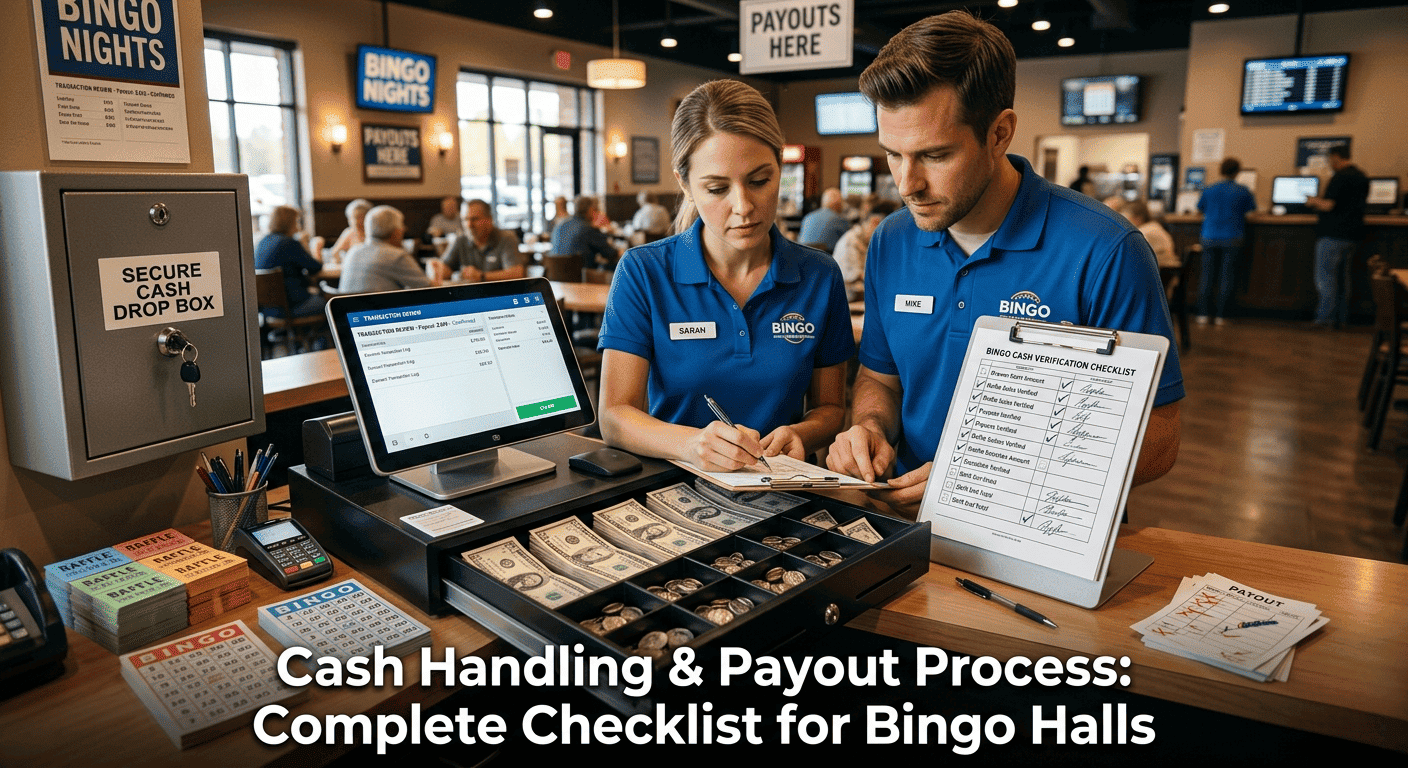
Cash is the lifeblood of your bingo hall – but it's also your biggest risk. One mistake can lead to shortages, disputes, or even theft. This comprehensive checklist covers every step of cash handling and payouts, from opening procedures to nightly reconciliation. Use it to train staff, prevent errors, and protect your hall.
The Problem: Cash Is Risky
You deal with cash constantly:
- Game card sales
- Pull tabs and raffles
- Concession sales
- Prize payouts
- Tip pools
Without clear procedures, things go wrong:
- Drawers come up short (or over)
- Players dispute payouts
- Staff make errors under pressure
- Theft becomes possible – and hard to prove
- Auditors find discrepancies
A standardized cash handling process eliminates guesswork and reduces risk.
Before You Start: Essential Setup
Physical Setup
| Item | Checklist |
| Cash drawers with removable trays | ☐ |
| Lockable cash room or safe | ☐ |
| Drop box for large bills | ☐ |
| Sufficient change (small bills, coins) | ☐ |
| Receipt books or POS system | ☐ |
| Calculator or POS with auto‑calculate | ☐ |
| Pens, paper clips, rubber bands | ☐ |
| Deposit slips (if banking nightly) | ☐ |
Staff Preparation
| Task | Checklist |
| All cash handlers trained on procedures | ☐ |
| Staff signed cash handling agreement | ☐ |
| Assigned roles (who counts, who verifies) | ☐ |
| Backup staff identified for breaks | ☐ |
Opening Procedures
Starting Cash
| Step | Done? |
| Obtain starting cash from safe/manager | ☐ |
| Count starting cash with another staff member present | ☐ |
| Both sign starting cash log | ☐ |
| Enter starting cash amount in POS/system | ☐ |
| Place cash in drawer in organized denominations | ☐ |
| Lock drawer until opening time | ☐ |
Register/POS Setup
| Step | Done? |
| Log into POS system | ☐ |
| Verify opening balance matches starting cash | ☐ |
| Test receipt printer | ☐ |
| Ensure enough receipt paper | ☐ |
| Verify card reader working (if accepting cards) | ☐ |
During Operations: Game Sales
Selling Game Cards
| Step | Done? |
| Announce prices clearly | ☐ |
| Accept cash, count change back to customer | ☐ |
| Place cash in drawer immediately | ☐ |
| Record sale in POS (or manual log if no POS) | ☐ |
| Give customer receipt (if requested or required) | ☐ |
| For large bills (>$50), consider dropping in lockbox | ☐ |
Handling Large Bills
| Step | Done? |
| If bill >$50, announce "dropping a [denomination]" | ☐ |
| Place bill in locked drop box (not in drawer) | ☐ |
| Record drop in drop log (time, amount, staff) | ☐ |
| Give change from drawer or get change from supervisor | ☐ |
Cash Drawer Limits
| Step | Done? |
| Set a maximum cash limit per drawer (e.g., $500) | ☐ |
| When limit reached, perform a "cash drop" | ☐ |
| Remove excess cash, place in drop box | ☐ |
| Record drop in log | ☐ |
| Update POS with new drawer total (if applicable) | ☐ |
During Operations: Pull Tabs & Raffles
Pull Tab Sales
| Step | Done? |
| Display prices clearly | ☐ |
| Collect payment before giving tickets | ☐ |
| Record sales separately from game cards | ☐ |
| Count unsold tickets regularly | ☐ |
| Secure unsold tickets in locked container | ☐ |
Raffle Ticket Sales
| Step | Done? |
| Use numbered ticket rolls (duplicate copy) | ☐ |
| Record starting ticket number | ☐ |
| Collect payment, give customer their portion | ☐ |
| Keep stub in locked box | ☐ |
| At end, count stubs vs. cash collected | ☐ |
During Operations: Concessions
| Step | Done? |
| Separate cash drawer or POS category for concessions | ☐ |
| Price list visible to customers | ☐ |
| Record every sale | ☐ |
| No "freebies" without manager approval | ☐ |
| Track inventory (count popular items nightly) | ☐ |
During Operations: Prize Payouts
Standard Payouts
| Step | Done? |
| Verify winning card with second staff member | ☐ |
| Both initial winning card | ☐ |
| Calculate payout amount based on posted prize schedule | ☐ |
| Pay winner from cash drawer | ☐ |
| Get winner's signature on payout log | ☐ |
| Record payout in POS/system | ☐ |
| File winning card with payout log | ☐ |
Large Payouts (e.g., Jackpots)
| Step | Done? |
| Two managers verify win | ☐ |
| Complete jackpot payout form | ☐ |
| Get winner's ID and signature | ☐ |
| Pay from safe (if drawer insufficient) | ☐ |
| File all paperwork in compliance folder | ☐ |
| Report to state gaming commission if required | ☐ |
End of Night: Reconciliation
Step 1: Stop Sales
| Step | Done? |
| Announce last game/sales closed | ☐ |
| No more sales after cutoff | ☐ |
| Count remaining pull tabs/raffle tickets | ☐ |
Step 2: Count Cash Drawer
| Step | Done? |
| Two staff members count together | ☐ |
| Separate currency by denomination | ☐ |
| Count coins separately | ☐ |
| Use calculator or POS count feature | ☐ |
| Record total cash in drawer | ☐ |
Step 3: Calculate Expected Total
| Step | Done? |
| Starting cash | $_____ |
| Plus sales (from POS or manual log) | $_____ |
| Minus payouts (from logs) | $_____ |
| Minus drops (from drop log) | $_____ |
| Expected ending cash | $_____ |
Step 4: Compare Actual vs. Expected
| Step | Done? |
| Actual ending cash (from count) | $_____ |
| Expected ending cash | $_____ |
| Variance | $_____ |
Step 5: Investigate Variances
| Variance Size | Action |
| Under $5 | Note, adjust, retrain if frequent |
| $5‑$20 | Double‑check counts, review transactions |
| Over $20 | Full investigation, review video if available |
Document all variances in variance log with explanation.
End of Night: Deposits
Prepare Deposit
| Step | Done? |
| Remove starting cash for next day | ☐ |
| Count remaining cash for deposit | ☐ |
| Prepare deposit slip (two staff verify) | ☐ |
| Place cash and deposit slip in deposit bag | ☐ |
| Seal bag, both sign across seal | ☐ |
Secure Deposit
| Step | Done? |
| If night deposit: take to bank immediately | ☐ |
| If morning deposit: place in locked safe | ☐ |
| Record deposit amount in deposit log | ☐ |
| Note any variance from expected | ☐ |
End of Night: Paperwork
| Document | Completed? |
| Daily sales summary | ☐ |
| Payout log (all winners) | ☐ |
| Drop log (all cash drops) | ☐ |
| Variance log (if any) | ☐ |
| Deposit receipt (from bank or temp) | ☐ |
| Pull tab/raffle inventory count | ☐ |
| Concession inventory count | ☐ |
| Staff sign‑off sheet (all cash handlers) | ☐ |
Weekly/Monthly Procedures
Safe Audits
| Step | Frequency | Done? |
| Count safe contents with two managers | Weekly | ☐ |
| Compare to expected (starting cash + deposits not banked) | Weekly | ☐ |
| Document audit in log | Weekly | ☐ |
Bank Reconciliations
| Step | Frequency | Done? |
| Compare deposit records to bank statements | Monthly | ☐ |
| Investigate any discrepancies | Monthly | ☐ |
| File reconciliation with financial records | Monthly | ☐ |
Inventory Audits
| Step | Frequency | Done? |
| Count all game cards, pull tabs, raffle tickets | Monthly | ☐ |
| Compare to sales records | Monthly | ☐ |
| Investigate variances | Monthly | ☐ |
Security Best Practices
| Practice | Why |
| Two‑person rule for counting, drops, deposits | Prevents theft, reduces errors |
| Surveillance cameras covering all cash areas | Deters theft, provides evidence |
| Limit cash in drawers | Reduces loss if robbery |
| Use drop boxes for large bills | Keeps drawers low |
| Rotate staff duties | Prevents complacency, schemes |
| Background checks on all cash handlers | Hires trustworthy people |
| Surprise cash audits | Keeps everyone honest |
| Separate cash handling from record‑keeping | Checks and balances |
Common Mistakes and How to Avoid Them
| Mistake | Prevention |
| Skipping the two‑person count | Make it policy, enforce consistently |
| Not documenting drops | Use a log, check it nightly |
| Loose bills in drawer | Train to keep organized |
| No variance follow‑up | Investigate every variance, no matter how small |
| Poor lighting at cash stations | Ensure adequate lighting |
| Distracted cashiers | No phones, limit conversations during transactions |
| Not counting pull tabs | Count before and after each session |
Cash Handling Checklist (Printable)
Download Printable PDF Checklist
Use this one‑page checklist nightly:
Opening
- Starting cash counted and verified (two staff)
- Starting cash entered in system
- Drawer organized
- POS tested
During Session
- All sales recorded
- Large bills dropped
- Drawer limits maintained
- Payouts verified by two staff
- Winners sign payout log
Closing
- Final count (two staff)
- Calculate expected vs. actual
- Investigate variances
- Prepare deposit
- Complete all paperwork
- Staff sign off
Frequently Asked Questions
How much starting cash should I use?
$200‑$500 is typical, depending on your average transaction size and expected attendance. Include plenty of small bills and coins.
What if my drawer is consistently over or short?
Investigate. Look for patterns – same staff member? Same time of night? Same type of transaction? Retrain or reassign as needed.
How often should I do drops?
Whenever the drawer reaches a set limit (e.g., $500) or at regular intervals (every hour). More frequent drops = less risk.
Do I need a POS system?
Strongly recommended. POS systems reduce errors, automate calculations, and provide an audit trail. If you can't afford POS, use numbered receipt books and reconcile meticulously.
How do I handle credit card payments?
Follow your card processor's procedures. Typically: swipe/dip/tap, get signature if required, provide receipt. Cash handling procedures don't apply to card sales, but reconciliation does.
What's the best way to prevent theft?
The two‑person rule is your best defense. Also: cameras, surprise audits, background checks, and a culture of accountability.
How long should I keep cash handling records?
At least as long as your state requires for gaming records (often 3‑7 years). Check with your state gaming commission.
Can volunteers handle cash?
Yes, but they should follow the same procedures as paid staff – including two‑person counts and signed logs.
Ready to Simplify Cash Handling?
Clear procedures + the right technology = fewer errors and less stress.
Book a Demo – See how JustKonnect's POS integration and reporting can help.
View Pricing – All features included.