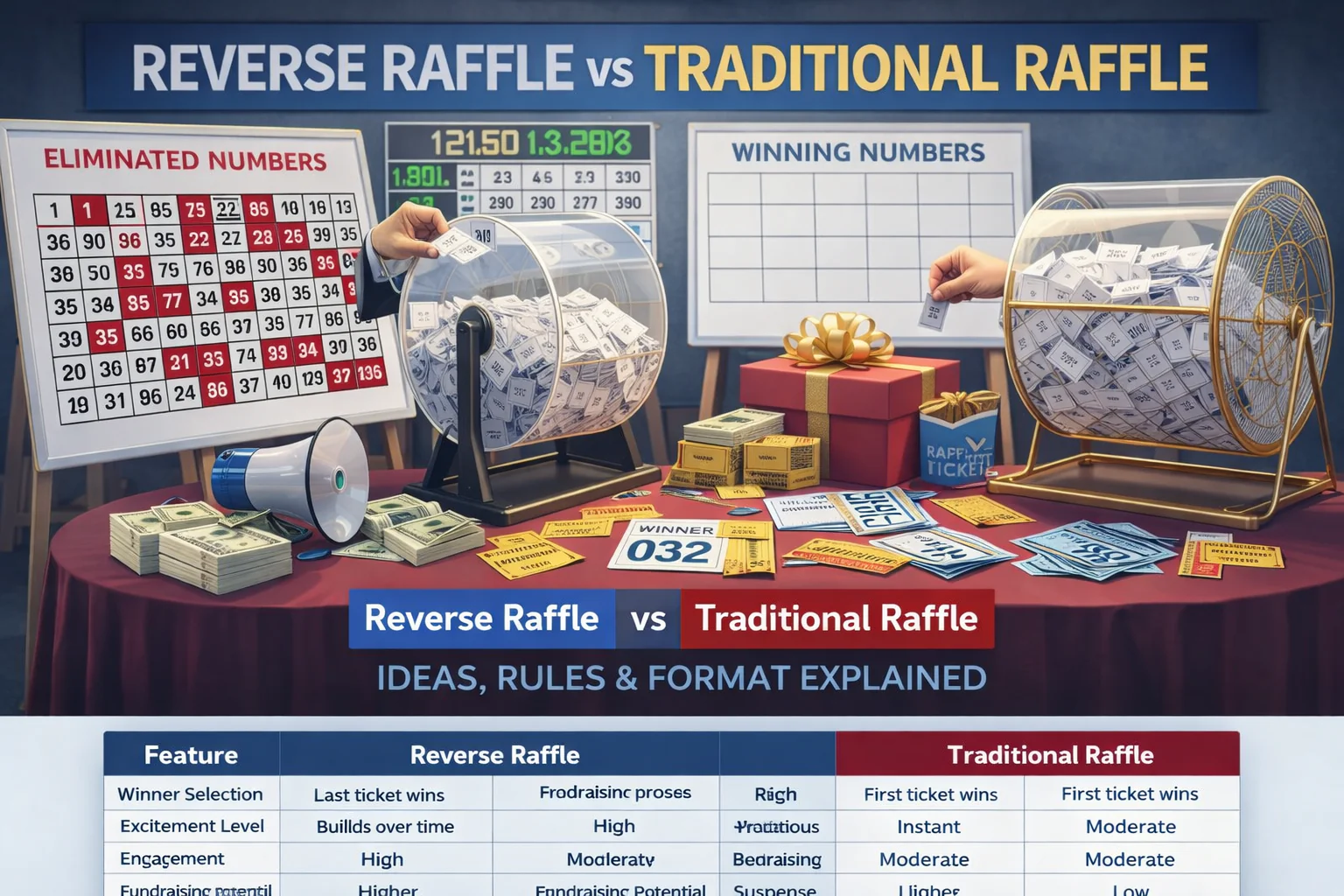
Reverse raffles have become one of the most popular fundraising formats for charities, nonprofits, schools, and community organizations. They are simple to run, highly engaging, and effective at generating donations. But to host a successful event, it’s important to understand reverse raffle ideas, the rules and format, and how they compare to traditional raffles.
This guide covers everything in one place — from creative reverse raffle ideas to step-by-step rules and a full comparison between reverse raffle vs raffle formats.
What Is a Reverse Raffle?
A reverse raffle is a fundraising game where participants purchase numbered tickets. Instead of drawing a winner immediately, numbers are eliminated one by one until only one ticket remains. The last remaining ticket wins the grand prize.
This gradual elimination creates suspense and keeps participants engaged throughout the entire event.
Reverse raffles are commonly used for:
- Charity fundraising events
- Nonprofit campaigns
- School fundraisers
- Church events
- Corporate charity nights
- Community raffles
- Sponsor-based events
Because participants remain in the game longer, reverse raffles often generate more excitement and higher ticket sales.
Reverse Raffle Rules & Format Explained
While reverse raffles are flexible, most events follow a standard format. Understanding these rules helps ensure a smooth and fair drawing process.
Basic Reverse Raffle Rules
Each participant purchases a ticket
Each ticket has a unique number
Numbers are randomly eliminated
Eliminated tickets cannot be returned
The draw continues until one ticket remains
The last remaining ticket wins
Optional bonus prizes may be added
Ticket quantity is limited
These rules keep the event simple and easy to understand.
Step-by-Step Reverse Raffle Format
A typical reverse raffle follows this structure:
Step 1: Set ticket limit
Step 2: Define ticket price
Step 3: Sell tickets to participants
Step 4: Assign numbers to tickets
Step 5: Start elimination draw
Step 6: Remove numbers randomly
Step 7: Announce remaining tickets
Step 8: Continue until the final ticket
Step 9: Declare the winner
This format works for both small and large fundraising events.
Reverse Raffle Ideas for Charity & Fundraising Events
Using creative reverse raffle ideas can significantly increase participation and excitement. Here are some of the most effective options.
Classic Reverse Raffle With Grand Prize
This is the simplest format. Participants buy tickets, numbers are eliminated, and the final ticket wins the grand prize. This works well for most charity events.
Split-The-Pot Reverse Raffle
In this format, the total amount raised is split between the winner and the organization.
Example:
Total raised: $8,000
Winner receives: $4,000
Charity keeps: $4,000
This encourages more ticket purchases since the prize grows with participation.
Last Ticket Bonus Prize
Award a bonus prize when a certain number of tickets remain. For example:
Last 20 tickets — bonus prize
Last 10 tickets — additional prize
Final ticket — grand prize
This keeps participants engaged during the final stage.
Multiple Prize Reverse Raffle
Instead of one winner, add prize tiers during elimination.
Example:
100 tickets remaining — small prize
50 tickets remaining — medium prize
10 tickets remaining — bonus prize
Last ticket — grand prize
This increases excitement and engagement.
Early Bird Reverse Raffle
Offer a bonus drawing for participants who purchase tickets early. This helps generate momentum and improve early ticket sales.
Reverse Raffle With Consolation Prizes
Give small prizes to eliminated participants. This keeps attendees interested even after elimination.
Examples:
Gift cards
Merchandise
Sponsor prizes
Event tickets
Dinner Event Reverse Raffle
Combine the raffle with a dinner event. Numbers are eliminated throughout the evening while guests enjoy food and entertainment.
This format:
- Extends engagement
- Improves event value
- Creates a social atmosphere
- Encourages attendance
Sponsor-Based Reverse Raffle
Sponsors provide prizes during the elimination process.
Example:
Sponsor 1 — last 100 tickets prize
Sponsor 2 — last 50 tickets prize
Sponsor 3 — last 10 tickets prize
This reduces event cost and increases prize value.
Online Reverse Raffle
Participants purchase tickets online, and eliminations are streamed live. This works well for remote fundraising.
Reverse Raffle vs Traditional Raffle
Understanding the difference between a reverse raffle vs raffle helps organizations choose the right format.
| Feature | Reverse Raffle | Traditional Raffle |
| Winner selection | Last ticket wins | First ticket wins |
| Excitement level | Builds over time | Instant |
| Participant engagement | High | Moderate |
| Audience retention | Strong | Limited |
| Fundraising potential | Higher | Moderate |
| Event duration | Longer | Shorter |
| Suspense | High | Low |
Reverse raffles are typically more engaging because participants remain in the game longer.
Which Is Better: Reverse Raffle or Traditional Raffle?
The better option depends on your event goals.
Choose reverse raffle if you want:
Higher engagement
Longer event experience
Suspense-driven format
Limited ticket sales
Premium fundraiser
Choose traditional raffle if you want:
Quick drawing
Simple event
Multiple winners
Short duration
Many charities prefer reverse raffles because they create a more exciting fundraising experience.
When Should You Use a Reverse Raffle?
Reverse raffles work best when:
You want to maximize engagement
You are hosting a fundraising dinner
You want limited ticket sales
You want a suspense-driven event
You need simple rules
You want one grand prize
They are ideal for charity and nonprofit events.
Reverse Raffle Prize Ideas
Popular reverse raffle prizes include:
Cash grand prize
Vacation packages
Electronics
Gift cards
Luxury items
Sports tickets
Experience packages
Sponsored prizes
Choosing a compelling prize increases ticket sales.
Tips for Running a Successful Reverse Raffle
Keep ticket quantity limited
Offer a strong grand prize
Announce the remaining numbers
Build suspense near the final draw
Promote early ticket sales
Add bonus prize rounds
Use a clear elimination process
These tips help improve participation and fundraising results.
Frequently Asked Questions
What are reverse raffle rules?
Participants buy numbered tickets, numbers are eliminated randomly, and the last remaining ticket wins.
What is the reverse raffle format?
Tickets are sold, numbers are eliminated one by one, and the final ticket wins.
Are reverse raffles better than traditional raffles?
Reverse raffles often create more engagement and higher fundraising potential.
Can reverse raffles have multiple prizes?
Yes. Bonus prizes can be added during elimination.
How many tickets should a reverse raffle have?
Most reverse raffles use 100–300 tickets.
Are reverse raffles good for fundraising?
Yes. Reverse raffles are widely used for charity events.
Reverse raffles offer a simple but powerful way to raise funds while keeping participants engaged. By understanding reverse raffle rules, choosing the right format, and using creative reverse raffle ideas, organizations can create exciting fundraising events that maximize participation and donations. Many teams also streamline the process using reverse raffle software to manage ticket elimination and run smoother events.