Technology should make running a bingo hall easier.
Yet for many operators, technology has become one of the biggest sources of operational frustration.
A typical bingo hall may use one system for customer records, another for text messaging, a separate loyalty platform, spreadsheets for reporting, and manual processes to connect everything together.
At first glance, this seems manageable.
Each tool serves a purpose.
Each vendor promises specialized functionality.
But over time, the cracks begin to appear.
Player information becomes fragmented.
Marketing campaigns become inconsistent.
Attendance tracking becomes unreliable.
Reporting takes hours instead of minutes.
Most importantly, operators lose the ability to see the complete player journey.
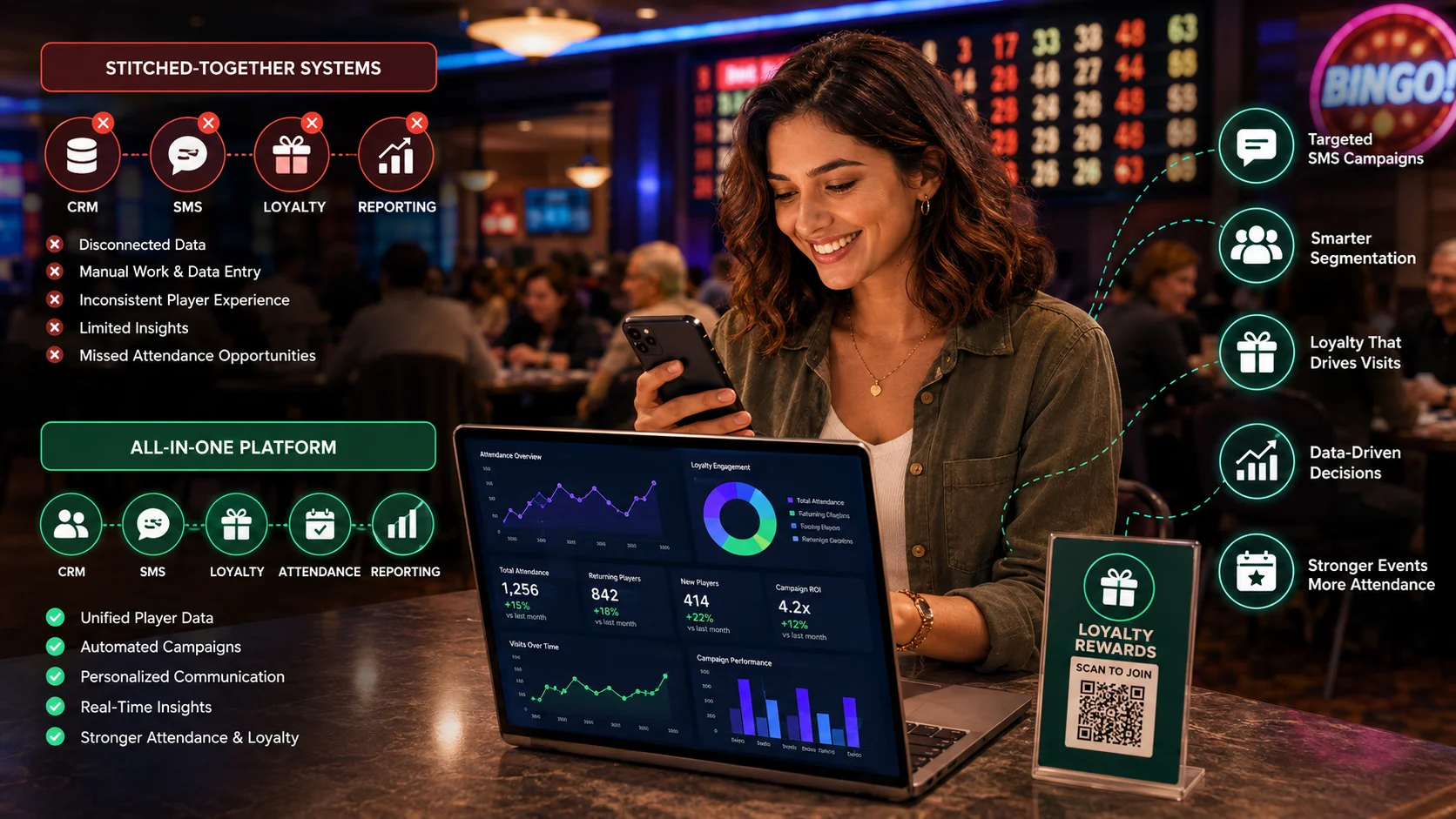
This is why more bingo halls are replacing stitched-together technology stacks with all-in-one platforms that combine CRM, SMS marketing, loyalty management, attendance tracking, and reporting into a single system.
The shift is not simply about convenience.
It is about improving attendance, strengthening player retention, increasing operational efficiency, and creating a better experience for both staff and players.
The Hidden Cost of Fragmented Software
Many bingo halls gradually accumulate software over time.
The process usually happens unintentionally.
A hall starts with a spreadsheet.
Then adds an SMS tool.
Later purchases a CRM.
Then adopts a loyalty system.
Eventually, operators find themselves managing five or six disconnected tools.
While each platform performs its specific function, none of them communicate effectively with one another.
This creates data silos.
A data silo occurs when information exists in one system but cannot easily be accessed or used by another.
For bingo halls, this creates serious operational challenges.
Staff spend valuable time moving information between systems instead of engaging players and improving attendance.
Why Player Data Fragmentation Hurts Attendance
Attendance marketing depends on understanding player behavior.
Operators need answers to questions such as:
- Who attended last week?
- Who has not visited in 30 days?
- Which players respond to promotions?
- Who qualifies for loyalty rewards?
- Which campaigns drive repeat attendance?
When CRM, SMS, and loyalty systems operate independently, these answers become difficult to obtain.
Staff often resort to exporting spreadsheets, manually combining reports, and making assumptions based on incomplete information.
This reduces marketing effectiveness and increases operational complexity.
What an All-in-One Platform Actually Means
An all-in-one bingo hall platform centralizes multiple functions within a single system.
These functions typically include:
- Customer relationship management (CRM)
- SMS marketing
- Loyalty programs
- Attendance tracking
- Reporting dashboards
- Campaign automation
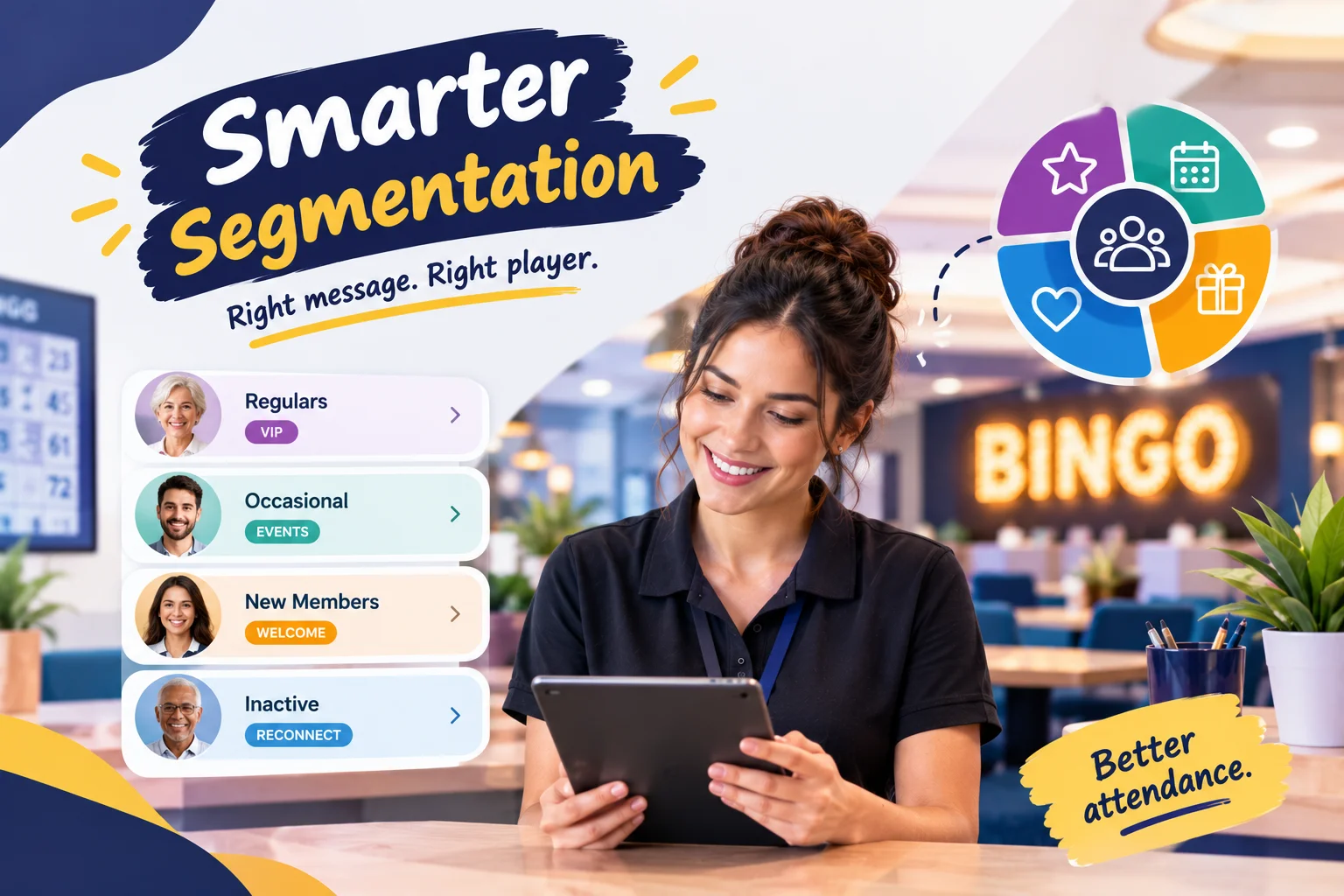
- Player segmentation
- Communication history
Instead of managing multiple databases, operators work from one source of truth.
Every interaction becomes connected.
Every player profile becomes more complete.
Every campaign becomes more intelligent.
The Problem With Separate CRM Systems
A CRM is designed to store customer information.
Most generic CRM platforms perform this task reasonably well.
However, many CRMs are not built specifically for bingo operations.
They often lack:
- Attendance tracking
- Visit frequency monitoring
- Loyalty automation
- Session engagement history
- Bingo-specific segmentation
As a result, operators often supplement their CRM with additional tools.
This creates more complexity rather than solving the underlying problem.
Why SMS Marketing Cannot Operate in Isolation
SMS marketing is one of the most effective attendance marketing tools available to bingo halls.
Text messages are direct, immediate, and highly visible.
However, SMS systems become significantly less effective when disconnected from player data.
Consider two approaches.
Separate SMS Platform
A staff member manually exports player lists.
Uploads contacts.
Creates audience segments manually.
Sends campaigns.
Repeats the process every week.
Integrated SMS Marketing
The platform automatically identifies:
- Active players
- Lapsed players
- VIP members
- Frequent attendees
- Loyalty participants
Campaigns are triggered automatically based on behavior.
The second approach is faster, more accurate, and more scalable.
Why Loyalty Programs Need CRM Data
Loyalty programs are only effective when they reflect actual player behavior.
To accomplish this, loyalty systems require access to:
- Attendance history
- Visit frequency
- Engagement patterns
- Communication preferences
- Promotional responses
When loyalty software operates separately from CRM systems, operators lose valuable context.
Rewards become generic.
Segmentation becomes weaker.
Player engagement suffers.
An integrated loyalty platform ensures rewards are tied directly to meaningful player behavior.
The Attendance Marketing Advantage
One of the biggest benefits of an all-in-one platform is attendance marketing automation.
Attendance marketing focuses on increasing visit frequency rather than simply promoting events.
Instead of asking:
"How many texts did we send?"
Operators begin asking:
"How many players came back?"
This shift creates measurable business outcomes.
Attendance marketing campaigns can automatically target:
- Players who missed recent sessions
- New members
- Frequent attendees
- Loyalty tier members
- Event participants
Because the system has access to complete player data, campaigns become highly relevant.
Automation Eliminates Manual Work
Manual processes create inefficiency.
Staff spend time:
- Exporting spreadsheets
- Updating databases
- Creating reports
- Managing lists
- Tracking attendance
These repetitive tasks consume hours every week.
An integrated platform automates many of these workflows.
Examples include:
- Birthday campaigns
- Win-back campaigns
- Attendance reminders
- Loyalty notifications
- Reward tracking
- VIP communications
Automation improves consistency while reducing administrative workload.
Better Reporting Creates Better Decisions
Reporting is often one of the most overlooked benefits of software integration.
When systems operate independently, reporting becomes fragmented.
Operators receive:
- One report from CRM
- Another report from SMS
- Separate loyalty analytics
- Manual attendance spreadsheets
Combining this information requires time and effort.
An all-in-one platform centralizes reporting.
Operators gain visibility into:
- Attendance trends
- Player retention
- Campaign performance
- Loyalty participation
- Visit frequency
- Revenue-driving activities
This enables faster and more informed decision-making.
Multi-Location Operations Become Easier
Technology fragmentation becomes even more problematic for organizations managing multiple halls.
Each location may use:
- Different spreadsheets
- Different processes
- Different communication methods
This makes standardization nearly impossible.
A centralized platform allows operators to:
- Manage all locations from one system
- Compare performance across halls
- Standardize loyalty programs
- Centralize reporting
- Improve operational consistency
This is especially valuable for bingo associations and multi-location organizations.
The True Cost of Stitched-Together Systems
At first, separate tools appear less expensive.
However, hidden costs quickly emerge.
These include:
- Staff time
- Data management
- Integration maintenance
- Reporting inefficiencies
- Missed attendance opportunities
- Lower retention rates
When these costs are considered, fragmented systems often become more expensive than an integrated solution.
Why Purpose-Built Platforms Outperform Generic Software
Generic software is designed for broad audiences.
Bingo halls have unique operational requirements.
Purpose-built bingo hall software understands:
- Attendance-based engagement
- Loyalty participation
- Session marketing
- Player retention
- Event attendance
- Charity gaming operations
This industry-specific functionality creates stronger results than attempting to force generic software into specialized workflows.
Signs Your Hall Has Outgrown Disconnected Tools
You may need an all-in-one platform if:
- Staff manually export customer data
- Attendance reporting takes hours
- SMS campaigns require spreadsheet uploads
- Loyalty data exists separately from CRM records
- Reporting is inconsistent
- Multiple vendors manage critical functions
- Player retention is difficult to track
These challenges are often symptoms of technology fragmentation.
The Future of Bingo Hall Technology
The industry is moving toward unified engagement platforms.
Operators increasingly recognize that attendance, loyalty, communication, and reporting are interconnected functions.
Managing them separately creates unnecessary complexity.
Managing them together creates operational clarity.
As competition increases and player expectations evolve, integrated technology becomes a competitive advantage.
Final Thoughts
The debate between all-in-one and stitched-together software is ultimately about visibility, efficiency, and player engagement.
Disconnected tools may solve individual problems, but they often create larger operational challenges.
A single platform that combines CRM, SMS marketing, loyalty management, attendance tracking, automation, and reporting provides bingo halls with a complete view of the player journey.
The result is stronger attendance, better retention, improved operational efficiency, and a more consistent player experience.
For modern bingo halls focused on long-term growth, an integrated platform is no longer a convenience.
It is becoming a necessity.