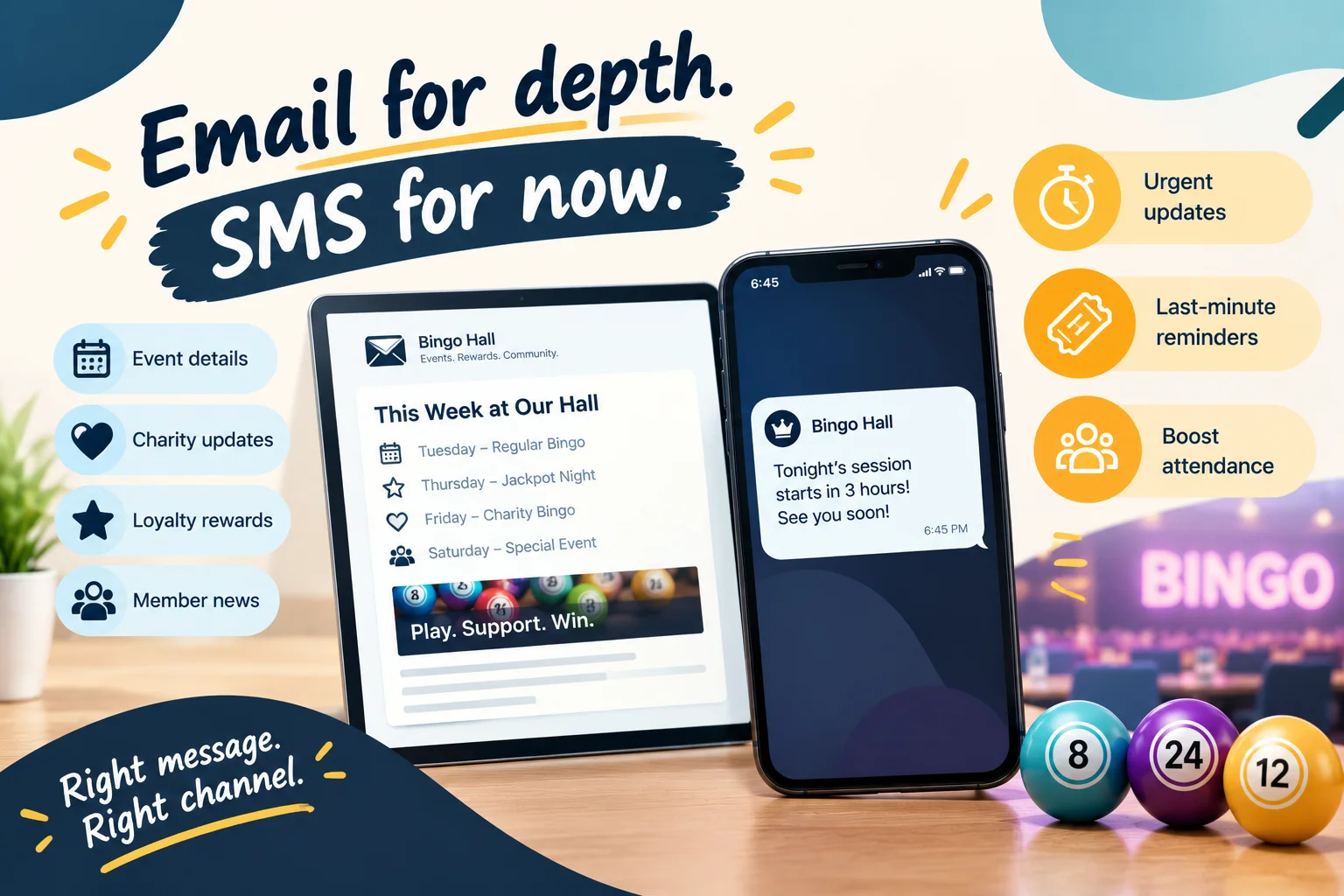
Not every bingo hall communication needs to be a text message.
And not every player communication belongs in an email inbox.
The mistake is treating the two channels as interchangeable.
A bingo hall might need to explain a monthly events calendar, announce a charity initiative, share loyalty updates, or tell players about a new programme. Email can give that communication room to breathe.
But if tonight's session starts in three hours and attendance needs a final push, sending another long email may not be the best move.
The better approach is to give each channel a job.
Email handles depth.
SMS handles immediacy.
And when both are connected to the same player data, operators can stop choosing channels based on habit and start choosing them based on the situation.
JustKonnect's Email Marketing feature is designed around bingo hall attendance, player engagement, rewards, and communication rather than a generic retail workflow. The wider platform also connects email and SMS with player profiles, segmentation, loyalty, and campaign reporting.
Email Is Not Dead. It Just Has a Different Job
There is a tendency in marketing to declare one channel better than another.
Email versus SMS.
Email versus social media.
SMS versus push notifications.
For a bingo hall, that thinking is not particularly useful.
The real question is:
What does the player need from this communication?
If the answer requires context, explanation, several pieces of information, or a message that players may want to revisit later, email can be a strong fit.
If the answer is:
“We need this player to know something right now.”
SMS may be the better channel.
That distinction becomes especially important for physical venues because attendance decisions are often tied to a specific day and time.
Where Email Works Particularly Well
Email has one major advantage over SMS:
space.
A bingo hall can use that space strategically.
Monthly or Weekly Event Calendars
Instead of sending separate messages for every upcoming session, an email can bring several events together.
For example:
This Week at [Hall Name]
- Tuesday — Regular Bingo
- Thursday — Jackpot Night
- Friday — Charity Bingo
- Saturday — Special Event
The player can scan the full schedule and decide which sessions interest them.
Trying to communicate the same amount of information through multiple SMS messages would quickly become excessive.
Charity and Fundraising Stories
A fundraising event often needs more than a date and start time.
Players may want to understand:
- What the event supports
- Why the cause matters
- What the hall is doing
- How to participate
- Whether registration is required
- Where donations or proceeds go
Email gives the operator enough room to tell that story without forcing everything into a short message.
Loyalty Updates
A loyalty programme can generate several pieces of information.
Players may want to see their progress, understand a reward, learn how to redeem it, or discover what benefits are available.
That can be difficult to communicate elegantly in a single text.
Email gives the operator room to explain the programme without turning every message into a fragmented conversation.
Event Recaps
After a major charity night or special event, email can be useful for:
- Thank-you messages
- Event photos
- Fundraising results
- Sponsor acknowledgements
- Upcoming dates
- Player appreciation
This is relationship communication rather than urgent attendance communication.
Email fits naturally.
The Problem Starts When Email Tries to Do Everything
An email newsletter can become a dumping ground.
One message contains:
- Next week's schedule
- Tonight's jackpot
- A loyalty offer
- A birthday promotion
- A charity announcement
- A VIP update
- A referral offer
- Three different calls to action
Technically, everything is there.
Practically, the player has to work out what matters.
The more important question is not:
“How much can we put into this email?”
It is:
“What should the player remember after reading it?”
Email works better when the content has a clear hierarchy.
Long-Form Information Belongs in Email
Consider a charity bingo event.
An SMS might say:
“Charity Bingo Night is this Friday at 7 PM. Join us to support [Cause]. Find out more today.”
That is useful.
But it cannot explain the entire event.
An email can.
The email could introduce the cause, explain the event, provide the schedule, highlight sponsors, explain participation details, and include the relevant action.
The two channels are therefore not competitors.
They can work in sequence.
Email explains.
SMS reminds.
That distinction is particularly useful for planned events.
The Moment Email Starts Losing Its Advantage
Now change the situation.
It is Friday.
The event starts at 7 PM.
It is 4:30 PM.
There are still seats available.
The operator wants eligible players to make a decision before the evening.
A newsletter that was sent on Monday may have contained the event details.
But the player may not remember it.
They may not have opened the email.
They may have seen it and planned to decide later.
The opportunity has changed.
Now the communication needs to be immediate.
That is where SMS becomes more appropriate.
JustKonnect's SMS tools are designed for bingo-specific uses such as session reminders, jackpot alerts, event promotions, and targeted player campaigns.
Think of Email as the Information Layer
A useful way to divide the channels is to imagine the player journey.
“Here is everything you need to know.”
SMS
“Here is what you need to know right now.”
That simple distinction can prevent a lot of poor campaign decisions.
For example:
Monday: Email the week's event calendar.
Wednesday: Email detailed information about Friday's fundraiser.
Friday afternoon: SMS eligible players with the final reminder.
Friday evening: Use SMS only if an important, timely update is required.
Saturday: Email a thank-you and event recap.
Each channel has a role.
Neither has to carry the entire marketing strategy.
What Makes an Email Worth Opening?
A bingo hall's email competes with everything else in the player's inbox.
That means the subject line has a job.
It should make the purpose clear.
Instead of:
“Newsletter #48”
Try something more specific:
“What's Happening at [Hall Name] This Week”
Or:
“Your Guide to Friday's Charity Bingo Night”
Or:
“July Events, Jackpots & Player Rewards”
The exact wording will depend on the actual content.
The principle is simple:
Tell the player why the email deserves attention.
The Content Needs a Hierarchy Too
Once the player opens the email, do not make every announcement equally important.
A useful structure might be:
Primary
The main upcoming event or announcement.
Secondary
Important dates and supporting information.
Supporting
Loyalty, rewards, community news, or additional activities.
Final
A clear next step.
That structure is much easier to scan than a wall of equal-weight promotions.
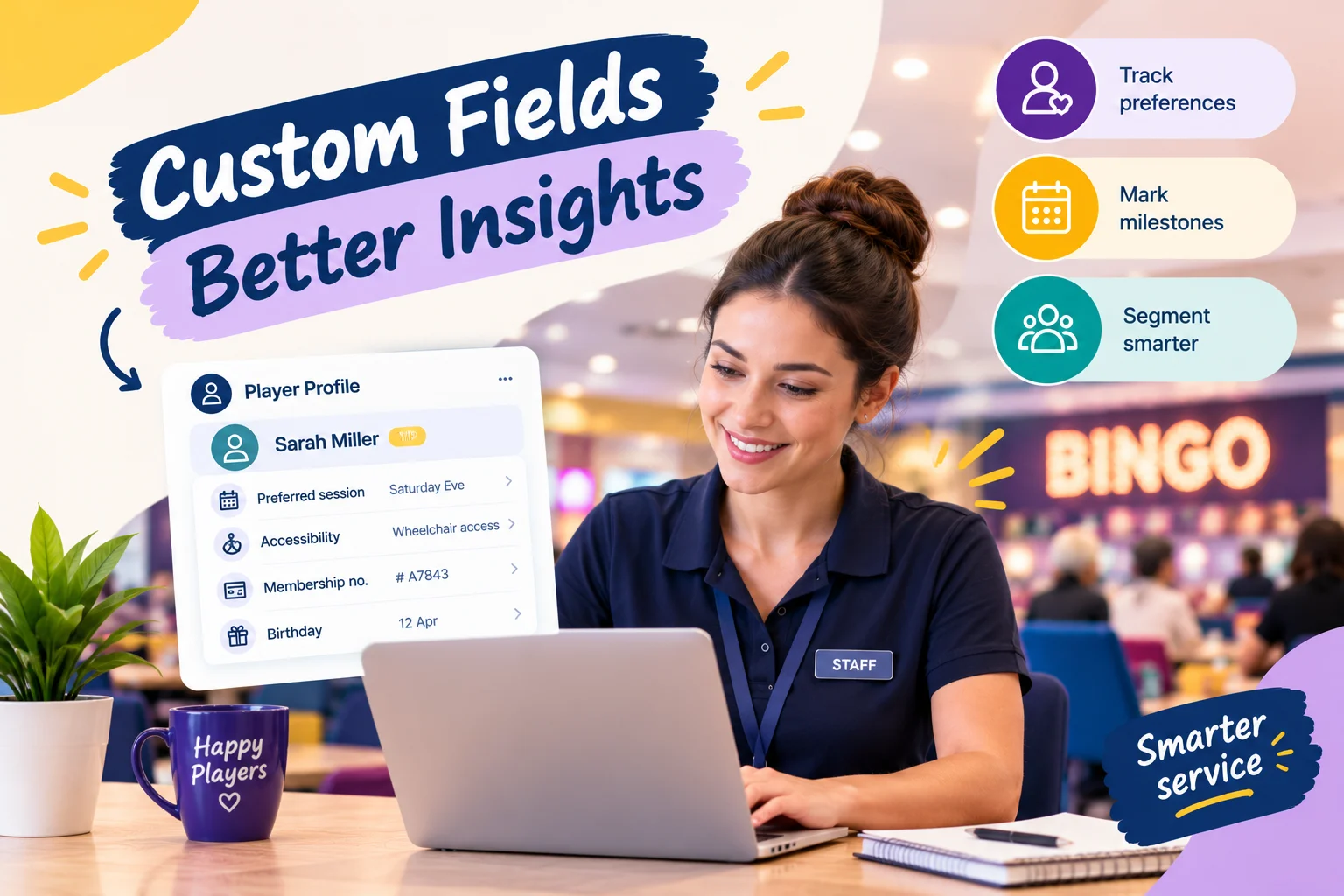
Personalisation Should Go Beyond “Hi Sarah”
A player's name is useful.
But it is not the most interesting form of personalisation.
A better question is:
What does this player actually care about?
JustKonnect's player CRM is built around attendance, contact information, loyalty status, and engagement, with segmentation based on factors such as visit frequency, last visit, and engagement.
That creates opportunities for more relevant communication.
For example:
A frequent Friday player may care most about Friday events.
A recently joined player may benefit from a welcome sequence.
A player who has not visited recently may need a re-engagement message.
A loyalty member may respond better to reward-related communication.
The email itself can therefore become more relevant without becoming dramatically longer.
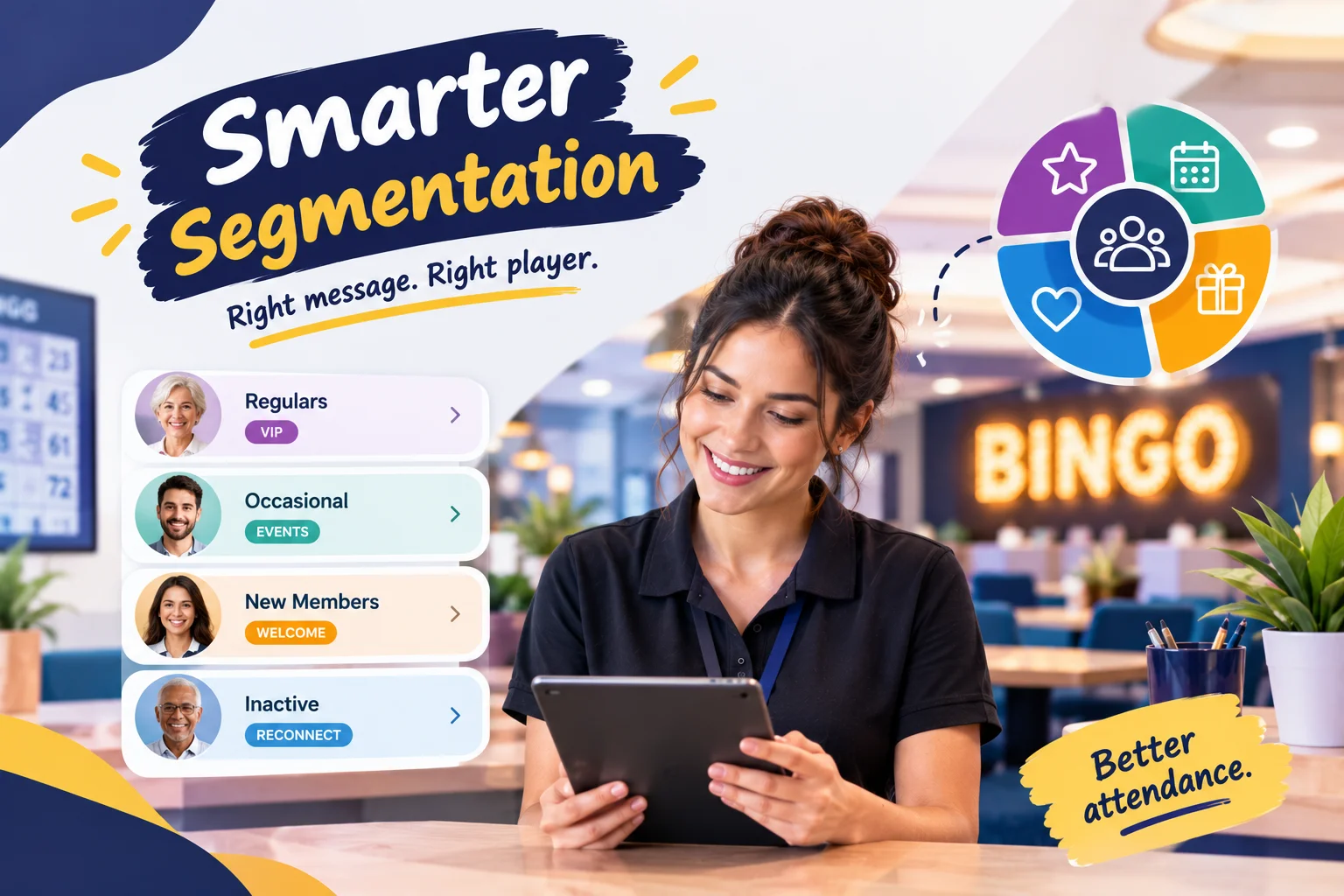
The “Everyone Gets the Same Newsletter” Problem
Imagine a hall has 3,000 contacts.
Sending the same email to all 3,000 players may seem efficient.
But the database could contain:
- New players
- Regular players
- Infrequent players
- Loyalty members
- High-frequency players
- Lapsed players
- Event attendees
Those groups do not necessarily need the same message.
Segmentation allows the operator to move from:
“What should we send everyone?”
to:
“Who actually needs this information?”
That is a much stronger starting point.
When Email Should Stay the Main Channel
There are several situations where there is no reason to force the communication into SMS.
A Detailed Event Announcement
If players need context, use email.
A Monthly Calendar
If the player needs several dates, use email.
A Fundraising Story
If the cause needs explaining, use email.
A Loyalty Programme Explanation
If the message requires instructions, examples, or multiple benefits, use email.
A Post-Event Thank You
If the purpose is relationship building rather than immediate action, email is a natural fit.
A Community Update
If the message is primarily informational, email can provide the necessary space.
These are situations where brevity is not necessarily the goal.
When SMS Should Take Over
Now consider the opposite.
Tonight's Session
The player needs to know now.
A Last-Minute Schedule Change
The information is time-sensitive.
Jackpot Update
The information may influence an immediate attendance decision.
Final Event Reminder
The event is approaching quickly.
Limited-Time Opportunity
The player has a short window to act.
Weather or Operational Update
Players may need timely information before travelling to the hall.
These are situations where a long email can create unnecessary delay.
JustKonnect's SMS marketing tools are positioned around these attendance-focused, time-sensitive communications.
A Simple Test: “Does This Message Expire?”
Here is a useful way for operators to choose the channel.
Ask:
Will the value of this information decrease significantly within a few hours?
If no:
Email may be appropriate.
If yes:
SMS deserves serious consideration.
For example:
“Our July fundraising programme”
This information remains useful for days.
Email works.
But:
“Tonight's 7 PM session has changed to 8 PM.”
That information expires quickly.
SMS is much more appropriate.
This is not a technical distinction.
It is a time-value distinction.
Email and SMS Can Work as a Two-Step Campaign
The strongest strategy may not be choosing one channel.
It may be using both at different points.
Consider a charity bingo event.
Seven Days Before
Send an email.
Explain the event, cause, schedule, participation details, and what players can expect.
Three Days Before
Send another email to relevant segments if more information or a reminder is useful.
Event Day
Send an SMS to eligible players.
Keep it short:
“Charity Bingo Night is tonight at 7 PM. We hope to see you at [Hall Name].”
Shortly Before Start
If an appropriate final reminder is needed, SMS can deliver the time-sensitive prompt.
After the Event
Return to email.
Thank players, share the result, and explain what their participation helped achieve.
The channels complement each other.
What Email Marketing Should Not Become
There are three traps worth avoiding.
Trap 1: The Weekly Dump
Every piece of information from the hall gets placed into one giant newsletter.
Result:
Players stop knowing what matters.
Trap 2: The Promotional Machine
Every email asks players to buy, attend, redeem, or respond.
Result:
The communication starts feeling like advertising rather than a relationship.
Trap 3: The SMS Copy-Paste
The operator writes an SMS and simply expands it into an email.
Result:
The email feels thin and fails to use the channel's strengths.
Email should provide something useful that justifies opening an email.
What SMS Should Not Become Either
The same principle applies in reverse.
Do not turn SMS into a newsletter.
A text message should not contain:
“Here are seven upcoming events, three loyalty updates, two sponsor announcements, our full monthly calendar, and a reminder about next month's fundraiser.”
That belongs elsewhere.
SMS works best when the player can understand the message quickly.
JustKonnect's recent SMS guidance similarly emphasizes giving each blast a single job and choosing the audience and timing around that objective.
Measure the Channels Differently
Another mistake is comparing email and SMS using one generic metric.
They have different jobs.
For email, an operator might monitor:
- Delivery
- Opens
- Clicks
- Engagement
- Event registrations
- Offer activity
- Attendance associated with campaigns
For SMS, the operator may focus more heavily on:
- Delivery
- Responses
- Link activity where applicable
- Attendance
- Offer redemption
- Campaign outcomes
JustKonnect's analytics platform is designed to track campaign performance alongside attendance, engagement, rewards, and other player activity.
That makes the measurement more meaningful than simply asking which channel generated the highest open or click rate.
The real question is:
Which channel helped achieve the objective?
Don't Judge an Email by Opens Alone
Suppose an email receives a strong open rate.
That sounds positive.
But if the objective was to fill a Friday charity event and very few players registered or attended, the campaign did not necessarily succeed.
Likewise, an SMS may have fewer visible interactions but still contribute to a measurable increase in attendance.
This is why bingo operators should connect communication metrics with venue outcomes.
The goal is not to win an email competition.
The goal is to improve player engagement and attendance.
Your Player Database Should Inform the Channel Choice
Channel strategy becomes more useful when it starts with player data.
Consider:
Player A
Visits every Friday.
The hall announces a Friday event.
SMS may be appropriate for a timely reminder.
Player B
Has not visited in six weeks.
A more thoughtful email could introduce a relevant reason to return.
Player C
Recently joined the loyalty programme.
A welcome email can explain how the programme works.
Player D
Is attending tonight.
A short SMS reminder may be more useful than another email.
The event is the same.
The player context is different.
JustKonnect's bingo-focused CRM allows operators to segment players using attendance and engagement information, helping communication become more targeted rather than relying on one database-wide message.
Build a Channel Decision Tree
Instead of asking staff to debate every campaign, create a simple internal rule.
Does the message require detailed explanation?
Yes → Email
Does the message contain several dates or pieces of information?
Yes → Email
Is the information time-sensitive?
Yes → SMS
Does the player need to act within hours?
Yes → SMS
Is this a relationship or community message?
Usually → Email
Is this a last-minute attendance prompt?
Usually → SMS
Could both channels add value at different times?
Use both, but give each a different job.
This creates consistency across the marketing team.
A Better Weekly Communication Rhythm
A bingo hall can use a predictable rhythm without turning every week into a flood of messages.
For example:
Monday
Email the week's schedule and major announcements.
Wednesday
Targeted email for an upcoming event or relevant player segment.
Thursday
SMS reminder for a Friday event where immediate attendance matters.
Friday
Time-sensitive SMS only if there is a genuine reason to send one.
Weekend
Post-event email, community update, or loyalty communication where appropriate.
The exact schedule should depend on the hall's calendar and player preferences.
The important part is that each communication has a reason.
Where JustKonnect Fits
JustKonnect does not position email as an isolated newsletter tool.
Its Email Marketing feature sits alongside SMS, player CRM, segmentation, loyalty, and analytics within a platform designed around bingo hall attendance and player engagement.
That creates a more connected workflow.
A player receives an email about an upcoming event.
The player is already part of a hall's CRM.
The operator can identify relevant audience segments.
Closer to the event, SMS can handle the time-sensitive reminder.
Afterward, campaign and attendance data can help the operator assess what happened.
That is a stronger model than having email in one system, SMS in another, and player data somewhere else.
A Practical Example: Filling a Saturday Event
Imagine a hall has a Saturday charity event.
The operator could approach it like this.
Monday: Explain
Send an email containing:
- Event purpose
- Charity information
- Date and time
- What players can expect
- Registration information
- Main call to action
Wednesday: Reinforce
Send a targeted email to players who are relevant to the event but have not yet responded.
Saturday Afternoon: Remind
Send an SMS to eligible players:
“Charity Bingo Night is tonight at 7 PM. We hope to see you at [Hall Name].”
After the Event: Continue the Relationship
Send an email thanking participants and sharing the outcome.
The communication feels coordinated rather than repetitive because every message does a different job.
The Biggest Mistake Is Choosing the Channel First
A common marketing workflow starts with:
“Let's send an email.”
Or:
“Let's send an SMS.”
That puts the technology before the objective.
A better workflow starts with:
What needs to happen?
Then:
Who needs to know?
Then:
How quickly do they need to know?
Then:
How much information do they need?
Only after those questions should the operator choose the channel.
That approach naturally separates email from SMS.
Frequently Asked Questions
Is email marketing still useful for bingo halls?
Yes. Email can be particularly useful for detailed event information, schedules, fundraising stories, loyalty education, community updates, and post-event communication. JustKonnect's Email Marketing feature is designed around bingo hall attendance, engagement, rewards, and communication.
When should a bingo hall use SMS instead of email?
SMS is generally better when the communication is time-sensitive or the player needs to make a decision within a short period. Examples include same-day session reminders, jackpot announcements, last-minute event updates, and schedule changes. JustKonnect supports SMS campaigns for these attendance-focused use cases.
Should a bingo hall use email and SMS for the same event?
They can, but each message should have a different purpose. Email can provide detailed information several days before an event, while SMS can deliver a concise reminder closer to the event.
Should every player receive the same email?
Not necessarily. Segmentation can make communication more relevant by considering factors such as attendance frequency, last visit, loyalty status, and engagement. JustKonnect's CRM is designed around these types of player segments.
What should a bingo hall measure from email and SMS campaigns?
Measure the metrics that connect to the campaign objective. That can include engagement, responses, offer activity, registrations, attendance, and other campaign outcomes. JustKonnect's analytics platform combines campaign performance with attendance and engagement reporting.
Can email and SMS be managed through the same platform?
Yes. JustKonnect includes Email Marketing alongside SMS marketing, player CRM, segmentation, loyalty, and analytics, allowing operators to manage communication as part of a wider bingo-focused player engagement system.
Give Every Channel a Job
The best bingo hall marketing strategy is not the one that sends the most emails or the most texts.
It is the one that knows why each message is being sent.
Use email when players need context.
Use email when the information has a longer shelf life.
Use email when the story matters.
Use SMS when timing matters.
Use SMS when the player needs to act soon.
Use SMS when a reminder needs to reach them while the opportunity is still available.
And when both channels are useful, connect them instead of making them compete.
That is where a bingo-focused platform becomes valuable. JustKonnect brings Email Marketing, SMS, player CRM, segmentation, loyalty, and analytics into the same broader workflow, helping operators coordinate communication around the way players actually attend and engage with the hall.
Explore JustKonnect's Email Marketing feature to see how email can fit alongside SMS and the rest of your player engagement strategy.