It is an hour before the evening session.
The phone starts ringing.
One player wants to know what time the doors open. Another asks whether tonight's game is still going ahead. Someone wants to know about the jackpot. Another caller is checking whether there is still time to join the charity event.
None of these questions is particularly difficult.
But when several calls arrive at the same time, they become an operational problem.
A staff member has to stop what they are doing, answer the phone, find the information, explain it, and move on to the next call.
Now imagine those same questions arriving by text.
The player sends a message.
A member of staff replies when they are available.
The conversation stays in writing.
The player gets the information they need without waiting on hold, and the front desk does not have to interrupt every task to answer another routine call.
That is one of the practical reasons two-way SMS can be useful for bingo halls.
The Pre-Game Period Is Often the Busiest Communication Window
Bingo players do not necessarily have questions days before an event.
Many questions appear much closer to the session.
A player may already be considering attending and simply need one detail before making the decision.
For example:
- “What time does tonight's session start?”
- “What time do doors open?”
- “Is the charity night still running tonight?”
- “How much is the entry?”
- “Is the jackpot the same as advertised?”
- “Can I still join?”
- “Do I need to book?”
- “What time should I arrive?”
- “Is there anything special happening tonight?”
These are small questions from the operator's perspective.
For the player, however, the answer may determine whether they attend.
If getting the answer requires calling during a busy period, waiting for someone to pick up, or trying again later, the player may simply decide not to bother.
Text removes some of that friction.
A Phone Call Requires Immediate Attention. A Text Does Not.
This is the operational difference that matters.
When the phone rings, someone usually has to respond immediately.
A text message creates a different workflow.
The message can be seen, prioritised, and answered without forcing the staff member to abandon whatever they are currently doing.
That does not mean every SMS should be answered hours later.
It means communication becomes easier to manage around the realities of running a bingo hall.
Consider a typical pre-game situation.
A staff member is preparing the reception area.
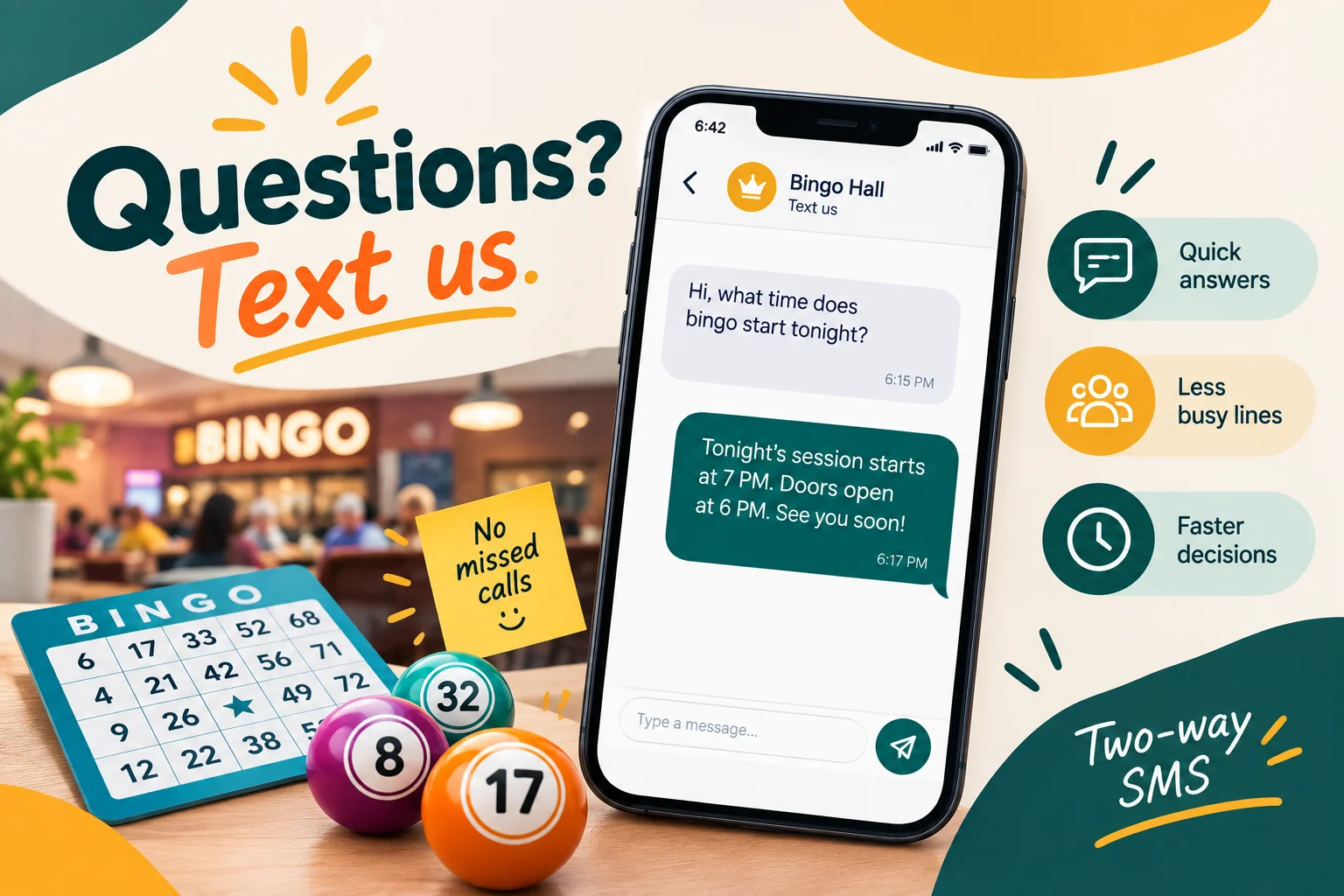
A player texts:
“Hi, what time does bingo start tonight?”
The staff member can respond:
“Hi! Tonight's session starts at 7 PM, and doors open at 6 PM. We look forward to seeing you.”
The conversation is finished.
No phone call.
No hold time.
No interruption lasting several minutes.
And the player has the answer in writing.
The Questions Are Often Simple — But They Still Matter
It is easy to underestimate routine questions because they do not look commercially important.
But consider what the player is actually doing.
They are showing intent.
Someone asking about tonight's session is not simply browsing.
They may be deciding whether to leave home, arrange transport, bring a friend, or make room in their evening schedule.
That makes the question part of the attendance journey.
The communication process therefore becomes:
Question → Answer → Confidence → Attendance
If the question is answered quickly and clearly, the player can move forward.
If communication becomes difficult, the journey can stop.
This is why two-way SMS should not be viewed simply as a replacement for a phone.
It is another way of removing small barriers between interest and attendance.
Turn Frequently Asked Questions Into Text-Friendly Conversations
Not every question requires a long explanation.
In fact, the best two-way SMS conversations are often surprisingly short.
“What time is tonight's game?”
A simple answer may be enough:
“Tonight's game starts at 7 PM. Doors open at 6 PM.”
“Is there still space for tonight?”
The response could provide the relevant information and next step:
“Yes, we're still accepting players for tonight's session. If you'd like to attend, please arrive before the game starts.”
“What's happening on Friday?”
Instead of sending the player to search through social media or an old email, staff can answer directly:
“Friday is our special charity bingo night. The session starts at 7 PM, with the fundraiser running throughout the evening.”
The important point is not the exact wording.
It is the reduction in effort.
The player asks.
The hall answers.
The conversation moves forward.
Use Two-Way SMS Before the Game, Not Just During Campaigns
One mistake is to think of SMS only as something the hall sends.
That creates a one-directional mindset:
Hall → Player
But two-way texting changes the relationship to:
Hall ↔ Player
The hall can still send reminders, announcements, and promotions.
The difference is that players can respond.
That creates useful opportunities before a session.
For example:
Reminder
“Tonight's special bingo session starts at 7 PM. We hope to see you there.”
Player reply
“Can I still come if I haven't booked?”
Staff response
“Yes, you can still attend. Please arrive before the session begins.”
That interaction is more valuable than the original reminder alone.
The campaign created awareness.
The conversation removed uncertainty.
Give Players an Alternative to Calling
Some players will always prefer the phone.
That is fine.
Two-way SMS does not need to replace phone communication completely.
The goal is to give players another convenient channel for questions that do not require a voice conversation.
This is particularly useful for straightforward requests.
A player who only needs to know the start time does not necessarily need a phone call.
Someone checking the details of a promotion may not need to speak with a staff member.
A player asking whether an event is still running may be perfectly happy with a text response.
When those conversations move to SMS, the phone line becomes available for situations where a live conversation is genuinely useful.
That can make the whole front-desk operation easier to manage.
Build a Simple Pre-Game Question Workflow
A bingo hall does not need an elaborate communication strategy to start using two-way SMS effectively.
A simple workflow can be enough.
Step 1: Identify the Questions That Keep Coming Up
Look at the questions staff hear repeatedly.
What do players ask before evening sessions?
What information do callers request on Fridays?
Which questions appear shortly before special events?
You will probably find patterns quickly.
Step 2: Prepare Clear Answers
Create straightforward responses for common questions.
Examples might cover:
- Session times
- Door opening times
- Event details
- Charity nights
- Entry information
- Jackpot information
- Booking questions
- Special promotions
- Location or arrival information
The answers should be accurate and easy to understand.
Step 3: Let Players Ask Follow-Up Questions
This is where two-way SMS becomes more useful than a simple automated message.
A player might receive:
“Friday Charity Bingo starts at 7 PM.”
Their response could be:
“Is there still time to join?”
The staff member can answer the specific question rather than sending another generic promotion.
Step 4: Record Useful Interaction Information
A conversation can reveal more than the immediate answer.
If a player repeatedly asks about certain sessions, promotions, or events, that interaction may provide useful context for future communication.
When messaging sits alongside player information and engagement history, those conversations become part of a broader view of the player rather than isolated phone calls.
JustKonnect's wider platform is built around player profiles, visit history, and engagement data, allowing communication to sit alongside the rest of the player relationship.
What Happens When Five Players Ask Questions at Once?
This is where the difference becomes particularly noticeable.
Imagine the following happening at 6:15 PM:
Phone: “What time does the game start?”
Phone: Another caller asks about Friday's event.
Phone: A player wants to know about tonight's jackpot.
SMS: “Can I still attend?”
SMS: “Do doors open at 6?”
With phone-only communication, each ringing phone demands immediate attention.
With two-way SMS available, some of those conversations can be handled without occupying the phone line.
That does not magically remove busy periods.
It simply gives staff another way to distribute communication.
The result is a more manageable workflow.
Use Saved Answers Without Making Conversations Feel Robotic
There is a useful middle ground between answering every message manually from scratch and sending completely automated replies.
For common questions, staff can maintain standard responses.
For example:
Session time
“Tonight's session starts at [time], with doors opening at [time].”
Event question
“Our [event name] takes place on [date] at [time].”
Booking question
“Yes, you can still join [event/session]. Please [next step].”
These responses save time.
But staff should still adapt them when the conversation requires a personal answer.
A player who asks:
“Is tonight's charity event suitable for someone coming for the first time?”
probably deserves more than a copied timetable.
Two-way SMS works best when efficiency and human communication work together.
Don't Force Every Question Into an Automated Journey
Automation is useful.
But not every player question should trigger a sequence of messages.
Imagine someone asks:
“I'm running late. Can I still come?”
A three-message automated campaign would be the wrong response.
The player needs a simple answer.
Likewise, if someone asks a specific question about an event, the goal should be to resolve the question rather than push another promotion.
This is an important distinction:
Automation should reduce unnecessary work, not create unnecessary conversation.
For bingo halls, that means using automated messaging for predictable communication while leaving room for staff to handle genuine questions.
Two-Way SMS Can Also Protect the Customer Experience
There is another benefit that is easy to overlook.
When a player sends a question, they are already taking an action.
They have chosen to communicate with the hall.
A useful response can reinforce the feeling that the venue is accessible and responsive.
Compare these two experiences.
Experience One
The player calls.
Nobody answers.
They leave a voicemail.
They wait.
They are unsure whether anyone received the message.
Experience Two
The player sends a text.
The hall replies.
The player asks one follow-up question.
The hall answers.
The decision is made.
The second experience has fewer communication gaps.
That matters because customer experience is often shaped by small interactions rather than major marketing campaigns.
Measure the Questions, Not Just the Messages
Most SMS reporting focuses on outgoing communication.
But two-way texting creates another source of information: the questions players actually ask.
Track recurring themes.
For example:
- Which event generates the most questions?
- What information do players repeatedly request?
- Do certain promotions create confusion?
- Are players asking about details that should already be included in the original message?
- Which questions appear most frequently before a session?
- Are players asking the same question after receiving a particular campaign?
These patterns can improve future communication.
If ten players ask what time doors open after receiving an event announcement, the next campaign should probably include the door-opening time.
If players repeatedly ask whether booking is required, make that information prominent.
The objective is not simply to answer more questions.
It is to create fewer unnecessary questions over time.
A Better Pre-Game Communication Loop
The most useful way to think about two-way SMS is as a feedback loop.
Promote the session.
↓
Player responds.
↓
Staff answers the question.
↓
Player decides whether to attend.
↓
Hall records the interaction.
↓
Future communication becomes clearer.
That final step is important.
The conversation should teach the hall something.
If players repeatedly ask the same question, improve the campaign.
If a particular event generates a lot of positive replies, understand why.
If players respond more often to certain types of messages, use that information when planning future communication.
Communication becomes an operational learning tool rather than just another marketing channel.
Where JustKonnect Fits
JustKonnect's Two-Way Texting feature is designed around the way bingo halls communicate with players around games, offers, and loyalty.
The platform brings two-way messaging into a wider bingo-focused workflow rather than treating it as a completely separate communication tool. Its feature set also includes player profiles, CRM, SMS marketing, segmentation and engagement reporting.
For an operator, that means the goal is not simply:
“How can we answer more texts?”
It is:
“How can we make it easier for players to get the information they need while making communication easier for our staff to manage?”
That is a much more useful question.
Frequently Asked Questions
What types of questions can bingo halls handle through two-way SMS?
Common examples include session times, door opening times, event details, booking questions, promotions, jackpot information, and general pre-game enquiries. The exact information should reflect what your players commonly ask.
Does two-way SMS replace the bingo hall phone line?
No. It gives players another communication option. Straightforward questions can often be handled by text, while phone calls remain available for situations where a live conversation is more appropriate.
Can players reply to promotional SMS messages?
Yes, that is the central difference between one-way messaging and two-way texting. Instead of communication ending when the hall sends a message, players can respond and staff can continue the conversation.
How can two-way texting reduce staff workload?
It can move simple questions away from phone calls and allow staff to respond to messages as part of their workflow. This can reduce interruptions during busy pre-game periods.
Should every SMS reply be automated?
No. Automation is useful for predictable information and repetitive communication, but genuine questions often require a human response. The best approach combines efficient standard responses with staff involvement when needed.
Can player questions help improve future SMS campaigns?
Yes. Repeated questions can reveal missing information or unclear wording in campaigns. If players continually ask about start times, booking requirements or event details, those answers can be made more prominent in future messages.
Make the Phone Line Available for What Actually Needs a Phone Call
A busy bingo hall will always have communication demands.
The objective is not to eliminate those conversations.
It is to make sure every question reaches the right channel.
A player asking what time tonight's game starts should not necessarily require a staff member to stop what they are doing and answer the phone.
A quick text can solve it.
And when dozens of small questions are handled this way across a week, the operational difference starts to add up.
Two-way SMS gives players an easy way to ask.
It gives staff a manageable way to respond.
And it keeps a simple question from becoming a lost attendance opportunity.
For bingo halls looking to make player communication more responsive without putting additional pressure on the phone line, explore JustKonnect's Two-Way Texting solution.