A bingo hall can have thousands of email addresses and still struggle to fill a quiet night.
The problem is rarely the size of the list alone. A large database does not automatically become a valuable marketing audience. If players receive irrelevant promotions, too many emails, vague subject lines, or messages at the wrong time, they gradually stop opening them.
For bingo operators, the better question is not:
“How many email addresses do we have?”
It is:
“How useful is our email list when we need players to take action?”
Building an effective bingo hall email list requires three things working together: useful segmentation, sensible timing, and messages that give players a reason to open.
When those elements are connected to player activity and attendance, email becomes more than a newsletter tool. It becomes a practical way to bring players back, promote events, communicate rewards, and build stronger relationships with regulars.
Start With the Player, Not the Email Address
It is tempting to treat every new email signup as another row in a spreadsheet.
That approach creates a database, but not necessarily an audience.
Two players might provide the same information — name and email address — while having completely different reasons for visiting your hall.
One may attend three times a week. Another may have visited once several months ago. A third may only come for special events. Sending exactly the same email to all three means ignoring information that could make your marketing considerably more relevant.
A useful bingo hall email strategy starts by connecting contact information with player behaviour.
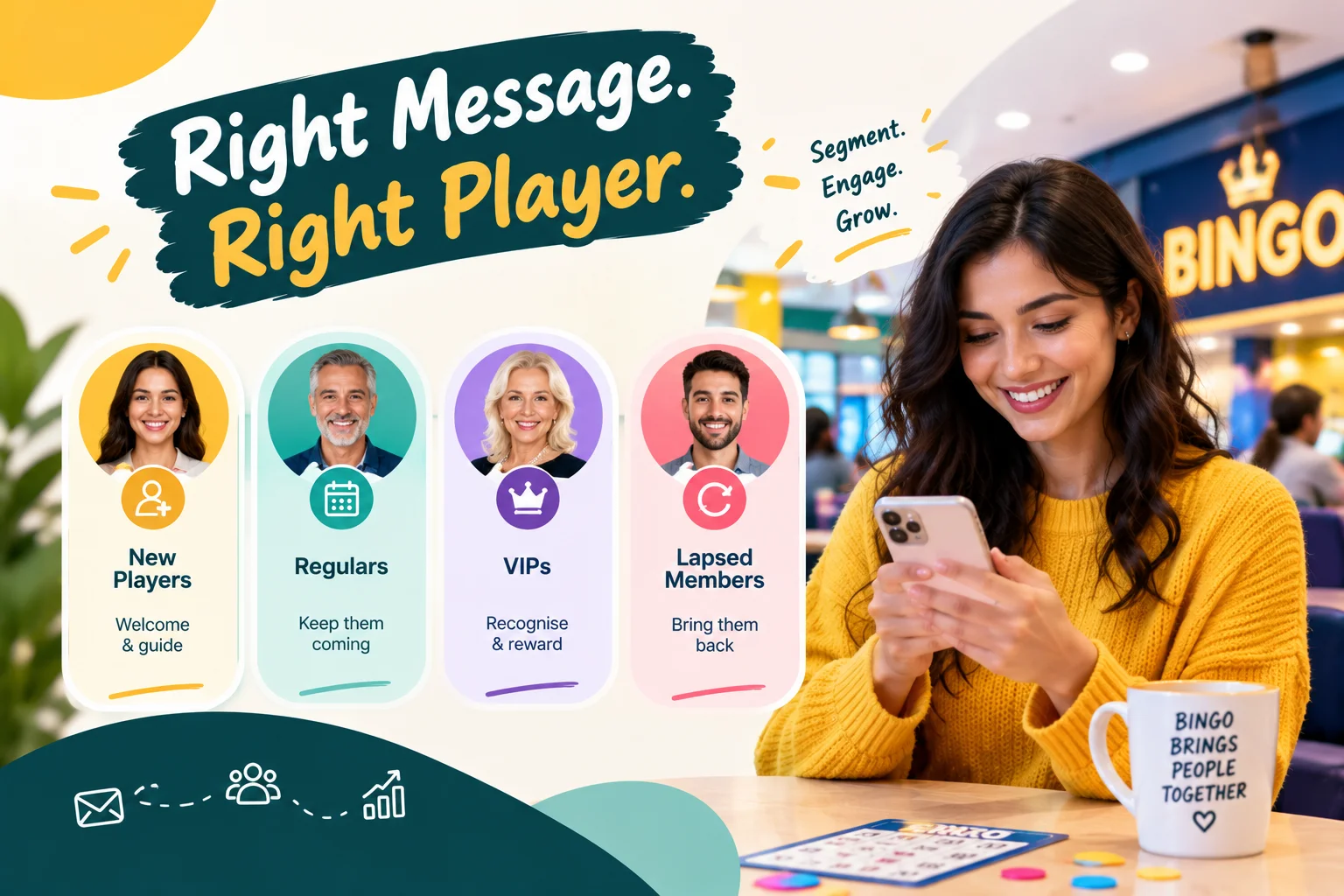
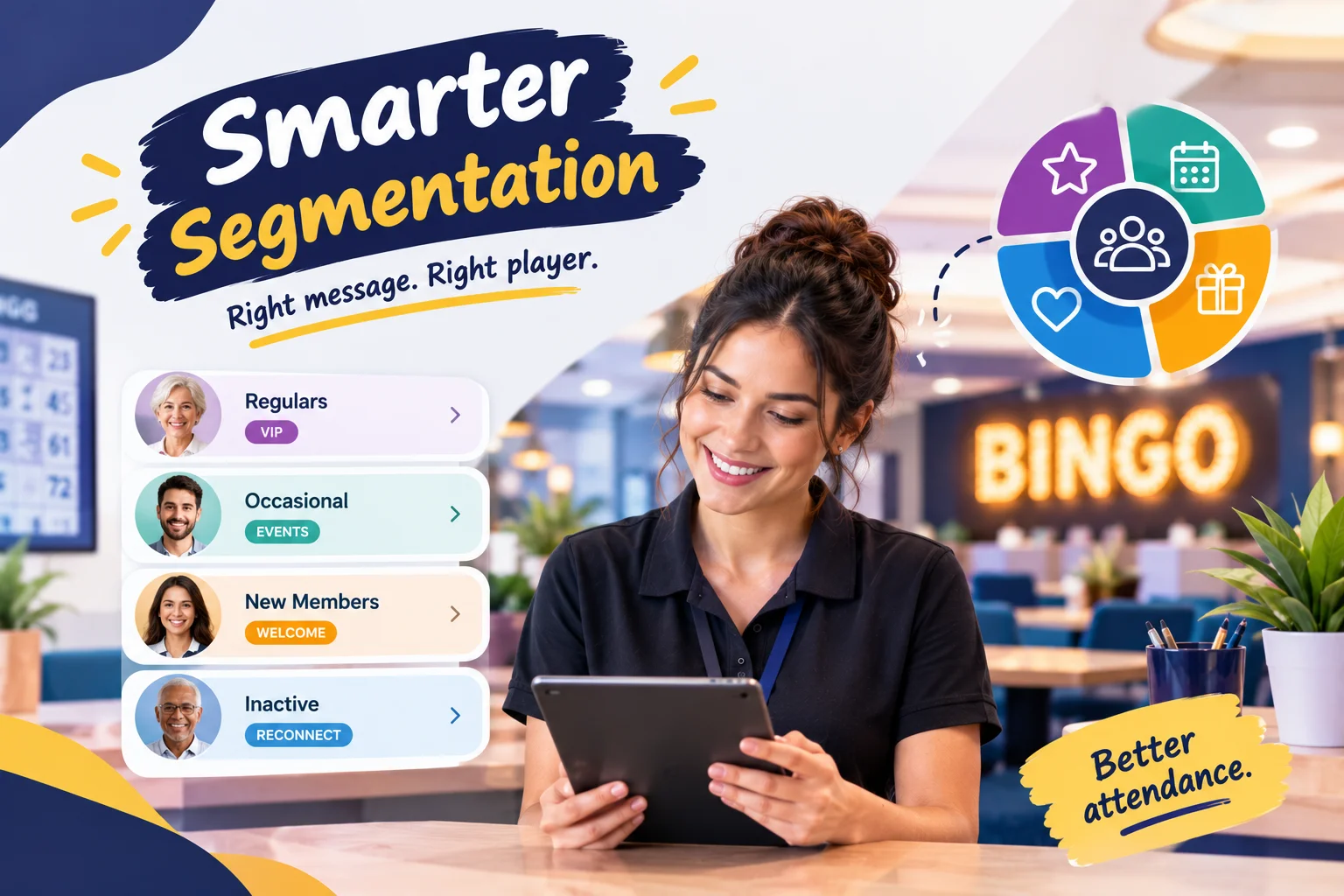
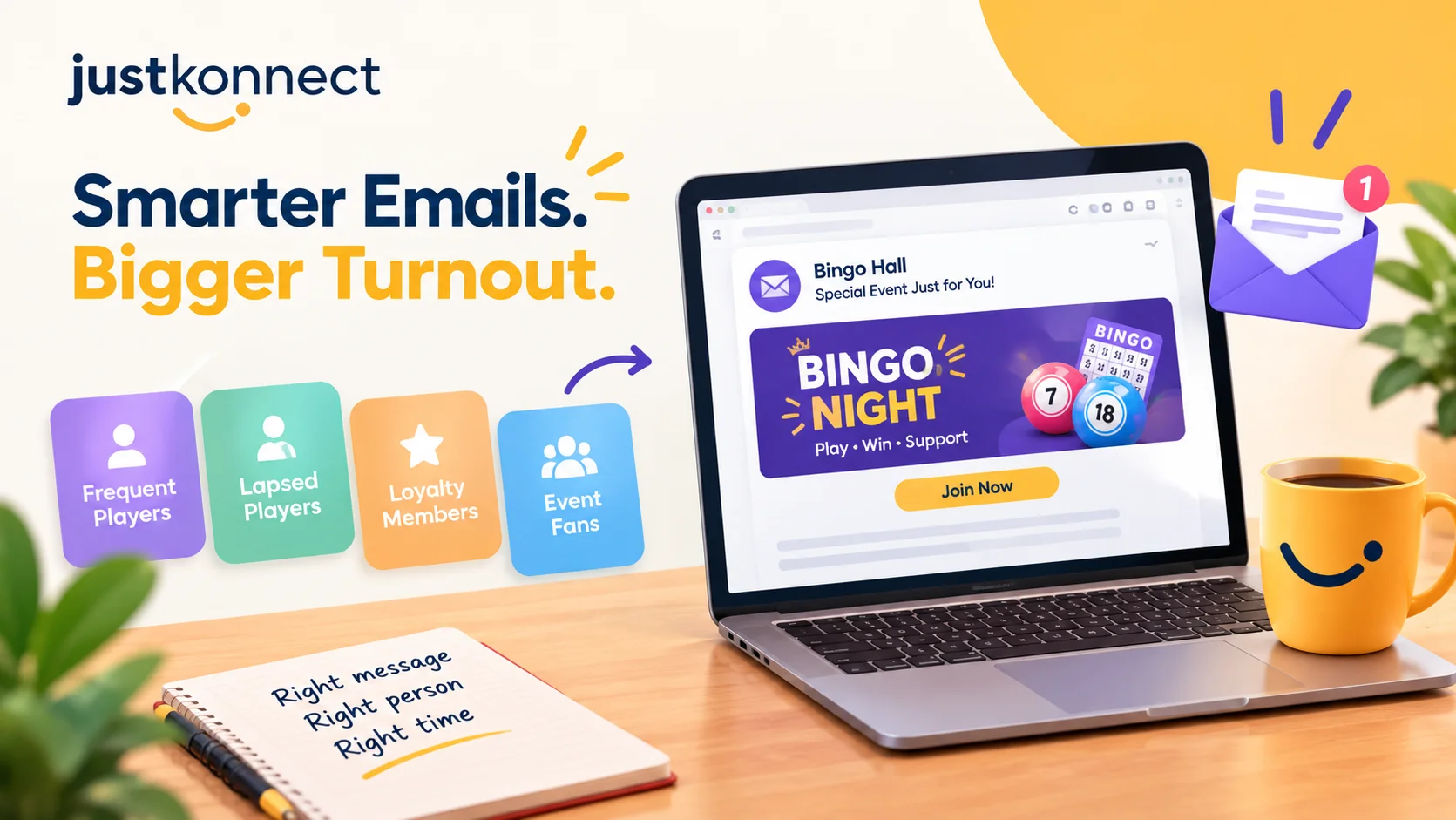
Depending on the data available to your hall, useful segments might include:
- Frequent players
- Occasional visitors
- First-time visitors
- Recently inactive players
- Players who have not visited for several weeks
- Loyalty members
- Players interested in particular events or promotions
- Players who regularly respond to offers
- Players who have recently joined the database
The objective is not to create dozens of complicated lists.
It is to create meaningful groups that allow you to change the message according to the player's relationship with the hall.
Build the List Around Permission and Value
A strong email list is built by giving players a reason to join.
Simply asking someone to “subscribe to our newsletter” may not be compelling enough.
Instead, make the value of joining clear.
For example, your signup messaging could explain that subscribers can receive:
- Upcoming bingo night announcements
- Special event information
- Exclusive promotions
- Loyalty-related updates
- Important schedule changes
- Jackpot or game information
- Invitations to selected events
- Updates relevant to their interests
The exact incentives will depend on your hall's marketing strategy and applicable rules.
The important point is that players should understand what they are signing up to receive.
Capture More Than an Email Address When Appropriate
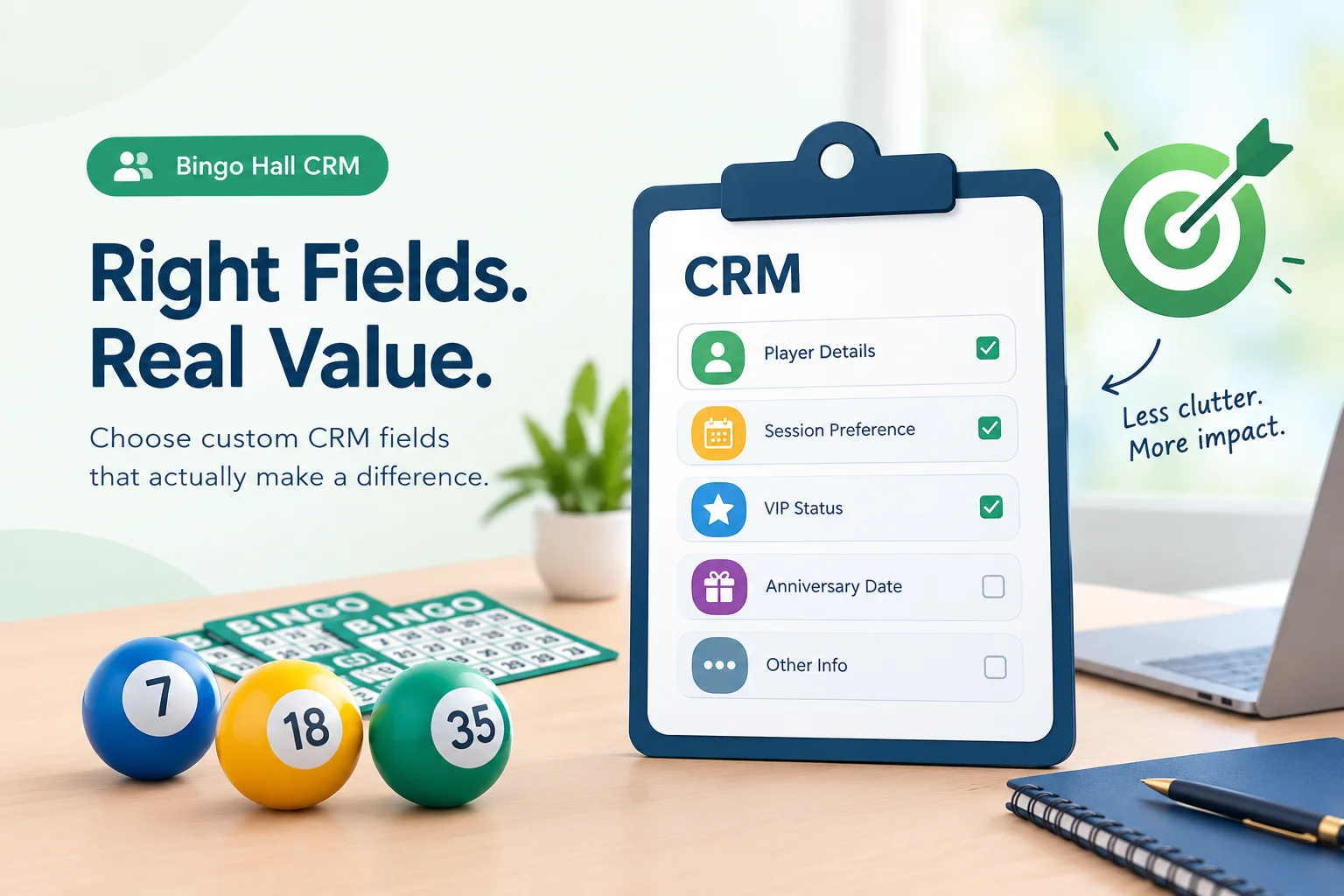
An email address is useful, but additional information can make future communication much more relevant.
For example, your registration process may capture information that helps distinguish:
New player → Welcome and introduction
Regular player → Upcoming games and loyalty communication
Lapsed player → Re-engagement messaging
Event-focused player → Special event invitations
The information you collect should have a clear purpose. Avoid turning signup forms into unnecessarily long questionnaires.
The goal is to collect enough information to improve communication without creating friction.
The Most Important Segmentation Rule: Recency Matters
One of the most useful ways to segment a bingo audience is by when the player last visited.
Why?
Because recency changes the context of the message.
Imagine sending the same promotion to:
- Someone who visited yesterday
- Someone who has not visited for three weeks
- Someone who has not visited for three months
The offer may be identical, but the communication problem is completely different.
A recent visitor may simply need information about the next event.
A player who has been absent for several weeks may need a reminder or reason to return.
A long-term inactive contact may require a different re-engagement approach altogether.
This is where a player-focused CRM can become valuable. JustKonnect Player Profiles CRM can connect player information with visit history, loyalty status, and engagement data, helping operators move beyond a basic contact list.
Don't Create Segments Just Because You Can
More segmentation does not automatically mean better marketing.
If your team creates 25 audience groups but cannot consistently manage them, the complexity becomes a problem.
Start with a small number of useful segments.
A practical starting structure could look like this:
| Segment | Communication Goal |
| New players | Welcome and encourage a second visit |
| Frequent players | Maintain engagement and promote relevant events |
| Occasional players | Give them reasons to return |
| Recently inactive | Re-engage before the relationship fades |
| Event-focused players | Promote relevant upcoming events |
| Loyalty members | Communicate rewards and member benefits |
You can expand the structure later as you learn which distinctions actually affect attendance and engagement.
Timing Should Follow the Reason for the Email
There is no universal “best day” or “best hour” for every bingo hall email.
The right timing depends on what the email is trying to accomplish.
Consider the difference between these messages:
“Our monthly charity event is coming up.”
and
“Tonight's special game starts in two hours.”
The first message gives players time to plan.
The second is much more immediate.
That means timing should be determined by the player's decision window, not simply by a marketing calendar.
Use a Different Rhythm for Different Messages
A bingo hall could structure communication around several timing patterns.
Plan-Ahead Messages
Use these when players need time to decide whether they want to attend.
Examples include:
- Special events
- Charity nights
- Tournament-style events
- Seasonal activities
- Major promotional dates
These messages can introduce the event early, followed by a reminder closer to the date.
Routine Attendance Messages
These can support regular communication around normal bingo activity.
The objective is to stay useful without making every email feel like a major promotion.
Last-Minute Messages
These are appropriate when the information genuinely has a short shelf life.
For example, a same-day schedule update or time-sensitive event reminder may justify a shorter window.
The mistake is turning every communication into a last-minute promotion.
If every subject line screams “TODAY!” or “DON'T MISS OUT!”, players eventually learn to ignore the urgency.
Create a Subject Line That Earns the Open
The subject line has one job:
Give the recipient a reason to open the email.
It does not need to explain the entire message.
In fact, trying to fit the whole promotion into the subject line can make it less effective.
Instead, focus on one clear reason to continue.
1. Lead With the Event
Instead of:
Bingo Hall Newsletter – October Updates
Try:
Your Next Charity Bingo Night Is Coming Up
The second version tells the player why the email may matter.
2. Make the Benefit Clear
Instead of:
This Week at the Hall
Try:
See What's Happening at the Hall This Week
The subject gives the reader a clearer expectation.
3. Use Specificity
Generic wording is easy to ignore.
Compare:
Don't Miss Our Special Event
with:
Saturday's Charity Bingo Night: What to Expect
The second provides more context without relying on exaggerated urgency.
4. Use Curiosity Carefully
Curiosity can encourage opens, but the email still needs to deliver on the promise.
For example:
There's Something New for Friday's Players
can work if the email immediately explains what is new.
Avoid misleading curiosity such as deliberately hiding important information simply to generate an open.
5. Keep the Subject Connected to the Audience
A loyalty member may respond differently to:
Your Loyalty Rewards Are Waiting
than a first-time visitor would.
That is why segmentation and subject lines should be treated as one process.
Audience first. Message second. Subject line third.
Preview Text Is Part of the Pitch
The subject line is not working alone.
Many inboxes display preview text alongside it, giving you another opportunity to explain why the message deserves attention.
For example:
Subject: Saturday's Charity Bingo Night Is Almost Here
Preview: See the start time, event details, and what's planned for the evening.
Together, these elements provide a simple reason to open.
Avoid wasting preview text on generic phrases such as “View this email in your browser” when a more useful message can be displayed.
Build Email Campaigns Around Player Moments
Instead of asking, “What should we email this week?” consider asking:
“What player moment are we trying to influence?”
That small change can improve the quality of your campaigns.
For example:
After a First Visit
The objective is relationship building.
A welcome or follow-up message can introduce the hall, explain relevant benefits, and encourage the player to return.
Before a Major Event
The objective is attendance.
Give the player enough information to decide and plan.
During a Loyalty Journey
The objective is engagement.
Explain relevant rewards, progress, or benefits clearly.
After a Period of Inactivity
The objective is reactivation.
The message should acknowledge that the player has been away without making the communication feel intrusive.
After a Successful Campaign
The objective is learning.
Look at which audience opened, clicked, responded, or attended — then use those insights when planning the next campaign.
This approach turns email from a publishing schedule into a player-engagement system.
Don't Send the Same Email to Everyone
Consider a fictional Friday promotion.
A generic email might say:
Join us Friday for great bingo, exciting games, and a fantastic night at the hall.
Now imagine adapting it for three audiences.
Frequent players:
Friday's Games Are Ready — See What's Coming Up
Occasional players:
Thinking About Your Next Bingo Night? Friday Could Be a Good One
Recently inactive players:
It's Been a While — Here's What's Happening This Friday
The underlying event has not changed.
The context has.
That is the advantage of segmentation.
Use Clicks to Improve the Next Email
An open tells you that the subject line and timing created enough interest to continue.
A click tells you something more.
It suggests the content created enough interest for the player to take another step.
That makes clicks particularly useful for improving future campaigns.
Track questions such as:
- Which audience clicked most often?
- Which links attracted attention?
- Did event-related emails generate more clicks than general newsletters?
- Which segments rarely interact?
- Did a particular subject-line style consistently outperform others?
- Did engagement translate into attendance or another meaningful outcome?
The objective is not to chase the highest open rate forever.
The objective is to understand which communication patterns contribute to useful player actions.
Treat Your Email List as a Living Audience
An email database changes constantly.
Players become more or less active. Their interests change. Some contacts engage frequently while others become inactive.
That means list management should not be a one-time setup task.
Build regular habits around:
Cleaning: Remove or manage contacts according to your permission and data-retention practices.
Segmenting: Keep audience groups aligned with current player behaviour.
Testing: Compare different messages, subject lines, and timing approaches.
Reviewing: Look at engagement and attendance-related results.
Adjusting: Change campaigns based on what the data shows.
This is much more useful than judging the entire email program based on one monthly newsletter.
A Simple Weekly Email Planning Model
You do not need to fill every day of the week with email.
A more sustainable approach is to give each communication a specific purpose.
For example:
Monday — Plan
Highlight important events or activities coming later in the week.
Wednesday — Engage
Share something relevant to a specific audience segment.
Friday — Attend
Send an appropriate reminder or event-focused communication.
After the event — Learn
Review engagement and attendance data rather than automatically sending another promotional email.
The exact schedule should be adapted to your hall, audience, event calendar, and communication preferences.
The principle is more important than the days:
Every email should have a reason to exist.
Where Email Marketing Software Becomes More Useful Than Spreadsheets
A spreadsheet can store email addresses.
It is much harder to use one effectively for ongoing audience management.
As the database grows, operators may need to coordinate player information, segmentation, communication, campaign performance, and attendance-related data.
That is where a bingo-specific platform can reduce manual work.
JustKonnect Email Marketing is designed around bingo hall communication rather than generic retail email marketing. The platform connects email activity with player engagement, attendance, rewards, and reporting, giving operators a more practical way to manage campaigns and understand what is working.
Instead of maintaining disconnected lists and manually deciding who should receive each message, operators can build communication around the information already available about their players.
The Real Goal Is Not a Bigger List
A bingo hall does not necessarily need the largest possible email database.
It needs an audience that is:
- Permission-based
- Relevant
- Properly segmented
- Actively maintained
- Responsive to useful communication
- Connected to meaningful business outcomes
A list of 5,000 disengaged contacts can be less valuable than a smaller audience that regularly opens relevant messages and responds to event invitations.
That is why list growth should never be separated from list quality.
When players receive communication that matches where they are in their relationship with the hall, email becomes less like mass advertising and more like a useful conversation.
Common Bingo Hall Email Mistakes to Avoid
Sending Every Promotion to Every Player
Not every player needs every message. Over-targeting can reduce relevance and increase fatigue.
Using the Same Subject Line Style
If every email relies on “Don't Miss Out,” urgency quickly loses its impact.
Ignoring Inactive Players
An inactive contact should not necessarily receive the exact same communication as a highly active regular.
Sending Without a Clear Objective
If you cannot explain what the email is supposed to achieve, it probably needs a clearer purpose before it is sent.
Measuring Opens in Isolation
Open rates are useful, but clicks, responses, redemptions, attendance, and longer-term engagement can provide a more meaningful picture.
Making Every Email Promotional
Some communication should inform, welcome, educate, or build the relationship. Constant selling can make players tune out.
Frequently Asked Questions
How often should a bingo hall send marketing emails?
There is no universal frequency that works for every hall. Start with a manageable schedule and monitor engagement, unsubscribes, and player response. Increase communication around genuinely important events rather than sending messages simply to fill a calendar.
What should I include in a bingo hall email?
Focus on information that is useful to the recipient. Depending on the audience, this could include upcoming events, game information, loyalty updates, promotions, reminders, or other relevant hall news.
Should bingo halls segment their email lists?
Yes. Segmentation allows operators to adapt messages based on factors such as visit frequency, recency, loyalty status, and engagement rather than treating every player identically.
What makes a bingo email subject line effective?
A strong subject line is relevant, specific, and aligned with the content inside the email. It should give the recipient a clear reason to open without relying on misleading claims or excessive urgency.
How can I know whether my email marketing is working?
Look beyond opens. Track clicks, engagement, campaign outcomes, offer responses, attendance patterns, and other relevant KPIs. Comparing results across audience segments can also reveal which campaigns deserve to be repeated or improved.
Can email marketing work alongside SMS for bingo halls?
Yes. Email and SMS can serve different communication needs. Email is useful when players need more context or detailed information, while SMS can be useful for concise, time-sensitive communication. The important point is to coordinate the channels rather than sending the same message everywhere.
Turn Your Bingo Email List Into a Smarter Marketing Asset
A successful bingo hall email strategy is not built by collecting as many addresses as possible and sending a newsletter every Friday.
It is built by understanding who the player is, where they are in their relationship with the hall, what information matters to them, and when that information is most useful.
Start with a few meaningful segments. Give every campaign a clear purpose. Write subject lines around genuine player value. Test timing instead of assuming there is one perfect schedule. Then use engagement and attendance data to improve what comes next.
With the right system behind it, your email list can become more than a database of contacts.
It can become a practical tool for bringing players back, promoting the right events, strengthening loyalty, and making your marketing decisions more informed.
Ready to move beyond generic email lists and manage bingo-focused communication in one place? Explore JustKonnect's email marketing capabilities or request a demo to see how the platform can fit into your hall's workflow.