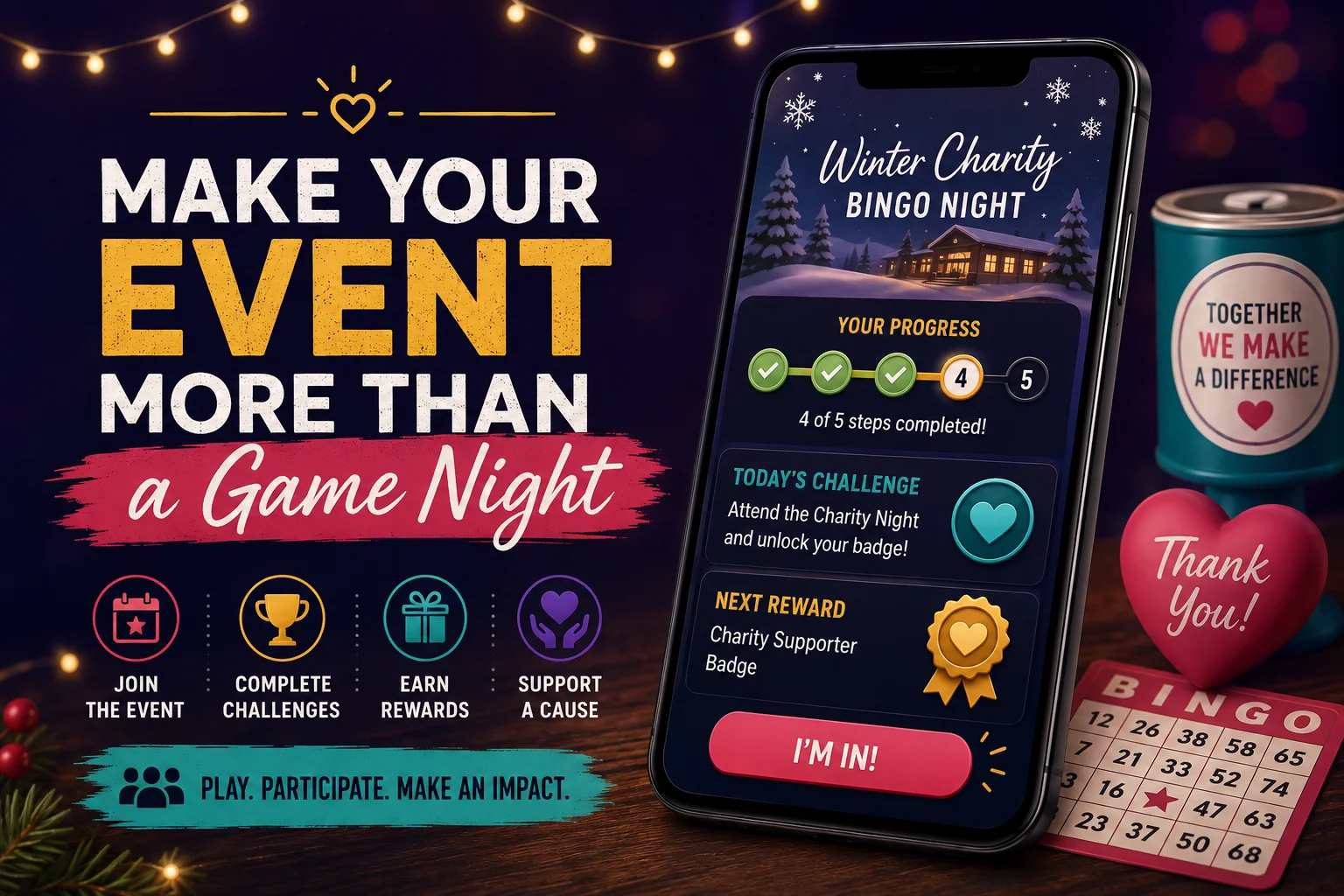
A seasonal event or charity fundraiser gives a bingo hall something an ordinary game night does not: a clear reason to make players feel part of something happening now.
That might be a Christmas fundraiser, Halloween night, summer promotion, anniversary event, community charity evening, or a special campaign supporting a local cause.
Yet many venues promote these events in the same way they promote a normal bingo session. They send a few messages, put up posters, announce the event on social media, and wait for the night to arrive.
The problem is not necessarily the promotion. It is the lack of interaction.
A custom gamification module can turn a seasonal or fundraising event into an experience that starts before players enter the hall and continues after they leave.
Instead of simply telling players about the event, the venue gives them something to participate in.
Start With the Event, Not the Game
The easiest mistake when designing a gamification campaign is to begin by asking:
“What game should we create?”
A better question is:
“What do we want players to do because of this event?”
The answer could be:
- Attend a particular night
- Register for the event
- Visit more frequently during a seasonal campaign
- Invite friends
- Engage with promotional messages
- Participate in fundraising activities
- Try a new event format
- Return for another session
- Join the venue's loyalty programme
Once the objective is clear, the game mechanic becomes much easier to choose.
For example, if the main goal is to increase attendance for a charity night, a complicated trivia game may not be the best fit. A simple progress challenge tied to attendance could make more sense.
If the goal is to generate referrals, a sharing or referral mechanic may be more appropriate.
One campaign does not need to accomplish everything.
The strongest campaigns usually have one primary objective and a simple player journey built around it.
Give the Event Its Own Identity
A seasonal campaign should feel like part of the event rather than a generic game placed on top of it.
Imagine a Christmas fundraiser called “12 Nights of Giving.”
Instead of giving players a standard digital game, the venue could create a twelve-stage progression campaign. Players unlock progress by completing selected activities throughout the campaign.
Those activities might include:
- Attending qualifying sessions
- Checking into special nights
- Completing a seasonal challenge
- Referring another player
- Participating in an eligible fundraiser activity
- Reaching a loyalty milestone
The important part is the connection between the mechanic and the event.
The player should immediately understand:
“This game exists because of this event.”
That connection makes the campaign more memorable and gives the promotion a stronger identity.
Build a Simple Player Journey
A useful way to design a custom module is to map the experience from the player's first interaction to the final follow-up.
A seasonal campaign might look like this:
Discover → Join → Play → Progress → Attend → Reward → Return
1. Discover
Players hear about the event through SMS, social media, email, signage, staff conversations, or other promotional channels.
The message should explain the event and introduce the interactive element.
2. Join
Give players a simple way to participate.
A QR code, digital sign-up, loyalty account, or another low-friction entry method can work depending on the venue's setup.
3. Play
The player completes the first action.
This should be easy enough that there is no confusion about what to do next.
4. Progress
The player can see that their participation is leading somewhere.
Progress bars, levels, badges, milestones, challenges, or collections can all make progress visible.
5. Attend
The digital experience should encourage the physical action that matters to the venue.
For example, players could unlock the next stage after attending a qualifying event night.
6. Reward
The reward does not always need to be expensive.
Recognition, badges, loyalty benefits, bonus entries where legally and operationally appropriate, vouchers, prizes, or exclusive event perks can all provide motivation.
7. Return
The campaign should create a reason to stay connected after the event.
The end of one campaign can become the beginning of the next visit.
Choose a Mechanic That Fits the Occasion
There is no universal gamification format for seasonal and charity events.
Different objectives call for different mechanics.
Seasonal Challenges
A seasonal challenge works well when you want to encourage repeat participation over several days or weeks.
For example:
Winter Bingo Challenge
Players complete selected activities throughout December and unlock different milestones as they progress.
The campaign can include attendance, participation, referrals, or other actions relevant to the venue.
Achievement Badges
Badges are useful when recognition is part of the experience.
A charity event could award badges such as:
- Community Supporter
- Fundraiser Friend
- Holiday Regular
- Event Champion
- Five-Visit Finisher
The badge itself may have little monetary value, but it gives players a visible sense of achievement.
Collection Mechanics
Collection-style campaigns can create a reason to return.
For example, a holiday campaign could contain several digital symbols or themed items that players unlock through qualifying activities.
The goal is not simply to “win a game.”
It is to complete something.
Referral Challenges
If bringing new people into the event is important, referrals can become part of the challenge.
Players could receive campaign progress when an eligible referred player joins the programme or attends a qualifying event.
This turns existing players into participants in the event's promotion rather than treating marketing as something the venue does entirely on its own.
Community Progress
Charity events offer another interesting possibility: a shared goal.
For example, the venue might create a campaign showing progress toward a community target.
The important distinction is that the campaign should clearly explain what player actions actually contribute to the fundraiser. If the venue pledges a specific donation based on participation, say so clearly. If participation simply unlocks recognition or rewards while fundraising happens separately, communicate that instead.
Clarity protects trust.
Make the Rules Easy to Understand
Gamification becomes less effective when players need a manual to figure it out.
A good seasonal module should answer three questions quickly:
What do I do?
What do I get for doing it?
What happens next?
For example:
Attend three qualifying event nights to unlock the Holiday Champion badge.
That is easier to understand than a campaign involving several point tables, multipliers, exceptions, and complicated eligibility rules.
Complexity can be added when it genuinely improves the experience. It should not be added simply because the technology allows it.
For physical venues, simplicity is especially valuable because players may be interacting with the campaign while talking to friends, playing bingo, eating, socialising, or moving around the venue.
The game should support the experience rather than compete with it.
Design Around the Three Phases of the Event
One of the biggest opportunities with a custom module is that the campaign does not have to begin on event night.
Think about the experience in three stages.
Before the Event: Build Anticipation
The pre-event stage is about giving people a reason to pay attention.
You might introduce:
- A countdown
- Early challenges
- Registration rewards
- Mystery milestones
- Referral opportunities
- Progress toward an event-specific achievement
SMS reminders can then be used to keep the campaign visible without sending the same generic invitation repeatedly.
A message such as “Your first challenge is waiting” can create more curiosity than another standard “Don't miss Friday night” reminder.
During the Event: Make Participation Visible
Event night is where the digital and physical experiences should meet.
Use signage, QR codes, staff prompts, kiosks, or other available touchpoints to make the game easy to access.
Players should understand how their participation connects to the event.
This could be as simple as unlocking a milestone, completing a challenge, earning recognition, or contributing to a clearly explained campaign goal.
After the Event: Keep the Relationship Going
The campaign should not disappear as soon as the last game finishes.
A follow-up message could:
- Thank participants
- Celebrate completed milestones
- Announce campaign results
- Recognise participants
- Remind players of unfinished progress
- Promote the next relevant event
This is where the campaign can move from a one-night promotion into a longer-term retention strategy.
Let the Charity Cause Shape the Experience
A charity fundraiser should feel different from an ordinary commercial promotion.
The cause gives the event an emotional centre.
That does not mean the gamification needs to become complicated or overly serious.
Instead, use the cause to influence the language, visuals, milestones, rewards, and community elements.
For example, a local charity fundraiser could use a “Community Champions” campaign.
Players might earn recognition for participating in qualifying activities throughout the campaign. Progress could be represented by a shared community graphic that shows how many people have participated.
The venue could then communicate:
“250 players have joined the Community Champions campaign.”
If the venue has committed to donating based on a defined metric, the campaign can display that progress as well.
The key is authenticity.
Players should never feel that the charity element is simply being used as decoration around a normal promotion.
Seasonal Themes Can Change the Same Basic Mechanic
You do not necessarily need an entirely different technical concept for every event.
The same underlying type of interaction can feel completely different when the theme changes.
A progress challenge could become:
- 12 Days of Christmas
- Halloween Hall Hunt
- Summer Bingo Passport
- Anniversary Challenge
- Valentine's Visit Challenge
- Community Champions
- Back-to-School Fundraiser
- Winter Warm-Up Campaign
The difference comes from the story, visual identity, milestones, language, rewards, and actions attached to the experience.
This is one of the advantages of a custom approach.
The venue is not forced to make every campaign look like the last one.
Connect Gamification to the Rest of Your Player Strategy
A custom module becomes much more useful when it does not operate in isolation.
Consider how the campaign could connect with the systems and activities you already use.
CRM
Player information can help you understand who is participating and create more relevant segments.
A frequent visitor might receive different messaging from someone who has not attended recently.
Loyalty
Campaign participation can complement existing loyalty mechanics.
For example, a seasonal challenge might sit alongside normal loyalty points rather than replacing them.
SMS Marketing
SMS can introduce the campaign, remind players about unfinished challenges, announce milestones, and bring inactive participants back into the experience.
Referrals
A campaign can incorporate referral actions when bringing new players into an event is a genuine objective.
Achievement Badges
Badges can provide a recognition layer for players who complete specific seasonal or fundraising milestones.
Analytics
After the campaign, the venue should be able to determine whether the experience actually achieved its objective.
Without measurement, gamification can become entertainment without a clear business purpose.
Measure More Than How Many People Played
Participation is useful, but it is only the beginning.
Suppose 500 people interacted with a seasonal module.
That sounds impressive.
But what happened next?
A better campaign review might look at:
- Number of participants
- Registration or opt-in rate
- Challenge completion rate
- Event attendance
- Repeat attendance
- Referral activity
- Loyalty engagement
- Reward redemption
- SMS engagement
- Re-engagement of previously inactive players
- Cost of the campaign
- Fundraising participation or outcome, where applicable
Metrics should follow the original objective.
If the campaign was designed to increase attendance, attendance should be one of the main measures.
If it was designed to generate referrals, referral activity matters more than raw game plays.
That simple discipline makes future campaigns easier to improve.
Avoid These Common Design Problems
Not every gamification campaign needs more features.
Often, it needs fewer.
Too Many Rules
If staff members struggle to explain the campaign, players probably will too.
Rewards That Have Nothing to Do With the Event
A generic reward can make a themed campaign feel disconnected.
Try to make the reward reinforce the event, the venue, or the player's sense of achievement.
Starting Too Late
Launching the game on the same evening as the event leaves little time to build anticipation.
Where possible, give players a reason to interact before the event.
No Follow-Up
A player who completes a challenge has demonstrated engagement.
Do not let that interaction disappear without a follow-up.
Measuring Vanity Metrics
A large number of game interactions does not automatically mean the campaign succeeded.
Always return to the original objective.
Making the Charity Element Vague
If money is being donated based on participation, explain the mechanism clearly.
If it is simply a charity-themed event, avoid language that could imply donations when none are being made.
What a Custom Fundraiser Campaign Could Look Like
Imagine a bingo hall is hosting a Friday-night fundraiser for a local charity.
Instead of relying only on posters and a few reminder messages, the venue creates a Community Champions gamification module.
One week before
Players receive an invitation explaining the fundraiser and introducing the challenge.
They can register and begin their campaign journey.
Three days before
Players receive a reminder encouraging them to invite friends or complete the first available challenge.
Event night
A QR code at the venue gives players quick access to the module.
The campaign shows their progress and recognises qualifying participation.
Staff can also mention the challenge during the event.
After the event
Participants receive a thank-you message.
Those who completed the challenge receive their achievement recognition, while players who did not finish can be given a relevant reason to return.
The venue can then review participation, attendance, engagement, referrals, and the fundraising outcome.
The result is more than a promotional message.
It becomes a connected event experience.
Where Custom Game Modules Fit
A custom gamification module is most valuable when a venue has a specific experience it wants to create rather than simply wanting to “add gamification.”
That could mean designing something around:
- A seasonal calendar
- A charity campaign
- A venue anniversary
- A major fundraising event
- A membership drive
- A new-player campaign
- A community initiative
- A special themed night
JustKonnect's Custom Game Modules feature can support this kind of tailored approach by giving bingo operators a way to build experiences around their own campaigns instead of forcing every promotion into the same template.
The real value is not the novelty of having another game.
It is the ability to make the game mean something within the event.
A Christmas challenge should feel like Christmas. A charity campaign should feel connected to the cause. An anniversary promotion should feel like a celebration of the venue.
When the mechanic, message, reward, and event all point in the same direction, gamification stops being an add-on and becomes part of the experience itself.
Frequently Asked Questions
What is a custom gamification module for a bingo hall?
A custom gamification module is a tailored interactive experience designed around a specific venue objective, event, promotion, or audience. It can use challenges, milestones, badges, progress mechanics, referrals, or other game elements.
Can gamification be used for charity fundraiser nights?
Yes. Gamification can encourage participation, attendance, referrals, and engagement around a fundraiser. The fundraising mechanism should always be explained clearly so players understand how their actions relate to the charitable outcome.
What type of game works best for seasonal bingo events?
There is no single best mechanic. Attendance challenges, milestone campaigns, collections, badges, referrals, and other interactive formats can all work. The right choice depends on the event's primary objective.
How far in advance should a seasonal gamification campaign start?
Ideally, give players time to discover and participate in the campaign before the main event. The exact timing depends on the campaign length and complexity, but launching only on event night limits the opportunity to build anticipation.
How do you measure whether a gamification campaign worked?
Start with the campaign objective. Then measure relevant actions such as participation, attendance, completion, referrals, loyalty engagement, reward redemption, SMS engagement, or fundraising outcomes.
Does every seasonal event need a completely new game?
Not necessarily. A familiar mechanic can be reused with a different theme, progression structure, messaging, rewards, and event objective. What matters is that the experience feels relevant to the occasion.