Managing a single bingo hall is already complex. Managing multiple locations introduces an entirely new level of operational challenges. From tracking attendance and coordinating marketing to ensuring compliance and reporting across locations, multi-location bingo hall operations require precision, consistency, and visibility.
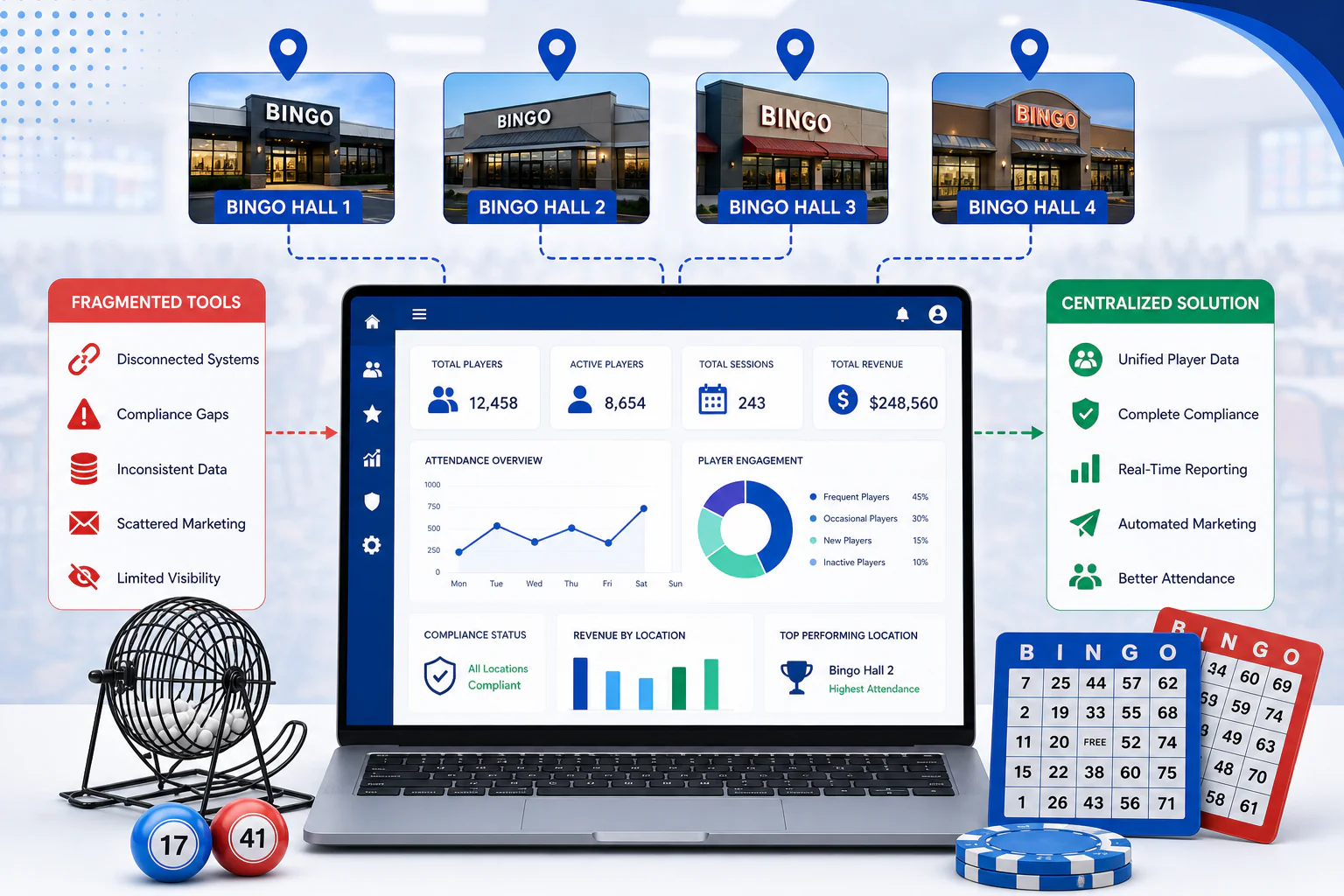
Yet many organizations attempt to manage multiple bingo halls using fragmented tools — spreadsheets for attendance, generic CRM systems for player data, separate email platforms for marketing, and manual processes for compliance tracking.
The result is predictable: compliance gaps, inconsistent attendance, and limited visibility into overall performance.
To operate efficiently at scale, bingo hall operators need centralized, purpose-built multi-location loyalty software designed specifically for their industry.
The Hidden Complexity of Multi-Location Bingo Hall Operations
Running multiple bingo halls is not just about replicating the same operation in different locations. Each location introduces variables:
- Different player demographics
- Different attendance patterns
- Different charities
- Different volunteers
- Different performance levels
- Different compliance requirements
At the same time, operators must maintain:
- Consistent reporting
- Unified player tracking
- Standardized compliance logs
- Centralized marketing
- Balanced attendance across locations
Without centralized systems, this becomes nearly impossible.
The Core Problem: Fragmented Tools
Many bingo hall operators rely on multiple disconnected tools:
- Spreadsheets for attendance tracking
- Generic CRM for player databases
- Email platforms for marketing
- Paper logs for compliance
- POS systems for sales
These systems do not communicate with each other.
This creates data silos, which prevent operators from seeing the full picture.
Fragmented data is a major challenge across industries. When customer data is split across systems, businesses struggle to create consistent experiences and accurate insights.
In bingo operations, this leads to operational inefficiencies and compliance risks.
How Fragmentation Creates Compliance Gaps
Compliance is one of the most critical aspects of charity bingo operations. Multi-location setups make compliance even more complex.
1. Inconsistent Record Keeping
When each location uses different systems or processes:
- Some sessions are fully documented
- Others have missing data
- Financial records vary in format
- Audit trails are incomplete
This creates serious compliance risks during audits.
2. Lack of Centralized Reporting
Without centralized bingo compliance reporting:
- Operators cannot generate unified reports
- Charity distributions may be inconsistent
- Financial reconciliation becomes difficult
- Audit preparation becomes time-consuming
A multi-location system should provide real-time reporting across all locations, ensuring consistency and transparency.
3. Manual Errors Across Locations
Manual processes increase:
- Data entry mistakes
- Missing records
- Duplicate entries
- Inaccurate financial tracking
These issues multiply across multiple bingo halls.
4. No Unified Audit Trail
Regulators often require complete audit trails.
Fragmented systems make it difficult to track:
- Who entered the data
- When changes were made
- Which location made updates
A centralized system solves this.
How Fragmentation Causes Inconsistent Attendance
Beyond compliance, fragmented tools directly impact attendance — the lifeblood of bingo operations.
1. No Unified Player Database
Without a centralized bingo hall CRM:
- Players are tracked separately per location
- Duplicate profiles are created
- Attendance history is incomplete
- Player behavior is unclear
Modern multi-location loyalty programs rely on shared customer data across locations to create a consistent experience.
2. Inconsistent Marketing Across Locations
When each location manages its own marketing:
- Messaging is inconsistent
- Promotions are duplicated or conflicting
- Players receive irrelevant offers
- Campaign performance is unclear
A centralized system enables coordinated campaigns.
3. No Cross-Location Loyalty Program
Without multi-location loyalty software:
- Players cannot earn rewards across locations
- Loyalty programs are fragmented
- Player retention decreases
- Engagement drops
A unified loyalty program allows customers to earn and redeem rewards across all locations seamlessly, improving retention and engagement.
4. Poor Player Retention Tracking
Without centralized data, operators cannot:
- Identify frequent players
- Detect lapsed players
- Track visit frequency
- Run win-back campaigns
This leads to declining attendance.
The Real Cost of Fragmented Systems
Fragmentation doesn’t just create inefficiencies — it directly impacts revenue.
Multi-location loyalty programs can increase revenue by 10–25% and improve retention by up to 20% when implemented correctly.
Without these systems, bingo halls:
- Lose repeat players
- Miss cross-location opportunities
- Fail to optimize attendance
- Struggle to scale operations
What Multi-Location Loyalty Software Does Instead
Purpose-built multi-location loyalty software solves these challenges by centralizing operations.
1. Unified Player Database
All player data is stored in one system:
- Visit history across locations
- Attendance tracking
- Loyalty status
- Engagement metrics
This creates a complete view of player behavior.
2. Centralized Loyalty Program
Players can:
- Earn points at any location
- Redeem rewards anywhere
- Maintain loyalty status across halls
This creates a seamless experience and increases retention.
3. Location-Specific Insights
Operators can:
- Track performance by location
- Compare attendance trends
- Identify underperforming halls
- Optimize scheduling
Modern systems provide location-level analytics while maintaining centralized control.
4. Standardized Compliance Reporting
Multi-location bingo software ensures:
- Consistent compliance logs
- Automated financial tracking
- Centralized audit trails
- Easy report generation
This reduces compliance risk.
5. Automated Multi-Location Marketing
With centralized marketing tools, operators can:
- Run campaigns across all locations
- Send targeted offers by location
- Automate SMS and email campaigns
- Track campaign performance
This improves attendance consistency.
6. Role-Based Access and Control
Different managers can access only their locations while leadership maintains full visibility.
This ensures:
- Security
- Accountability
- Operational control
How Centralization Improves Attendance Across Locations
A unified system allows operators to:
- Balance attendance across locations
- Promote underperforming sessions
- Run cross-location promotions
- Encourage players to visit new halls
- Optimize scheduling
For example:
- Players from a full location can be redirected to another location
- Promotions can target specific geographic areas
- Loyalty rewards can encourage multi-location visits
Key Features to Look for in Multi-Location Loyalty Software
When evaluating solutions, bingo hall operators should prioritize:
- Centralized player database
- Cross-location loyalty program
- Attendance tracking
- Multi-location reporting
- Compliance tracking
- Marketing automation
- SMS and email campaigns
- Role-based permissions
- Real-time analytics
These features ensure scalability.
When It’s Time to Replace Fragmented Tools
If your organization is experiencing:
- Inconsistent attendance across locations
- Difficulty tracking players
- Compliance reporting challenges
- Multiple spreadsheets and systems
- Limited visibility into performance
It’s time to move to a centralized system.
Final Thoughts
Managing multiple bingo halls with fragmented tools creates more problems than it solves. Disconnected systems lead to compliance gaps, inconsistent attendance, poor player tracking, and limited operational visibility.
A centralized multi-location loyalty software platform brings everything together — player data, attendance tracking, marketing, and compliance — into one unified system.
For bingo hall operators looking to scale, improve attendance, and maintain compliance across locations, centralized software is no longer optional. It is the foundation for sustainable growth, operational efficiency, and long-term success.