Not all loyalty platforms are created equal.
Many vendors promise increased retention, stronger customer relationships, and improved revenue. Yet after implementation, operators often discover that their loyalty software delivers plenty of data but very little business impact.
The reason is simple.
Most loyalty programs focus on rewards.
The best loyalty platforms focus on behavior.
For physical venues such as bingo halls, restaurants, arcades, family entertainment centers, fundraising organizations, and other attendance-driven businesses, success depends on getting customers to come back more often.
That means loyalty software should be evaluated based on one question:
Does it increase visit frequency and customer retention?
The answer depends on the features available inside the platform.
While dozens of loyalty tools exist on the market, only a handful of capabilities consistently produce measurable improvements in attendance, engagement, and long-term customer value.
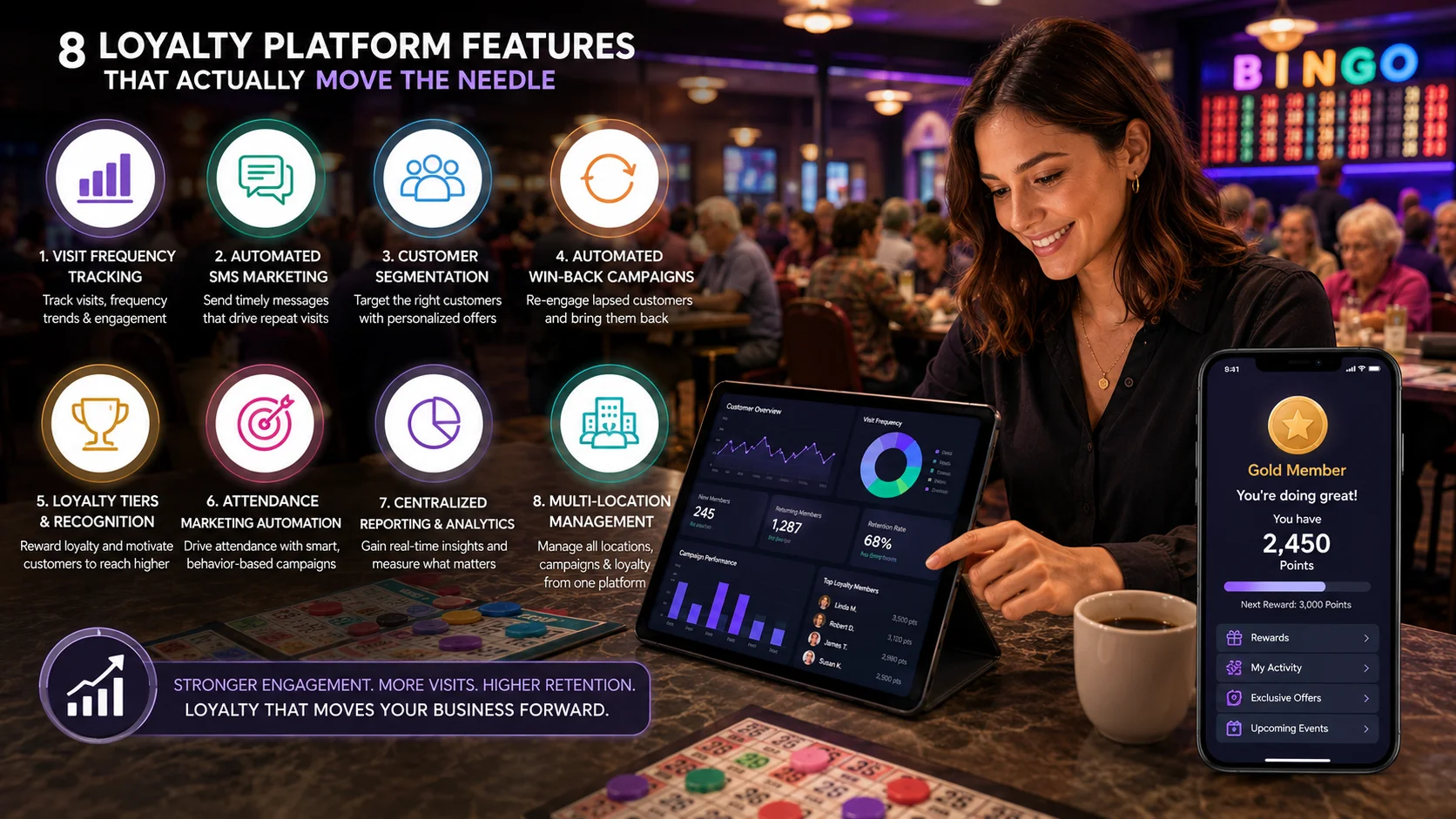
Here are the eight loyalty platform features that actually move the needle for physical venue operators.
1. Visit Frequency Tracking
The most important metric in any physical venue is not points earned.
It is the visit frequency.
A customer who visits once every six months is fundamentally different from a customer who visits every week.
Unfortunately, many loyalty programs focus heavily on transactions while providing limited visibility into attendance behavior.
A modern loyalty platform should track:
- Total visits
- Average visits per month
- Time between visits
- Attendance trends
- Frequency milestones
- Repeat visit rates
This information allows operators to identify their most valuable customers and proactively address declining engagement before customers disappear entirely.
Visit frequency tracking transforms loyalty from a rewards program into a retention strategy.
2. Automated SMS Marketing
A loyalty program cannot influence behavior if customers forget your venue exists.
This is why SMS marketing automation has become one of the most powerful retention tools available.
Unlike social media algorithms or crowded email inboxes, text messages provide direct communication with customers.
The best loyalty platforms integrate SMS marketing directly into customer engagement workflows.
Examples include:
- Event reminders
- Loyalty updates
- Birthday campaigns
- Reward notifications
- Win-back campaigns
- VIP promotions
Automation ensures communication happens consistently without requiring manual effort from staff.
More importantly, SMS keeps your venue top of mind between visits.
3. Customer Segmentation
One-size-fits-all marketing rarely works.
A first-time visitor should not receive the same message as a VIP member.
A customer who visits weekly requires different communication than someone who has not attended in three months.
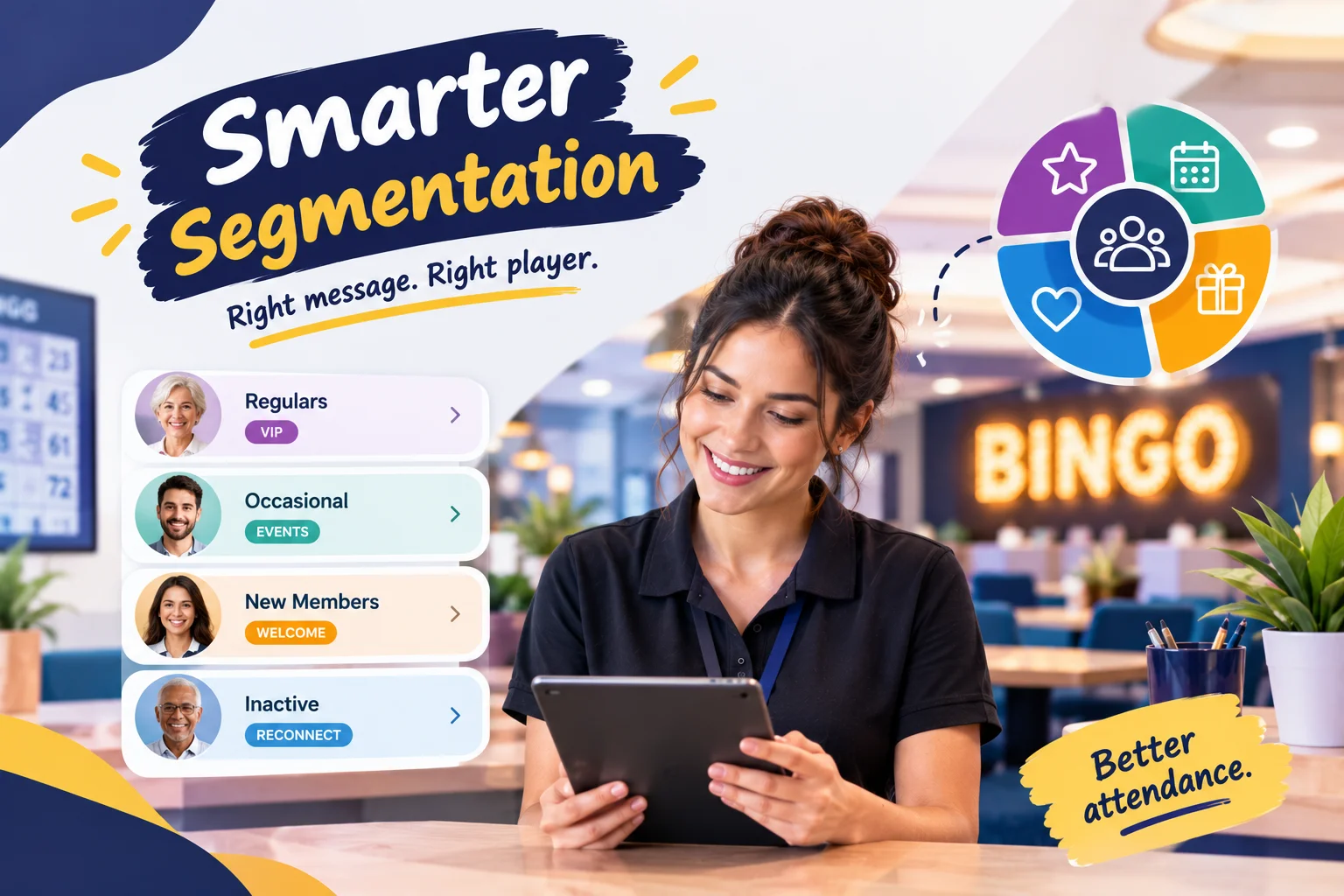
Customer segmentation allows operators to organize audiences based on behavior and engagement patterns.
Common segments include:
- New customers
- Frequent visitors
- VIP members
- Lapsed customers
- Event attendees
- Loyalty program participants
Segmentation improves relevance, increases engagement, and creates more personalized customer experiences.
The result is stronger retention and better campaign performance.
4. Automated Win-Back Campaigns
Every venue loses customers.
The difference between average operators and exceptional operators is what happens next.
Many businesses never attempt to recover lapsed customers.
Modern loyalty platforms automate this process.
The system identifies customers who have not visited within a predetermined timeframe and triggers re-engagement campaigns automatically.
Examples include:
- "We miss you" messages
- Bonus reward opportunities
- Limited-time offers
- Loyalty point reminders
- Event invitations
Because acquiring new customers is often significantly more expensive than retaining existing ones, win-back automation can generate substantial returns.
5. Loyalty Tiers and Status Recognition
Discounts alone rarely create lasting loyalty.
Recognition often proves more powerful.
Customers enjoy feeling valued, appreciated, and acknowledged for their participation.
This is where loyalty tiers become valuable.
Examples may include:
- Bronze Member
- Silver Member
- Gold Member
- VIP Member
As customers progress through tiers, they unlock additional benefits and recognition.
Tier systems encourage continued participation because customers become invested in maintaining or improving their status.
For physical venues, loyalty tiers often generate stronger engagement than simple point accumulation.
6. Attendance Marketing Automation
Traditional marketing focuses on promotion.
Attendance marketing focuses on behavior.
The objective is not simply sending messages.
The objective is to drive visits.
A loyalty platform should automatically identify attendance opportunities and communicate with customers at the right time.
Examples include:
- Customers approaching attendance milestones
- Declining visit frequency
- Seasonal attendance patterns
- Event participation opportunities
- Membership renewal reminders
Attendance marketing automation aligns loyalty efforts directly with operational goals.
Instead of measuring messages sent, operators begin measuring visits generated.
This creates meaningful business outcomes.
7. Centralized Reporting and Analytics
Many operators struggle because customer information exists in multiple systems.
Data may be spread across:
- CRM software
- Loyalty platforms
- SMS tools
- Spreadsheets
- Event systems
This fragmentation creates reporting challenges.
A modern loyalty platform should provide centralized visibility into:
- Attendance trends
- Retention performance
- Loyalty engagement
- Campaign effectiveness
- Customer lifetime value
- Visit frequency metrics
Comprehensive reporting helps operators identify what is working and where improvements are needed.
Better visibility leads to better decisions.
8. Multi-Location Management Capabilities
For organizations operating multiple venues, loyalty management becomes significantly more complex.
Without centralized oversight, locations often develop:
- Different loyalty structures
- Different marketing practices
- Different customer experiences
- Different reporting standards
A strong loyalty platform should support:
- Centralized administration
- Multi-location reporting
- Shared loyalty programs
- Standardized campaigns
- Roll-up analytics
This ensures consistency across locations while providing leadership with enterprise-level visibility.
For growing organizations, multi-location functionality is often a necessity rather than a luxury.
Why These Features Matter More Than Fancy Rewards
Many loyalty software vendors emphasize rewards catalogs, points balances, and redemption options.
While rewards certainly matter, they are not the primary driver of retention.
Customers return because of habits.
Because of relationships.
Because of engagement.
Because they feel connected to the venue.
The eight features outlined above support those behaviors.
Together, they create an ecosystem that encourages repeat visits and long-term loyalty.
Common Mistakes Operators Make When Evaluating Loyalty Software
Many operators focus on the wrong criteria.
Common mistakes include prioritizing:
- The largest rewards catalog
- The lowest software price
- The most points options
- The flashiest user interface
Instead, operators should ask:
- Can the platform increase visit frequency?
- Does it automate engagement?
- Can it identify lapsed customers?
- Does it provide attendance visibility?
- Can it support growth?
The answers to these questions are far more predictive of success.
The Shift From Rewards Programs to Retention Platforms
The loyalty industry is evolving.
Traditional rewards programs were built around transactions.
Modern loyalty platforms are built around customer behavior.
This shift reflects changing business priorities.
Operators increasingly recognize that sustainable growth comes from:
- Retention
- Engagement
- Attendance frequency
- Customer lifetime value
Not simply distributing rewards.
The most successful venues are moving beyond basic loyalty programs and adopting comprehensive customer engagement platforms that integrate CRM, SMS marketing, attendance tracking, automation, and reporting into one system.
Final Thoughts
Physical venues face growing competition for customer attention, time, and spending.
A loyalty platform should do more than manage rewards.
It should actively help operators increase attendance, strengthen customer relationships, improve retention, and create predictable revenue growth.
The eight features that consistently drive these outcomes are visit frequency tracking, automated SMS marketing, customer segmentation, win-back automation, loyalty tiers, attendance marketing automation, centralized reporting, and multi-location management.
When combined inside a single platform, these capabilities transform loyalty from a marketing initiative into a measurable growth engine.
For modern venue operators, that is what truly moves the needle.