A reverse raffle can start with hundreds of tickets and end with one winner.
But if the only prize people care about is the final prize, much of the event can feel like a long wait for one announcement.
The prize structure gives organisers a way to change that.
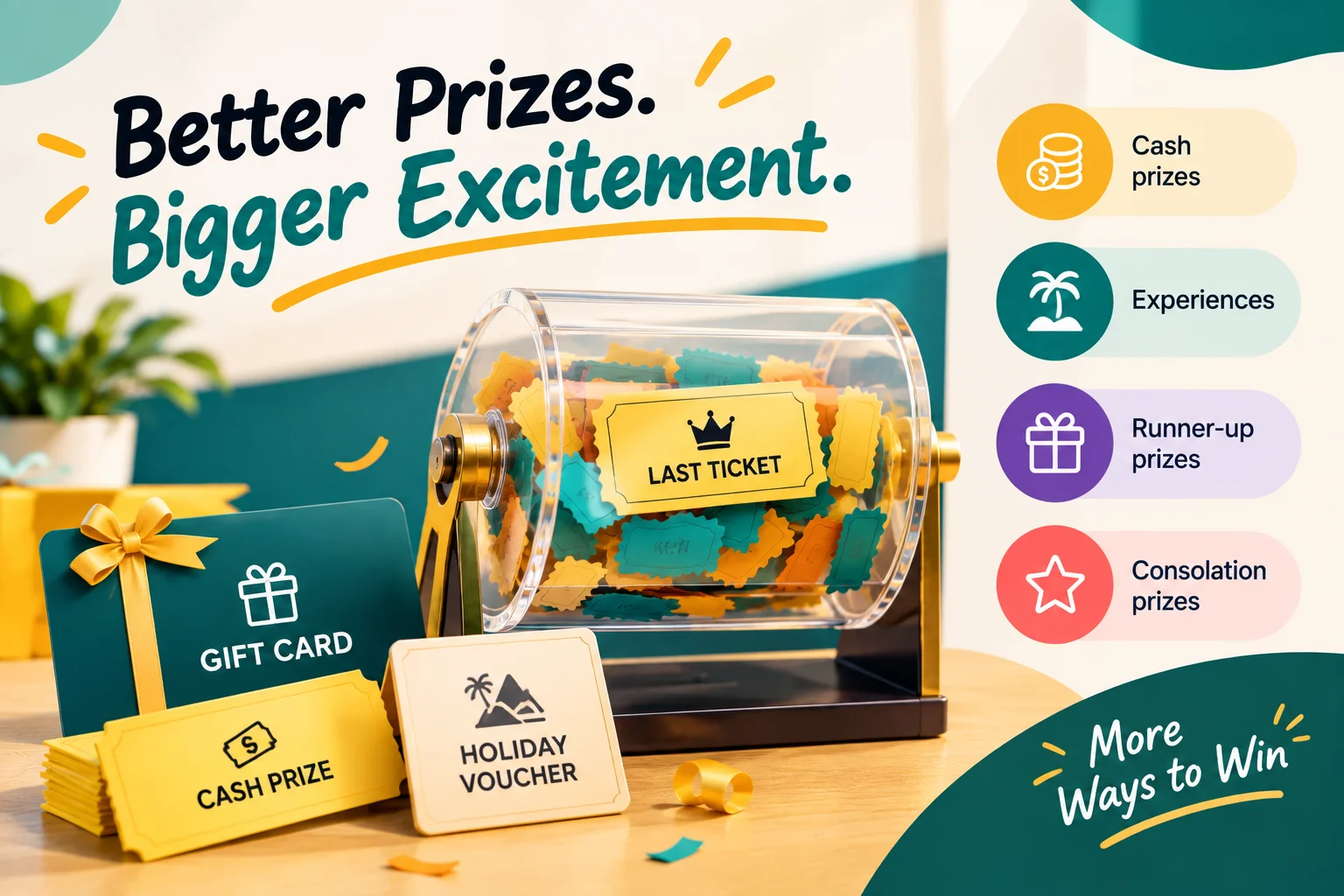
A well-planned reverse raffle can have a major grand prize at the end, smaller prizes along the way, runner-up rewards, sponsor-donated prizes, or special incentives that keep participants interested even after their original ticket has been eliminated.
The important thing is not simply to add more prizes.
It is to use the prizes to give the event a sense of progression.
The audience should understand what is at stake at different points in the draw.
That could mean a small prize early in the evening, a more valuable prize in the middle, and a major final prize that everyone is waiting for.
Here are some reverse raffle prize ideas to consider when planning your next event.
Start With the Prize That Defines the Event
Every reverse raffle needs a central attraction.
This is usually the grand prize attached to the final remaining ticket.
It might be:
- A cash prize
- A new vehicle
- A holiday package
- A high-value gift card
- A technology bundle
- A luxury experience
- A sponsored prize
- A major charity-donated prize
The grand prize does not necessarily need to be the most expensive item an organisation can find.
It needs to be clear, desirable and easy to communicate.
For example:
“One ticket. One final draw. £10,000 cash.”
That is simple.
Participants immediately understand what they are playing toward.
The grand prize becomes the anchor around which the rest of the event is built.
Cash Prizes Keep the Message Simple
Cash is one of the easiest prizes to explain.
There is no complicated product description.
There is no question about whether the winner wants it.
And the headline value can become part of the event's marketing.
Examples include:
- £1,000 final prize
- £5,000 grand prize
- £10,000 jackpot
- £25,000 charity event prize
For larger fundraising events, a substantial cash prize can also make the reverse raffle easy to communicate through posters, email, social media and SMS.
The important consideration is the overall financial structure.
The prize cost should make sense alongside ticket pricing, expected sales, event expenses and the organisation's fundraising objectives.
Don't Make Every Prize Cash
Cash is straightforward, but it is not the only way to create interest.
Some events can benefit from prizes that provide an experience.
Consider:
- Weekend hotel stays
- Restaurant experiences
- Concert tickets
- Sporting event tickets
- Spa packages
- Family attractions
- Travel vouchers
- Entertainment packages
- Local experience days
An experience can also create a useful sponsorship opportunity.
A hotel might donate a weekend stay.
A restaurant might provide a dinner package.
A local attraction might contribute tickets.
That allows the event to offer additional prizes without requiring the organiser to purchase every item at full cost.
Build a Prize Ladder
One of the simplest ways to structure a reverse raffle is to create a prize ladder.
Instead of:
One grand prize
consider:
Grand prize → Runner-up prize → Third-place prize → Consolation prizes
For example:
| Final Position | Example Prize |
| Last remaining ticket | £10,000 |
| Second-to-last | £2,500 |
| Third-to-last | £1,000 |
| Fourth-to-last | £500 |
| Selected earlier finalists | £250 |
The exact values depend on the event.
The principle is what matters.
As the number of remaining tickets decreases, the potential rewards increase.
That gives the final stages additional significance.
Use Runner-Up Prizes to Keep the Final Stage Meaningful
Imagine there are three tickets left.
The audience knows one person will win the grand prize.
But what happens to the other two?
If there is nothing else at stake, two participants are about to lose everything at the same moment.
A runner-up structure changes the dynamic.
For example:
First place: £10,000
Second place: £2,500
Third place: £1,000
Now all three remaining participants have something to play for.
The final three are not simply waiting to find out who gets the grand prize.
They are competing for different prize levels.
This can make the final stage more meaningful for everyone still involved.
Consider Consolation Prizes
Consolation prizes can serve another purpose.
They give organisers a way to acknowledge participants whose tickets were eliminated earlier.
For example, an event might offer occasional prizes to selected eliminated participants.
Possible options include:
- £25 vouchers
- Free event tickets
- Restaurant vouchers
- Merchandise
- Small cash prizes
- Sponsored gift baskets
- Free entry to a future event
These prizes should be clearly defined within the event rules.
The purpose is not to make every participant a winner.
It is to create additional moments of anticipation throughout the event.
Add Surprise Prizes Carefully
A surprise prize can create an unexpected moment during a reverse raffle.
For example:
“Before we continue with the main draw, we're giving away a £100 restaurant voucher.”
The winner could be selected according to predetermined rules.
This creates a change of pace.
However, surprise prizes should not make the core rules confusing.
Participants should know before entering whether additional prizes may be awarded and how eligibility works.
Surprises work best when they are entertaining—not when they create uncertainty about the rules.
Use Milestone Prizes
This is an interesting way to connect prizes with the progress of the draw.
Suppose the event starts with 500 tickets.
You could introduce prize milestones such as:
250 tickets remaining: £100 bonus prize
100 tickets remaining: £250 prize
50 tickets remaining: £500 prize
10 tickets remaining: Finalist bonus
1 ticket remaining: Grand prize
The prizes become part of the countdown.
The audience is not only watching numbers disappear.
They are watching the event move toward increasingly valuable moments.
Give Sponsors Their Own Prize Moments
Reverse raffles can be attractive to sponsors because the event creates multiple opportunities for recognition.
Instead of one sponsor simply appearing on a banner, a sponsor might contribute a specific prize.
For example:
“The 50-ticket milestone prize is sponsored by ABC Restaurant.”
Or:
“Tonight's runner-up prize has been provided by XYZ Travel.”
This gives the sponsor a natural connection to the event.
It also helps the organiser build a more varied prize pool.
For local charity events, partnerships with nearby businesses can be particularly useful.
A business may prefer donating a product, service or experience rather than making a cash contribution.
Create Prize Packages Instead of Individual Items
A single item can become more attractive when combined with complementary prizes.
For example:
Weekend Away Package
- Two-night hotel stay
- Restaurant voucher
- Attraction tickets
- Travel voucher
Entertainment Package
- Concert tickets
- Dinner voucher
- Hotel stay
Family Package
- Family attraction tickets
- Restaurant voucher
- Activity experience
Technology Package
- Tablet
- Headphones
- Smart device
- Accessories
The package creates a larger perceived experience without necessarily requiring one extremely expensive individual prize.
Local Business Prizes Can Make the Event Feel More Community-Based
Charity and bingo events often have strong local connections.
Use that.
Approach local businesses about contributing:
- Restaurant meals
- Salon vouchers
- Gym memberships
- Hotel stays
- Retail vouchers
- Entertainment tickets
- Local experiences
- Gift baskets
The prize becomes more than something given to the winner.
It can also introduce the business to the event audience.
For the organiser, local prize partnerships can expand the prize pool.
For the business, the event provides an opportunity for community visibility.
Think Beyond Physical Products
Not every prize needs to be something the winner takes home.
Experience-based prizes can be memorable.
Consider:
- VIP event access
- Behind-the-scenes tours
- Sports experiences
- Theatre packages
- Cooking classes
- Golf days
- Spa experiences
- Adventure activities
- Private dining
These prizes can work particularly well when local businesses or sponsors are involved.
They also give organisers more options when building a prize structure around a particular audience.
Use Prize Timing to Control the Pace
Prize selection and draw pacing can work together.
Early in the event, you may want to keep the pace relatively quick.
Later, you can give important prizes more attention.
For example:
Early Stage
Small sponsored prizes.
Keep the draw moving.
Middle Stage
Larger prizes.
Introduce milestones.
Give the host more opportunities to explain what remains.
Final Stage
Runner-up prizes.
Finalist recognition.
Grand prize.
This creates a natural escalation.
The prize structure tells the audience:
“The event is getting closer to the main moment.”
Avoid Giving Away Your Biggest Prize Too Early
This sounds obvious, but prize sequencing matters.
If the event's most valuable prize is awarded early, the audience may feel that the main reason to keep watching has disappeared.
The grand prize should generally remain connected to the final stage according to the published rules.
That way, the event has a clear destination.
Everything else builds toward it.
Create a “Final Five” Prize Moment
The final five can be one of the most exciting stages of a reverse raffle.
At this point, consider clearly displaying:
5 Tickets Remaining
Then explain the prize structure.
For example:
- 5th place: £250
- 4th place: £500
- 3rd place: £1,000
- 2nd place: £2,500
- 1st place: £10,000
Now every remaining participant understands what is at stake.
Every elimination changes the prize position.
The final five become an event within the event.
Don't Forget the People Who Have Already Been Eliminated
A reverse raffle naturally creates winners and eliminated participants.
But the evening does not have to end for someone simply because their ticket is no longer eligible for the grand prize.
The organiser can include other event activities:
- Food and drinks
- Live entertainment
- Side games
- Sponsor activities
- Additional fundraising
- Loyalty rewards
- Future event promotions
This keeps the venue active while the main draw continues.
The reverse raffle becomes part of a larger event experience rather than the only activity happening in the room.
Match the Prize to the Audience
A prize that sounds impressive on paper may not be particularly meaningful to your audience.
Before choosing prizes, consider who is attending.
For example, a community fundraiser might find strong interest in:
- Restaurant vouchers
- Local experiences
- Family days
- Holiday packages
- Cash prizes
A corporate fundraising event might lean toward:
- Premium experiences
- Travel
- Technology
- Fine dining
- Sporting experiences
A bingo hall audience may respond to a mixture of cash, vouchers, entertainment and venue-related rewards.
The right prize structure starts with the people you want to attract.
Don't Let Prize Value Become the Only Selling Point
A large prize can attract attention.
But the event still needs a reason for people to participate.
Explain what the money or prizes support if the event is raising funds for a charity.
Tell people about the event experience.
Highlight the live draw.
Explain how the reverse raffle works.
Show the range of prizes.
Then communicate the main prize clearly.
The marketing becomes stronger when people understand both:
What they could win
and
Why the event exists.
Use SMS to Build Anticipation Around Prizes
Once the prize structure is confirmed, SMS can help communicate the important moments.
For example:
Before ticket sales
“Tickets are now available for our £10,000 Reverse Raffle. Join us on Friday 18 October.”
Before the event
“Only 3 days to go. Our Reverse Raffle includes £10,000 for the final ticket plus runner-up prizes.”
On event day
“Tonight's Reverse Raffle starts at 7 PM. Doors open at 6 PM.”
During the event
“Only 25 tickets remain in tonight's Reverse Raffle.”
The exact messaging should reflect the event rules and the audience's consent preferences.
The point is to turn the prize structure into a communication journey rather than mentioning the grand prize once.
Keep the Prize Rules Crystal Clear
The more prizes you add, the more important clarity becomes.
Before selling tickets, document:
- Number of prizes
- Prize values
- How winners are selected
- When each prize is awarded
- Whether eliminated tickets remain eligible for other prizes
- Whether winners must be present
- What happens if a winner cannot be contacted
- Any eligibility requirements
- How prize substitutions are handled
Don't introduce rules halfway through the event.
Participants should know what they are entering before they buy a ticket.
For regulated fundraising or gaming activities, organisers should also check the applicable local requirements before launching the event.
Use Software to Keep Track of a Growing Prize Structure
Once a reverse raffle has one prize, administration is relatively straightforward.
Add multiple prizes, consolation awards, sponsor prizes, and milestone rewards, and the process becomes more complicated.
Someone needs to know:
Which numbers are still active?
Which numbers have already been eliminated?
Which prize comes next?
Who won each prize?
What remains for the final stage?
This is where dedicated reverse raffle software can reduce manual administration.
Instead of relying entirely on paper lists or spreadsheets, the organiser can manage the draw and prize structure through a central system.
Where JustKonnect Fits
JustKonnect Reverse Raffle Software is built to support the operational side of running a reverse raffle, including ticket management, automated drawing, live updates, multiple prize tiers and winner management.
That matters when an event moves beyond a single grand prize.
A platform can help the organiser keep track of the draw while the host concentrates on presenting the event.
JustKonnect also connects reverse raffle activity with communication tools such as SMS, giving organisers options for promoting the event and communicating with participants.
The software should not dictate the prize structure.
The organiser defines the event, prizes and rules.
The technology helps manage the process.
A Sample Reverse Raffle Prize Structure
Here is one example of how a charity could structure a 300-ticket event.
Grand Prize
£10,000
Runner-Up
£2,500
Third Place
£1,000
Fourth Place
£500
Five Milestone Prizes
£100 each
Sponsor Prizes
Restaurant voucher, hotel stay and family attraction package
This creates several different layers of value.
The £10,000 prize provides the headline.
The runner-up prizes make the final stage more meaningful.
The milestone prizes create additional moments during the draw.
The sponsor prizes add variety and partnership opportunities.
The actual numbers should be determined by the organisation's budget, ticket revenue, fundraising objectives and event rules.
Prize Ideas by Budget
If you are working with a limited prize budget, you can still create variety.
Lower-Budget Event
Consider:
- Restaurant vouchers
- Local retail vouchers
- Small cash prizes
- Gift baskets
- Entertainment tickets
- Sponsored products
Mid-Range Event
Consider:
- Weekend hotel stays
- Technology bundles
- Larger cash prizes
- Family experience packages
- Premium restaurant experiences
Larger Event
Consider:
- Significant cash prizes
- Vehicle prizes
- Luxury travel packages
- High-value experience packages
- Multiple major runner-up prizes
The important thing is to create a prize structure that the event can realistically support.
A smaller event with well-chosen prizes can still feel substantial.
Frequently Asked Questions
What are good prizes for a reverse raffle?
Popular options include cash, gift cards, travel packages, hotel stays, technology, entertainment tickets, restaurant vouchers and experience packages. The best fit depends on the audience, event budget and fundraising objectives.
Should a reverse raffle have more than one prize?
It can. A grand prize supported by runner-up, consolation, milestone or sponsor prizes can create additional moments of interest throughout the event.
What is a good grand prize for a charity reverse raffle?
Cash is simple to communicate, but travel, vehicles, experiences and sponsored prize packages can also work. The prize should fit the audience and the financial structure of the event.
How can sponsors contribute to a reverse raffle?
Local businesses can donate products, services, gift vouchers or experiences. Sponsors can then be recognised alongside the prizes they contribute, subject to the event's promotional arrangements.
Can eliminated players win other prizes?
They can if the event rules allow it. Organisers can create separate prize categories or additional drawings, but the eligibility rules should be established and communicated before the event.
How can reverse raffle software help with prizes?
Dedicated software can help organisers manage active entries, run the draw, track eliminations and manage multiple prize tiers and winners. This can reduce the need for manual tracking as the event becomes more complex.
The Prize Is Only the Beginning
A £10,000 prize may get people to look at a reverse raffle.
But the way you structure everything around that prize determines what happens next.
A runner-up prize can make the final two meaningful.
A milestone prize can create another moment of anticipation.
A sponsor prize can bring a local business into the event.
A consolation prize can keep eliminated participants interested.
An experience package can make the event memorable in a way that cash alone cannot.
The strongest prize structures do not simply ask:
“What can we give away?”
They ask:
“What should happen at each stage of the event?”
Once you answer that question, the prizes become part of the storytelling.
The first prize creates interest.
The middle prizes create moments.
The final prizes create suspense.
And the grand prize gives everyone a reason to stay until the last number is standing.
Explore JustKonnect Reverse Raffle Software to see how ticket management, automated draws, live updates and prize management can support the operational side of your next reverse raffle.