A player has a question.
Maybe they want to know what time tonight's session starts.
Maybe they're asking whether there are still places available for Friday's special event.
Maybe they want to know how a promotion works.
Or perhaps they're simply trying to confirm one detail before deciding whether to come to the hall.
They call.
Nobody answers.
They leave a voicemail.
Or they send an email and wait.
By the time someone responds, the moment may have passed.
This is the problem with treating player communication as a one-way process.
A marketing message can create interest, but interest is not attendance.
There is often a short window between a player deciding “I'd like to go” and actually making the decision to visit.
Two-way texting helps shorten that gap.
Instead of making the player switch between channels, wait for a response, or repeat their question, the conversation can happen through the same messaging channel they are already using.
For a bingo hall, that can turn a simple inquiry into a confirmed visit much faster.
The Moment Between “Interested” and “I'm Coming”
This is the part of the customer journey that is easy to overlook.
A player sees an SMS about Friday night bingo.
They are interested.
But then they have a question:
“What time does it start?”
That question creates friction.
If the only option is to call the venue, the player has to stop what they're doing, find the number, wait for someone to answer, and explain what they need.
If the player can simply reply to the SMS, the journey becomes much shorter.
Promotion → Question → Answer → Decision → Attendance
That's what makes two-way texting particularly useful.
It doesn't just deliver information.
It gives the player somewhere to continue the conversation.
One-Way SMS Stops at the Message
Traditional SMS marketing is largely one-directional.
The venue sends:
Friday Night Bingo is coming up! Join us this Friday from 6 PM.
The player reads it.
That's where the communication normally ends.
But what if they want to ask:
“Is there still space?”
Or:
“Can I bring a friend?”
Or:
“What time should I arrive?”
Or:
“Does my loyalty reward apply?”
A one-way communication system may force the player to find another way to get an answer.
Two-way texting removes that unnecessary step.
The player replies directly.
The conversation continues.
Why Small Questions Matter So Much
Not every inquiry is a major sales opportunity.
Sometimes the player only needs one piece of information.
But that one piece of information can determine whether they attend.
Think about the difference between:
“I might go.”
and:
“Yes, I'm going.”
The player may already be 80% of the way there.
They simply need reassurance.
A quick answer can remove the final obstacle.
That is why response speed matters.
The longer the player has to wait, the more likely the original intention is to disappear.
The Player Doesn't Think in Channels
Marketing teams often think in terms of:
- SMS
- Phone
- Website
- Social media
- CRM
The customer doesn't necessarily think that way.
They simply think:
“I need an answer.”
If they've received a text from the bingo hall, replying to that text is often the most natural next step.
They don't want to navigate through your marketing technology.
They want to communicate with the venue.
That's the real advantage of two-way texting.
A Simple Example: The Friday Night Inquiry
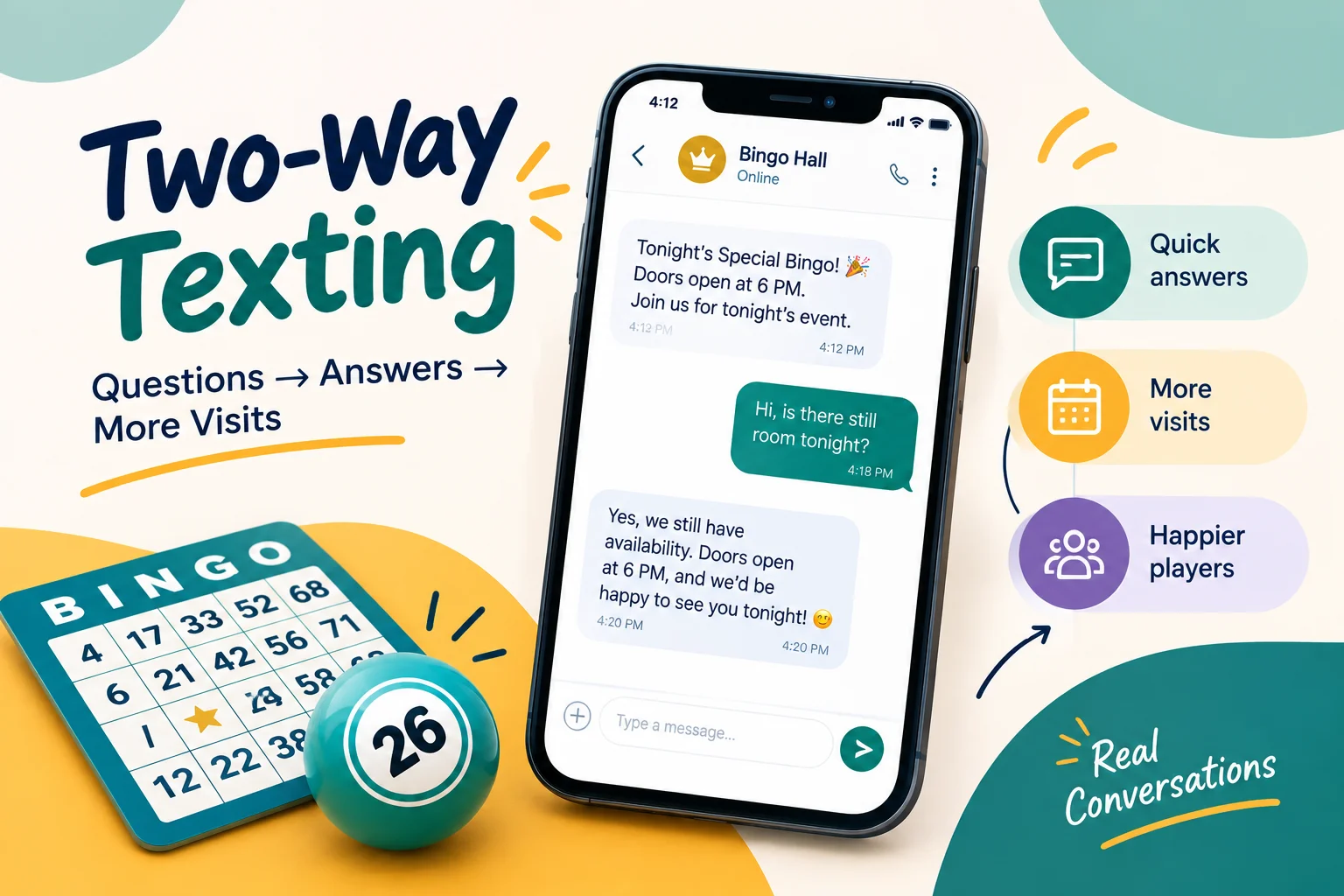
Imagine your hall sends this message on Friday afternoon:
Tonight's Special Bingo 🎉 Doors open at 6 PM. Join us for tonight's event.
A player replies:
“Hi, is there still room tonight?”
With two-way texting, someone can respond:
“Yes, we still have availability. Doors open at 6 PM, and we'd be happy to see you tonight.”
The interaction is complete.
The player has an answer.
The venue has removed uncertainty.
The next step is attendance.
Without two-way communication, that same customer may have had to search for a phone number or wait for another communication.
It sounds like a small difference.
Across hundreds or thousands of player interactions, it isn't.
Two-Way Texting Turns Campaigns Into Conversations
This is the biggest conceptual difference.
A broadcast says:
“Here's something you should know.”
Two-way texting says:
“Here's something you should know, and you can talk to us about it.”
That second experience is much closer to a real customer conversation.
And conversations create opportunities to understand what players actually want.
A player might reply:
“Do you have anything on Saturday?”
Now you've learned something.
They weren't interested in Friday.
They are interested in Saturday.
That response can potentially inform how your team communicates with that player in the future.
Where Two-Way Texting Fits Best
There are plenty of situations where player replies can be valuable.
Event Questions
A customer wants more information about an upcoming fundraiser, themed night, or special bingo session.
They can ask directly.
Attendance Confirmation
A player may want to confirm that an event is still running or that they can attend.
A quick response can remove uncertainty.
Promotion Questions
Customers may want clarification about eligibility, timing, or how an offer works.
Two-way messaging gives them a direct route to an answer.
Loyalty Questions
A player might ask about a reward, points balance, or how to use an available benefit.
Instead of forcing them to find another contact channel, they can reply to the message.
General Player Inquiries
Not every question will fit neatly into a marketing campaign.
That's fine.
The value of two-way communication is that customers can start conversations when they need information.
The Faster the Answer, the Shorter the Decision Gap
Imagine two scenarios.
Scenario A
A player sends an SMS inquiry.
The venue responds 10 minutes later.
The player confirms their plans.
Scenario B
The player has to call.
Nobody answers.
They leave a voicemail.
They wait.
They become busy.
The event gets forgotten.
Neither situation means the customer wasn't interested.
The difference is friction.
Two-way texting helps reduce that friction.
Of course, actual response times depend on how the venue manages incoming messages. Two-way texting isn't a substitute for having someone or something responsible for handling replies.
The technology creates the channel.
The operational process makes the channel useful.
A Shared Inbox Can Change the Workflow
This becomes particularly important when several staff members manage customer communication.
Without a centralised system, replies can end up scattered across individual phones or personal inboxes.
That creates questions of its own:
Who saw the message?
Who replied?
Has the player already been contacted?
What was promised?
Does another team member need to follow up?
A shared communication environment makes the conversation easier to manage.
Instead of the player talking to an anonymous SMS number, the venue has a more structured way to handle the interaction.
Don't Treat Every Reply as a Sales Lead
This is another important distinction.
A player replying to an SMS doesn't necessarily want to be sold something.
They may simply need an answer.
If someone asks:
“What time does bingo start?”
the best response is the start time.
Not:
“Bingo starts at 6 PM! Would you also like to hear about our loyalty programme, VIP tiers, referral rewards, gift cards, next month's fundraiser and seasonal promotion?”
That's too much.
Answer the question.
Then let the conversation develop naturally.
Good two-way texting feels helpful rather than scripted.
Use Questions to Discover Intent
Sometimes a customer's reply reveals more than they realise.
For example:
“Is there anything on this weekend?”
That could be answered with the weekend schedule.
But it also tells the venue that the player is considering a visit.
If the system and staff workflow allow it, that interaction can become a useful signal for future communication.
Another example:
“Can I use my points tonight?”
Now you know the player is engaged with the loyalty programme and is considering attending.
The conversation can therefore provide useful context that a simple SMS delivery report cannot.
From Inquiry to Attendance: The Five-Step Journey
A useful way to think about two-way texting is as a short conversion journey.
1. The player receives a message
An event, promotion, reminder, or other communication creates awareness.
2. The player replies
They have a question, need clarification, or want to confirm something.
3. The venue responds
The answer removes uncertainty.
4. The player makes a decision
The friction that was stopping them is reduced.
5. The player attends
The communication has achieved its practical purpose.
The interesting part is that the SMS didn't necessarily “sell” the player.
It helped them make a decision.
What Should Staff Say?
There is no need for complicated scripts.
A good response is usually:
Fast.
Clear.
Friendly.
Accurate.
Relevant to the question.
For example:
Player:
“Is the charity bingo still happening tonight?”
Response:
“Yes, it's going ahead tonight. Doors open at 6 PM and the session starts at 7 PM. We hope to see you there.”
That's enough.
If the player then asks another question, continue the conversation.
The objective is to make communication feel human without creating unnecessary work for staff.
Set Expectations for Response Times
Two-way texting creates an expectation that someone is listening.
If customers can reply but nobody checks the inbox until the next morning, the benefit is reduced.
Before launching two-way communication, define:
- Who monitors incoming messages
- During which hours
- How quickly replies should normally be handled
- Which questions staff can answer
- Which questions need escalation
- What happens outside operating hours
This turns the technology into an operational process.
What About Missed Calls?
Two-way texting can also complement phone communication.
A player may call while the team is busy.
Instead of leaving the customer with no response, a venue can use an SMS follow-up process to acknowledge the missed call and provide a route for continuing the conversation where the relevant system supports it.
For example:
“Sorry we missed your call. Reply to this message, and we'll be happy to help.”
Now the missed call doesn't necessarily become a dead end.
The player has another way to reach the venue.
Don't Lose the Conversation After the Player Replies
This is where CRM integration becomes valuable.
A customer conversation shouldn't exist entirely on its own.
If the system can associate communication with a player profile, the venue has more context when handling future interactions.
For example, the team may be able to see relevant information such as:
- Previous visits
- Communication history
- Loyalty activity
- Relevant campaign interactions
- Player status
The more context staff have, the less likely the player is to repeatedly explain who they are or why they're contacting the venue.
Two-Way Texting Can Improve More Than Attendance
Attendance is an obvious outcome.
But the conversations themselves can reveal useful information.
You may discover that customers frequently ask:
“What time does Saturday start?”
That suggests your event communication may need clearer timing.
Or players repeatedly ask:
“Can I use my loyalty reward tonight?”
That suggests the reward communication could explain redemption more clearly.
Or customers often ask:
“Do I need to book?”
That may indicate an information gap in your event promotion.
In this way, customer replies can become a source of marketing insight.
Measure the Conversation, Not Just the Send
A standard SMS campaign might tell you:
5,000 messages sent.
Two-way texting gives you another layer of information.
You can potentially look at:
- Number of replies
- Response rate
- Response time
- Common questions
- Conversations leading to attendance
- Event confirmations
- Follow-up requirements
- Campaign-level engagement
The most useful measurements will depend on how your venue handles conversations and what data your system captures.
The important shift is from asking:
“Did they receive the message?”
to:
“What happened after they received it?”
Use Replies to Improve Future Campaigns
Suppose a special event generates 150 player replies.
You review the conversations and notice that many people asked the same question:
“What time does it start?”
Next time, put the start time prominently in the original SMS.
Now fewer players need to ask.
The following campaign might reveal a different question.
Over time, the communication gets better because you're learning from real conversations rather than guessing what information customers need.
Two-Way Texting Doesn't Replace Good Marketing
There is a temptation to think that if customers can reply, the original SMS doesn't matter.
It does.
The better the initial message, the fewer unnecessary questions you'll create.
A strong SMS should already provide the key information:
- What is happening
- When it is happening
- Where relevant, who it is for
- Why it matters
- What to do next
Two-way texting handles the questions that remain.
Think of it as a safety net for the decision-making process.
The Difference Between “Contact Us” and an Actual Conversation
Many businesses tell customers:
“Contact us for more information.”
Then they provide a phone number or email address.
That's technically communication.
But it introduces friction.
The customer has to decide how to contact you.
Two-way texting removes that decision.
You've already started the conversation.
They simply reply.
That's particularly useful for a bingo hall because the original marketing message is often already sitting on the customer's phone.
The path from marketing to conversation is immediate.
Keep Conversations Within the Right Boundaries
Two-way texting should remain focused on appropriate customer communication.
Staff should know how to handle:
- Marketing questions
- Event questions
- Attendance queries
- Loyalty questions
- General information requests
- Complaints or issues requiring escalation
Sensitive or complex issues may need to move to another channel.
The important point is to have a process rather than leaving staff to improvise every interaction.
Where JustKonnect Fits
Two-way texting becomes much more useful when it is part of the same player communication environment as your SMS campaigns and customer data.
JustKonnect provides Two-Way Texting as part of its communication toolkit, allowing players to respond to messages and enabling the venue to manage those conversations rather than treating SMS as a purely one-directional channel.
This can be particularly useful when a bingo hall wants to connect outbound marketing with actual player conversations.
A campaign can create the initial interest.
The reply creates the opportunity to answer questions.
The response can remove friction.
And the resulting interaction can become part of the wider customer relationship.
That's a very different workflow from simply sending a promotional text and hoping someone acts on it.
A Practical Example From Start to Finish
Let's put the whole idea together.
Your hall is hosting a Saturday charity bingo night.
Thursday — Awareness
Saturday Charity Bingo is almost here. Join us for a special evening supporting [Cause]. Find out more today.
Friday — Reminder
Tomorrow is Charity Bingo Night. Doors open at 6 PM. Reply to this message if you have any questions.
Player Replies
“Do I need to book?”
Venue Responds
“You can [insert the actual booking/attendance process]. We'd be happy to see you Saturday.”
Saturday — Final Reminder
Tonight's Charity Bingo starts at 7 PM. We look forward to seeing you.
The important moment isn't just the initial SMS.
It's the reply in the middle.
The player had uncertainty.
The venue removed it.
The decision became easier.
Frequently Asked Questions
What is two-way texting for bingo halls?
Two-way texting allows players to reply directly to SMS messages from the bingo hall. Instead of communication ending when the venue sends a message, the player can ask questions and continue the conversation.
Can two-way texting help increase bingo attendance?
It can help reduce communication friction by allowing players to quickly ask questions and receive answers. Whether that results in increased attendance depends on the campaign, audience, response process, and other factors.
What kind of questions might bingo players ask by SMS?
Players may ask about event times, availability, promotions, loyalty rewards, booking procedures, charity events, or general venue information.
How quickly should a bingo hall respond to player texts?
The faster the better for time-sensitive inquiries, but the venue should establish realistic response-time expectations based on its staffing and operating hours.
Should every SMS campaign allow replies?
Not necessarily. Some messages may be informational or automated. If replies are enabled, the venue should have a process for monitoring and responding to them.
Can two-way texting work with CRM and player data?
When the messaging system is connected with a CRM, conversations can potentially be associated with relevant player information and communication history. This can give staff more context when handling inquiries.
The Fastest Conversation Is Often the One You Don't Make the Customer Start
A player who receives an SMS has already entered the conversation.
Don't necessarily make them leave that conversation to get an answer.
If they have a question, let them reply.
If they need clarification, give them a direct response.
If they're deciding whether to attend, remove the uncertainty that is holding them back.
That is why two-way texting can be so valuable for bingo halls.
The technology itself is simple.
The real advantage is what happens between the message and the visit.
A blast creates awareness. A reply creates a conversation. A useful conversation can remove the final barrier to attendance.
For bingo operators looking to turn SMS from a one-way announcement channel into a more responsive player communication system, JustKonnect's Two-Way Texting feature is worth exploring.
Don't just send players a reason to visit. Give them an easy way to say yes.