For arcade operators and family entertainment center (FEC) managers, attracting visitors is only half the battle.
The real challenge begins after guests leave.
A family visits your arcade on Saturday.
The kids have an amazing time.
Parents spend money on games, food, attractions, and prizes.
Everything seems successful.
Then weeks pass.
And they never come back.
This is one of the most common problems facing entertainment venues today.
Many arcades focus heavily on customer acquisition while overlooking the systems that encourage repeat visits.
The result is an endless cycle of spending money to attract new guests while struggling to build a loyal customer base.
This is where gamification becomes one of the most powerful tools available.
When loyalty programs feel like games rather than marketing campaigns, guests engage more frequently, return more often, and develop stronger connections with the venue.
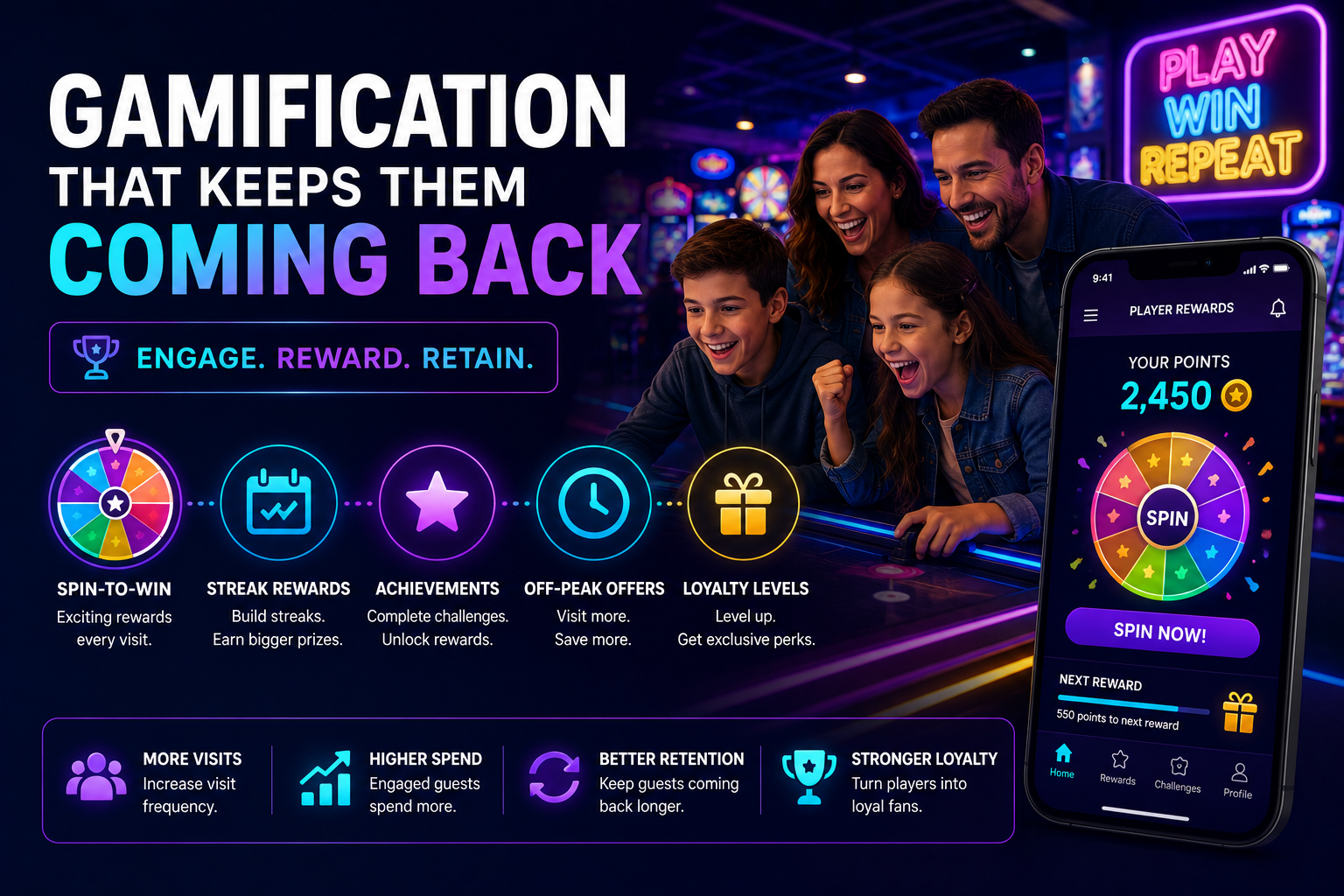
Modern arcade loyalty platforms use gamification elements such as spin-to-win promotions, streak rewards, achievement challenges, and off-peak visit incentives to transform occasional guests into regular visitors.
Why Traditional Arcade Loyalty Programs Often Fail
Many arcades already offer some form of loyalty program.
Common examples include:
- Buy-one-get-one offers
- Punch cards
- Generic discounts
- Basic point systems
While these promotions can generate short-term activity, they rarely create long-term behavioral change.
The problem is simple.
Most traditional rewards programs are transactional.
Customers participate only when they receive an immediate benefit.
Once the reward disappears, so does the motivation.
Gamification changes the relationship entirely.
Instead of simply rewarding purchases, it creates excitement, anticipation, achievement, and ongoing engagement.
What Is Gamification in Arcade Loyalty Programs?
Gamification applies game mechanics to customer engagement and loyalty systems.
These mechanics include:
- Challenges
- Achievements
- Progress tracking
- Rewards
- Competition
- Randomized prizes
- Status levels
The goal is to make participation fun.
Arcades are uniquely positioned to benefit from gamification because customers already visit for entertainment.
When loyalty programs become entertaining, engagement naturally increases.
Why Gamification Works So Well
Gamification taps into several powerful psychological drivers.
Anticipation
People enjoy the possibility of winning.
Progress
Customers like seeing advancement toward goals.
Achievement
Completing challenges creates satisfaction.
Recognition
Status and rewards encourage continued participation.
Habit Formation
Repeated engagement develops routine behaviors.
Together, these elements create stronger loyalty than traditional discount programs.
Spin-to-Win Campaigns: Turning Rewards Into Entertainment
One of the most effective gamification strategies for arcades is the spin-to-win campaign.
Rather than offering a fixed reward, guests receive an opportunity to spin a virtual prize wheel.
Potential prizes may include:
- Bonus game credits
- Attraction passes
- Free food items
- Birthday party discounts
- Loyalty points
- VIP access
- Merchandise rewards
The excitement comes from uncertainty.
Customers are motivated by the possibility of receiving something valuable, even when the actual reward varies.
When to Use Spin-to-Win Promotions
Spin-to-win campaigns work particularly well for:
- First-time visitor engagement
- Loyalty program enrollment
- Event participation
- Guest reactivation campaigns
- Seasonal promotions
- SMS marketing campaigns
Because the experience feels interactive, participation rates are often significantly higher than traditional offers.
Streak Rewards: Encouraging Habit Formation
One of the biggest goals of an arcade loyalty program is to increase visit frequency.
Streak rewards are specifically designed to achieve this.
A streak reward encourages customers to visit repeatedly within a specific timeframe.
Examples include:
- Visit three weekends in a row
- Attend twice per month
- Play during four consecutive weeks
- Participate in recurring events
As customers progress toward a streak goal, motivation increases.
No one wants to lose their progress.
This creates a powerful retention mechanism.
Why Streak Rewards Are Effective
Streak rewards encourage:
- Consistent attendance
- Routine behavior
- Repeat engagement
- Long-term participation
Instead of rewarding spending alone, they reward habits.
For arcades and FECs, habit formation is often more valuable than one-time purchases.
Off-Peak Offers: Solving One of the Biggest Revenue Challenges
Most entertainment venues experience attendance imbalances.
Saturday afternoons are crowded.
Tuesday evenings are empty.
This creates inefficiencies in staffing, operations, and revenue generation.
Gamified off-peak offers help solve this challenge.
Rather than discounting heavily, operators can create engaging incentives that encourage visits during slower periods.
Examples include:
- Double loyalty points on Wednesdays
- Mystery rewards during weekday visits
- Midweek challenge campaigns
- Bonus spins for off-peak attendance
- Limited-time achievement rewards
These promotions shift customer behavior without relying entirely on discounts.
How SMS Marketing Amplifies Gamification
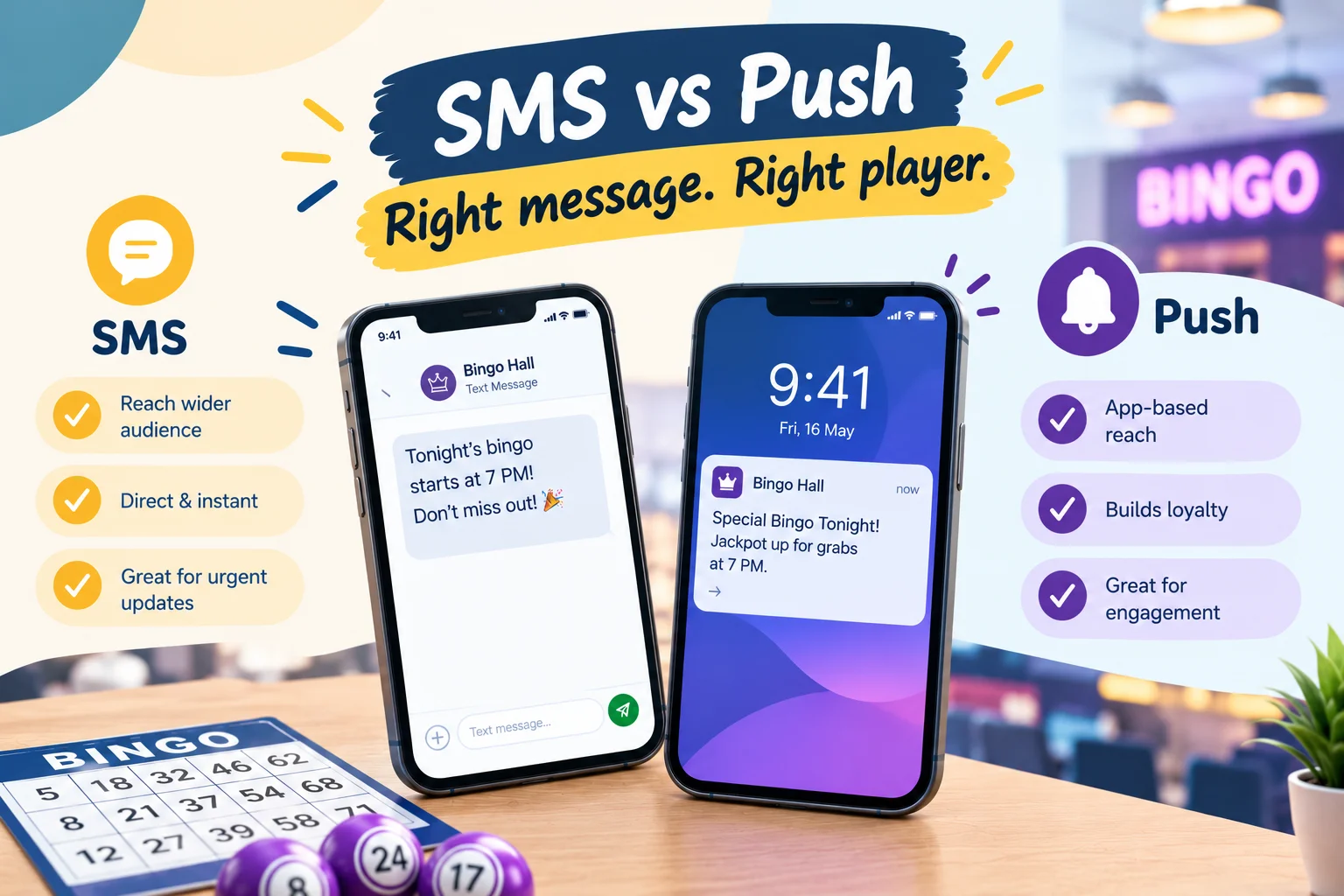
Gamification becomes significantly more effective when combined with SMS marketing.
Text messages create urgency and visibility.
Examples include:
"Your spin-to-win reward expires tonight."
"You are one visit away from unlocking your streak bonus."
"Visit today for double loyalty points."
These messages encourage immediate action and help maintain engagement between visits.
Because text messages are highly visible, they are ideal for promoting time-sensitive gamified campaigns.
Creating Achievement-Based Loyalty Programs
Achievement systems are another powerful gamification tool.
Customers can unlock rewards by completing milestones such as:
- First visit
- Five visits
- Ten visits
- Birthday celebrations
- Event participation
- Family attendance goals
Achievements create a sense of progression.
Guests feel like they are working toward something meaningful rather than simply collecting discounts.
Tiered Loyalty Programs and Status Recognition
Status is a major driver of engagement.
Many successful arcade loyalty programs include tiers such as:
- Bronze Member
- Silver Member
- Gold Member
- VIP Member
As customers move through levels, they unlock additional benefits.
Examples include:
- Exclusive promotions
- Early event access
- Bonus rewards
- Special recognition
Tier systems encourage long-term participation because customers become invested in maintaining their status.
Family Engagement Through Gamification
Most arcade visitors attend as families.
Gamification can be designed around family participation rather than individual spending.
Examples include:
- Family challenge nights
- Group attendance rewards
- Parent-child achievement campaigns
- Seasonal participation competitions
These programs increase household engagement and encourage repeat family visits.
Reactivating Lapsed Visitors
Every arcade has customers who stop visiting.
Gamification provides an excellent framework for win-back campaigns.
Examples include:
- Surprise spin-to-win invitations
- Bonus streak recovery opportunities
- Returning visitor rewards
- Reactivation achievement challenges
Rather than simply offering discounts, operators create engaging reasons for customers to return.
Measuring Success
Effective arcade loyalty platforms provide visibility into campaign performance.
Important metrics include:
- Visit frequency
- Loyalty participation rates
- Repeat visit percentage
- Guest retention rates
- SMS engagement rates
- Campaign redemption rates
- Off-peak attendance growth
Tracking these metrics helps operators refine and improve their gamification strategy.
Common Gamification Mistakes
Some venues fail because they:
- Make rewards too complicated
- Focus only on discounts
- Ignore customer data
- Fail to automate campaigns
- Provide inconsistent communication
- Do not measure results
The most successful programs are simple, engaging, and consistently promoted.
Why Modern Arcade Loyalty Platforms Matter
Managing gamified campaigns manually is difficult.
Modern arcade loyalty software centralizes:
- Customer profiles
- SMS marketing
- Spin-to-win campaigns
- Streak rewards
- Loyalty tiers
- Visit tracking
- Automated workflows
- Performance reporting
This allows operators to scale engagement without increasing administrative workload.
The Future of Arcade Customer Retention
Entertainment venues are becoming increasingly competitive.
Families have more choices than ever.
Arcades that rely solely on attractions will struggle to maintain long-term attendance.
The future belongs to venues that create ongoing engagement systems.
Gamification transforms loyalty programs from passive reward systems into active customer experiences.
Instead of simply rewarding transactions, operators create excitement, anticipation, achievement, and habits that encourage guests to return again and again.
Final Thoughts
Gamification is no longer just a trend in the arcade and family entertainment industry.
It is becoming a core customer retention strategy.
By using spin-to-win campaigns, streak rewards, achievement systems, tiered loyalty programs, and off-peak engagement offers, arcades can dramatically improve visit frequency and customer loyalty.
Combined with SMS marketing automation and modern arcade loyalty software, these strategies help transform one-time visitors into regular guests, creating more predictable attendance, stronger customer relationships, and sustainable long-term revenue growth.