Two bingo players receive the same promotion.
One attends several sessions each month and regularly participates in the hall's loyalty programme. The other visits occasionally, usually when a particular event or offer catches their attention.
Both receive the same message. Both are technically eligible. But does the promotion make equal sense for each player?
Not necessarily.
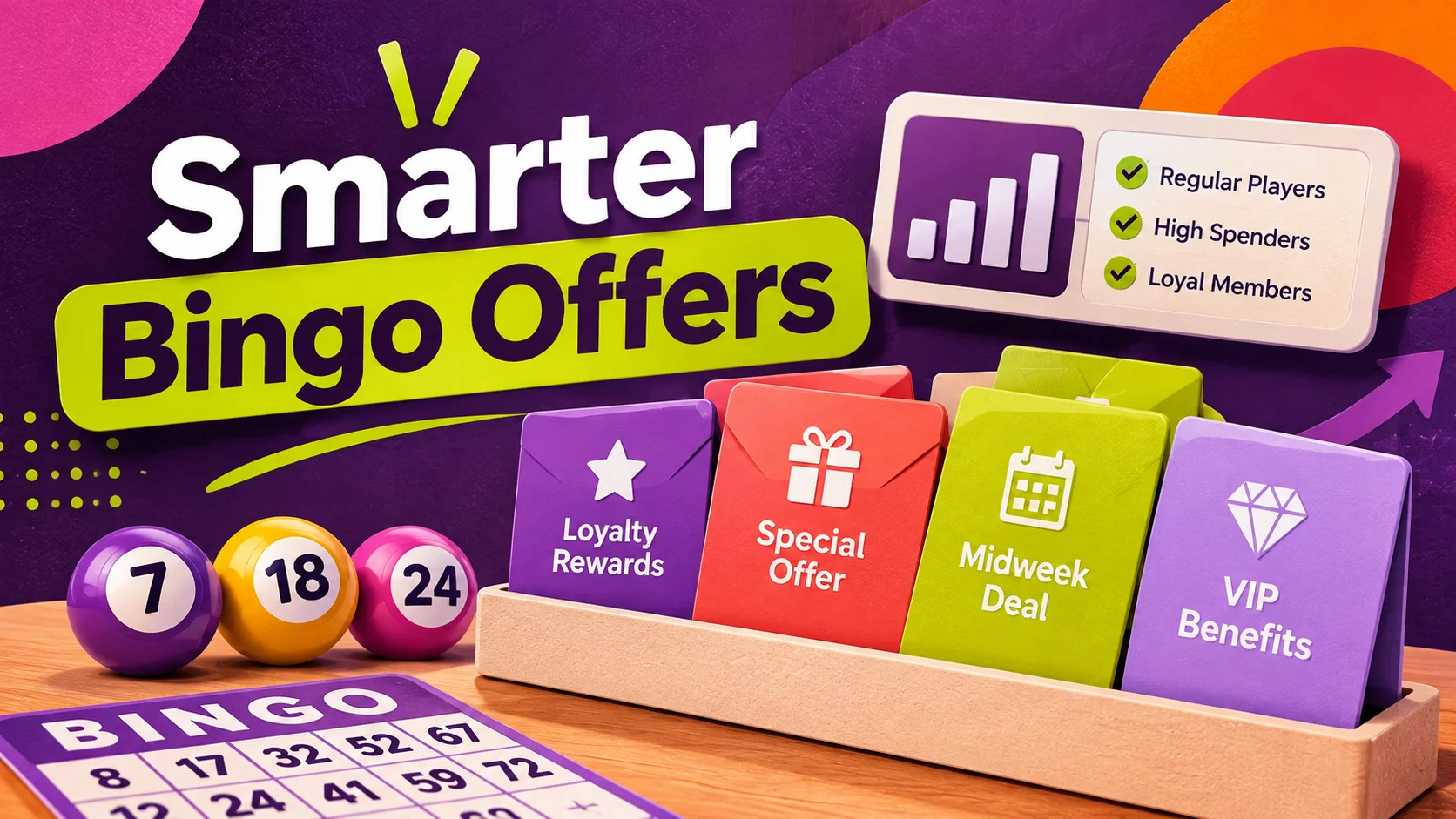
A regular visitor may respond better to an experience that recognises continued participation. An occasional player may need a timely invitation that gives them a reason to return. Sending the same incentive to both audiences could mean overlooking what makes each relationship different.
This is where player activity and spend history can help operators make more informed campaign decisions.
Rather than choosing an offer because it worked last month or sounds attractive, a hall can review information on attendance, recorded spending, loyalty activity, and previous campaign results. That information provides a stronger basis for deciding what to test.
The objective is not to encourage players to spend more or rank people by how much they contribute. It is to understand engagement patterns, design appropriate offers, and find out which campaigns support sustainable attendance.
The Problem With Designing Offers From Assumptions
Many promotional decisions begin with a familiar discussion:
- Should we offer bonus loyalty points?
- Would a complimentary game book attract more visitors?
- Should we run a special midweek promotion?
- Would a discount encourage occasional players to return?
- Should regular visitors receive something different from new members?
These are reasonable questions. The problem starts when the answers are based entirely on instinct.
A promotion might generate a large number of redemptions but produce little additional attendance. Another might attract fewer responses while encouraging players to attend a session they would otherwise have missed.
Without reviewing the available data, both campaigns can appear successful for different reasons.
A more useful approach begins with three questions:
- Who is the offer intended to serve? Define the player group and the reason for selecting it.
- What behaviour or experience is the offer intended to support? For example, repeat attendance, loyalty participation, or interest in a particular session.
- How will the hall judge the result? Decide whether success means additional visits, reward participation, offer redemption, or another measurable outcome.
Spend history can contribute to the analysis, but it should be considered alongside attendance and engagement. One financial figure cannot explain the entire relationship between a player and a bingo hall.
Start by Understanding What the Data Actually Shows
Before creating a campaign, establish what information is available and what it represents.
JustKonnect's Spend History Tracking is positioned around how players engage with games, offers, and loyalty. Its feature description focuses on attendance patterns, campaign outcomes, rewards activity, and reporting designed for bingo hall operations rather than conventional retail transactions.
That distinction matters.
A retail business might build an offer around a customer's purchase history. A bingo hall needs to understand participation in the context of sessions, visits, loyalty, and the activities available at the venue.
Depending on the information collected by the hall and the platform's supported reporting, operators can examine several useful indicators.
Attendance frequency
How often does the player visit during a defined period?
Attendance frequency helps distinguish regular visitors from occasional attendees. It can also reveal whether a player's activity has changed.
A player who attends every week may need different communication than someone who hasn't visited recently.
Recorded spend patterns
What does the available spend information show over time?
Reviewing recorded spend can help identify differences in participation and changes across comparable periods. However, the data should be interpreted according to what the hall actually records.
It should not be treated as a complete measure of loyalty, satisfaction, or financial circumstances.
Loyalty participation
Does the player earn or redeem loyalty rewards?
A player who actively participates in a loyalty programme may respond to a relevant points-based incentive differently from someone who has not engaged with rewards before.
The hall can use this information to decide whether a loyalty-related offer is appropriate.
Previous offer activity
Which promotions has the player received, and what happened afterward?
Where campaign and redemption records are available, operators can review whether an offer was delivered, whether it was redeemed, and whether attendance changed during the relevant period.
This helps prevent the team from repeatedly testing the same idea without learning from earlier results.
Four Player Activity Patterns That Can Shape Offer Decisions
A useful campaign does not require a complicated scoring model. Start by identifying meaningful differences in player activity.
The following examples are illustrative segments, not fixed categories or automatic player classifications.
1. Consistent attendees
These players attend regularly and have an established relationship with the hall.
The campaign question is not simply how to get them through the door again. It is how to recognise their continued participation without making every visit dependent on a promotion.
Possible approaches include:
- A loyalty milestone recognition message.
- An invitation to a relevant special event.
- A reward linked to an existing loyalty programme.
- Information about upcoming sessions they may be interested in.
The hall should avoid offering unnecessary incentives to people who would have attended anyway. Recognition and useful information may be more appropriate than repeatedly discounting the experience.
2. Occasional visitors
These players attend less frequently, but their records show some previous engagement.
The operator might investigate whether certain sessions, events, or communications coincide with their visits.
A suitable test could involve a clear invitation to an upcoming session or a limited, appropriate introductory offer.
The important question is whether the campaign gives the player a relevant reason to attend—not whether a larger incentive can produce a larger response.
3. Players whose attendance has declined
A previously regular player may have started attending less frequently.
This is a signal worth reviewing, not proof that the player has lost interest.
Before sending an offer, consider the available attendance history, previous campaign interactions, and any recorded preferences. A friendly update about upcoming sessions may be more appropriate than an aggressive discount.
If the hall chooses to test an incentive, compare the outcome with the player's previous attendance pattern and the results from a suitable comparison group where practical.
4. New or recently registered players
New players may not have enough history for meaningful spend comparisons.
That does not mean they should be ignored. Their first few interactions can help the hall understand whether they are becoming familiar with the venue and its programmes.
A welcome message, explanation of the loyalty programme, or invitation to a suitable upcoming session may be a more sensible starting point than assigning a value category based on limited data.
As more reliable activity becomes available, the hall can refine its approach.
Match the Offer to the Objective, Not Just the Player Segment
Once the hall understands the audience, it needs to choose the right type of offer.
The same segment may respond differently depending on the campaign objective. A reward designed to recognise regular attendance is not necessarily suitable for encouraging a first return visit.
Use the following framework to connect the objective with a possible offer.
| Campaign objective | Possible offer or message | What to measure |
| Recognise regular attendance | Loyalty milestone recognition or an appropriate reward | Repeat visits and reward participation |
| Encourage an occasional player to return | Invitation to a relevant upcoming session | Attendance during the campaign period |
| Introduce new players to the hall | Welcome message explaining sessions and loyalty benefits | First return visit and programme participation |
| Improve loyalty programme engagement | Reminder about available points or rewards | Reward engagement and redemption |
| Promote a particular event | Event announcement to an appropriate audience | Event attendance and campaign response |
| Test interest in a quieter session | Relevant session information or a carefully defined incentive | Incremental attendance for that session |
The offer should be proportionate to the objective.
For example, a player who already attends every Saturday may not need a discount to attend the same session next week. A reminder about a special event could be enough.
Likewise, an occasional visitor should not automatically receive a more valuable reward simply because the hall wants to attract them back.
The decision should be based on the purpose of the campaign, the available evidence, and responsible promotional practices.
A Worked Example: Why One Offer Should Not Go to Everyone
Imagine a fictional bingo hall is preparing a four-week attendance campaign.
The operator has three broad audience groups:
- Regular attendees.
- Occasional visitors.
- Previously active players whose visits have declined.
The marketing team initially proposes a single promotional offer for the entire database.
Before launching it, the manager reviews the available attendance, recorded spend, loyalty, and campaign information.
The review suggests three different approaches.
Group A: Regular attendees
The hall decides to test a recognition-focused message about an upcoming special session and an existing loyalty benefit.
The purpose is to maintain engagement without unnecessarily discounting visits that are already likely to happen.
Group B: Occasional visitors
The team tests a relevant session invitation with a clearly defined offer for eligible players.
The purpose is to find out whether the additional incentive makes a difference to attendance.
Group C: Previously active players
The hall uses a friendly re-engagement message and tests a suitable return incentive with a limited audience.
The purpose is to investigate whether the campaign encourages some players to attend again.
The campaign is not automatically successful just because each group receives a different message. The operator must review what happens afterward.
For example:
| Audience | Campaign approach | Main evaluation question |
| Regular attendees | Recognition and event information | Did engagement remain consistent without unnecessary incentives? |
| Occasional visitors | Session invitation with a defined offer | Did the offer encourage additional visits? |
| Previously active players | Re-engagement message and return incentive test | Did more recipients return than comparable non-recipients? |
The example demonstrates why audience context matters. It does not establish that one offer will always outperform another.
How to Test an Offer Before Rolling It Out to the Whole Database
A campaign should be treated as a testable decision rather than a one-time guess.
If every eligible player receives a new promotion immediately, it may be difficult to determine whether the offer caused any change.
A controlled test can provide a clearer picture.
Step 1: Define the campaign hypothesis
Write down what you expect the offer to achieve.
For example:
"We believe a relevant midweek session invitation with a limited loyalty incentive may encourage more occasional visitors to attend."
This is specific enough to evaluate.
Step 2: Select an appropriate audience
Use reliable player information to identify the intended group.
The selection might involve attendance frequency, last visit, loyalty participation, or another relevant indicator. Include only players who are eligible and have the appropriate communication permissions.
Avoid using incomplete spend data to make unsupported assumptions about individuals.
Step 3: Create a comparison group where practical
If the audience size and campaign design allow it, keep a comparable group that does not receive the new offer during the test period.
Compare the attendance outcomes between the two groups.
This is more informative than simply counting how many recipients redeemed the promotion.
Step 4: Define the measurement period
Decide how long the campaign will run and which attendance window will count toward the result.
A short event campaign may need a different measurement period from a longer-term loyalty initiative.
Use the same measurement rules when comparing the groups.
Step 5: Review the outcome
Look beyond message delivery.
Examine attendance, redemption, campaign engagement, and any relevant recorded spend information. Consider the cost of the reward and whether the additional attendance justifies the campaign.
Step 6: Decide what happens next
The result should lead to a decision:
- Continue the offer if the evidence supports it.
- Change the audience if the response is inconsistent.
- Adjust the incentive if the cost outweighs the benefit.
- Stop the campaign if it does not achieve its objective.
A test that produces a disappointing result is still useful if the hall learns something reliable from it.
Measure Incremental Attendance, Not Just Offer Redemptions
One of the easiest ways to overestimate a campaign's success is to focus on redemption numbers alone.
Suppose 40 players redeem an offer. That sounds encouraging, but how many would have attended without it?
If many recipients were already regular visitors, the promotion may have rewarded existing behaviour rather than generated additional visits.
This is why incremental attendance is an important measure.
Consider a simplified illustrative example:
Illustrative Campaign Test
- Offer Group: 30% attendance rate
- Comparison Group: 20% attendance rate
Difference in Attendance Rates:
30% − 20% = 10 percentage points increase.
The offer group attended at a higher rate in this example. That is a promising result, but it does not automatically establish causation unless the test design supports that conclusion.
Operators should also consider:
- How many additional visits occurred?
- What did the offer cost?
- Were the additional visits concentrated in the intended session?
- Did the promotion affect attendance in other sessions?
- Did players return after the offer period ended?
A campaign that produces redemptions but no meaningful additional attendance may need a different design.
Use Spend History as Context, Not a Ranking System
There is an important distinction between understanding recorded activity and deciding that players should be treated according to how much they spend.
Spend history can help operators review differences in participation. It should not become the sole basis for deciding who receives attention, recognition, or better service.
A player who spends less may still be a consistent attendee and an important part of the hall community. Another player may show a higher recorded amount during one period without having a stronger long-term relationship with the venue.
For this reason, campaign planning should consider multiple dimensions:
Attendance: How consistently does the player visit?
Recorded spend: What does the available information show, and is it complete enough to compare?
Loyalty engagement: Does the player participate in the hall's reward programme?
Campaign response: How have previous communications and offers performed?
Player experience: Is the proposed offer appropriate, clear, and respectful?
This broader view prevents a single metric from dominating decisions that should account for the entire player relationship.
It also avoids a harmful approach: targeting people with increasingly valuable promotions because their recorded spending is high or attempting to encourage someone to spend more after a decline.
Offers should support appropriate participation and a positive hall experience, not pressure players to increase their spending.
Connect Spend History With the Rest of Your CRM
Spend information becomes more useful when operators can interpret it alongside other reliable records.
For example, JustKonnect Player Profiles CRM brings together player contact information, visit history, and loyalty status. This gives operators additional context when reviewing recorded activity.
The platform's Analytics feature covers campaign performance, visit-frequency trends, last-visit trends, offer redemptions, and engagement measures. These reports can help operators assess whether a campaign is associated with changes in attendance or loyalty participation.
The Customer Segmentation capability can also help organise eligible player groups for more relevant communication.
Together, these capabilities support a more connected campaign process:
- Review the available player and spend information.
- Identify an audience based on a defined operational objective.
- Choose an appropriate message or reward.
- Launch the campaign to eligible players.
- Review attendance, engagement, and redemption results.
- Refine the next campaign based on what the evidence supports.
Confirm the specific spend data, reporting, and campaign rules available in your platform configuration before building a workflow around them.
A Simple Offer Review That Operators Can Repeat
A hall does not need a complex analytical department to become more disciplined about promotions.
A short review before and after each campaign can prevent repeated mistakes.
| Before the campaign | After the campaign |
| Define the objective | Check whether the objective was achieved |
| Select the eligible audience | Review actual recipients and participation |
| Review relevant attendance and spend patterns | Compare attendance during the measurement period |
| Choose the message and offer | Review delivery, response, and redemptions |
| Establish the reward cost | Assess the cost against the result |
| Decide how success will be measured | Record what should change next time |
The most important part is consistency.
If one campaign is judged by redemptions, another by attendance, and a third by message clicks, the results will be difficult to compare. Establish a small set of relevant measures and use them consistently.
Over time, the hall can build a clearer picture of which offers are worth repeating, which audiences need a different approach, and which promotions create activity without delivering meaningful results.
Responsible Offer Design Matters
Player data should improve the relevance of communication, not become a tool for applying pressure.
Operators should collect and use spend-related information for legitimate purposes, maintain accurate records, restrict access appropriately, and follow applicable privacy and gaming requirements.
Campaigns should also respect communication consent and player preferences.
Avoid using high recorded spend as a reason to send more aggressive incentives. Do not treat reduced spending as evidence that someone needs a stronger offer. A change in recorded activity may have many explanations, and the hall should not make assumptions about a player's personal circumstances.
Where appropriate, offers should have clear conditions, reasonable limits, and transparent expiry dates.
A responsible campaign recognises that players should be able to enjoy the hall without feeling that they are being pushed to spend more.
Frequently Asked Questions
How can spend history help a bingo hall design better offers?
Spend history can add context to attendance and loyalty information, helping operators investigate differences in player activity and evaluate previous promotions. It can inform campaign planning, but it should not be used alone to decide which players receive offers.
Should bingo halls give higher-value offers to players who spend more?
Not automatically. Recorded spend is only one measure of activity and does not establish loyalty, satisfaction, or future attendance. Offers should be based on a clear campaign objective, appropriate eligibility, and responsible engagement practices.
What is the difference between attendance data and spend history?
Attendance data shows when and how often players visit. Spend history provides information about recorded financial participation, depending on what the hall collects. Reviewing both can provide more context than relying on either measure alone.
How do I know whether a promotional offer actually increased attendance?
Compare attendance among recipients with a suitable comparison group where practical. Use consistent measurement periods and consider other factors that may influence visits. Redemptions and message clicks are useful indicators, but they do not prove that the offer generated additional attendance.
What types of offers can bingo halls test?
Depending on the hall's programmes and applicable rules, operators might test event invitations, loyalty recognition, eligible reward offers, or session-specific promotions. Each campaign should have a defined audience, clear conditions, and a measurable objective.
How often should spend history be reviewed?
A monthly review is a reasonable starting point for many halls. Operators running frequent campaigns may review results more often, provided the data is reliable, and the analysis leads to a practical decision.
Is spend history enough to calculate player lifetime value?
No. Lifetime value requires a broader view of the player relationship over time. Attendance, repeat participation, loyalty activity, and reliable financial information may all contribute. A single spending figure should not be treated as a complete lifetime-value calculation.
Stop Repeating Offers Without Knowing Why They Work
A promotion can look successful because players redeemed it, because the message received a strong response, or because the hall was already expecting a busy session. Those outcomes are not necessarily the same thing.
Spend history adds useful context, but the strongest campaign decisions come from reviewing it alongside attendance, loyalty participation, and actual campaign results.
When operators understand the audience, define the objective, test an appropriate offer, and measure the outcome consistently, they can move away from repeated guesswork.
Explore JustKonnect Spend History Tracking to see how bingo-focused activity tracking, campaign outcomes, attendance patterns, and rewards reporting can help your hall make more informed engagement decisions.