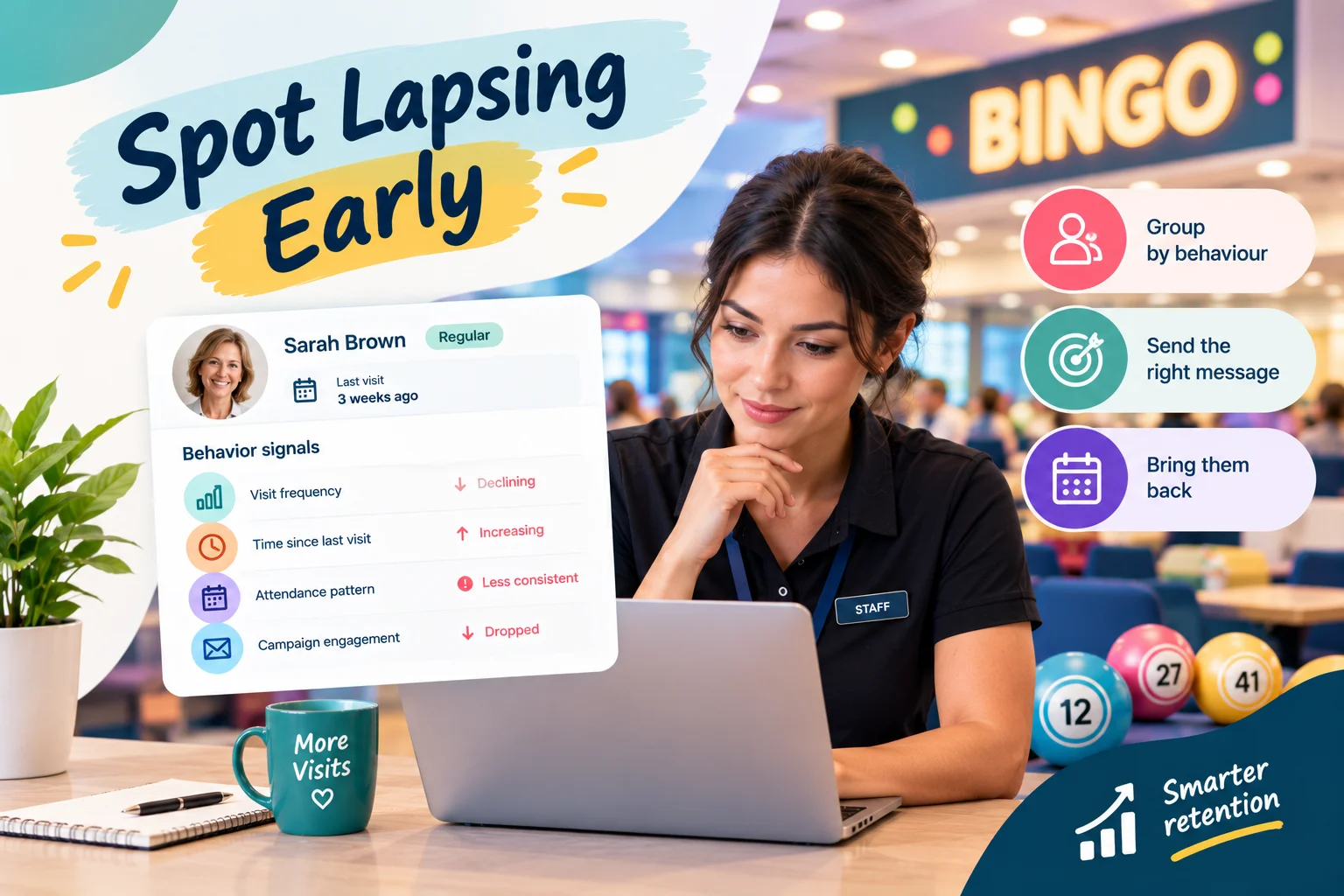
A regular player used to attend every Thursday. Over the past month, they have visited only once. They have stopped responding to session reminders, and their usual pattern of attendance has become less consistent.
Nothing in the player database says they have left for good. But something has changed.
For a bingo hall operator, this is the point worth paying attention to. Waiting until the player has been absent for several months means the opportunity to understand the change may already have passed.
The challenge is that a single missed session rarely tells the whole story. Players have work commitments, family responsibilities, changing budgets, and other reasons for adjusting their routines. A hall cannot reliably predict someone's intentions from one missed visit.
Player behavior analytics helps operators identify meaningful changes in attendance and engagement, assess which players may need attention, and decide when a retention action is appropriate.
Rather than treating every inactive member the same way, a hall can use historical patterns and recent activity to recognize potential warning signs earlier. The aim is not to predict every departure perfectly. It is to give staff a better opportunity to respond before a temporary change becomes a lasting loss of engagement.
The Difference Between a Player Who Misses a Session and One Who Is Drifting Away
Consider two players who have not visited your hall for three weeks.
Player A normally attends once a month. Their absence is consistent with their usual routine.
Player B normally attends three times a week. Their visits have gradually fallen from twelve per month to five, then two, and now none.
Both players have been absent for the same period, but the context is very different.
A fixed inactivity rule might flag both players as needing attention. A behavior-based approach asks a more useful question: How does each player's recent activity compare with their normal pattern?
This distinction matters because bingo attendance is often routine-driven. A player's established session preferences and visit frequency can provide useful context for identifying changes.
An operator who understands those patterns can make more informed decisions about follow-up instead of sending the same win-back offer to everyone who has missed a visit.
The goal is to recognize a change in behavior, not to assume the reason behind it.
Five Signals That May Indicate a Player Is at Risk of Lapsing
No single metric can reliably tell a bingo hall that someone is about to stop attending. Several signals, considered together and in context, can provide a more useful picture.
1. Visit frequency is declining
A gradual reduction in attendance can be an early sign that a player's relationship with the hall is changing.
For example, someone who typically attends four sessions a month may begin visiting twice a month, followed by one visit. If the reduction continues, the player may warrant attention.
However, the comparison needs to account for the player's normal routine. A person who attends only for special events should not be judged against the pattern of a frequent attendee.
Operators can monitor:
- Visits per week or month.
- Changes in attendance compared with the player's previous baseline.
- Consecutive periods with fewer visits than expected.
- Differences between usual attendance and recent attendance.
A decline does not prove that a player will leave. It creates a reason to investigate whether a timely, relevant communication might help maintain the relationship.
2. The time since the last visit is increasing
Recency is useful because it shows how long a player has been away. Its meaning, however, depends on how often that player normally attends.
A seven-day absence may be unusual for a twice-weekly regular but entirely normal for someone who visits once every few weeks.
This is why last-visit tracking becomes more valuable when considered alongside attendance frequency.
For example, a hall might establish different review rules for weekly players and occasional visitors. Those rules should reflect the venue's actual attendance patterns rather than an arbitrary universal deadline.
A growing gap between visits can then trigger a review before the player reaches the hall's definition of a lapsed member.
3. Attendance becomes less consistent
Some players maintain a recognizable routine. They tend to attend particular days, sessions, or types of events.
When that routine changes, the hall may have an opportunity to notice the shift.
Imagine a player who has attended nearly every Friday session for several months. They begin missing alternate Fridays and then stop attending altogether.
The first missed session might mean very little. A repeated pattern of missed sessions is more informative.
Consistency analysis can help operators distinguish between an isolated absence and a sustained change. It can also highlight players whose attendance is becoming less predictable, even when they have not yet crossed a formal inactivity threshold.
The interpretation still needs care. A changed routine may reflect a new work schedule, a seasonal commitment, or another factor unrelated to dissatisfaction with the hall.
4. Engagement with campaigns is changing
Attendance is not the only available signal. Campaign engagement can provide additional context when reliable tracking is available.
For instance, a player who previously clicked through event emails or responded to permitted text-message campaigns may stop interacting with those communications.
A reduction in engagement could indicate declining interest, but it can also result from changing contact details, message fatigue, channel preferences, or technical issues.
Operators should therefore examine engagement alongside visit history rather than treating a lack of clicks or replies as proof of churn.
It is also important to distinguish between a message being delivered, a player interacting with it, and that player actually attending a session. These are different outcomes.
5. Loyalty participation is weakening
Where a hall operates a loyalty programme, changes in participation may offer another useful signal.
A player who regularly participates in the programme may become less active, stop redeeming eligible rewards, or show a decline in related engagement.
This information can help complete the picture, particularly when combined with attendance trends.
However, reward redemption is not a universal measure of loyalty. Some players attend consistently without using rewards, while others redeem an offer during a period of otherwise low activity.
The question is not whether every player uses the loyalty programme. It is whether their behavior has changed in a way that deserves further review.
Why Combining Signals Is More Useful Than Watching One Metric
Each signal has limitations on its own. A player might miss several visits without losing interest, ignore messages while continuing to attend, or stop redeeming rewards while maintaining their usual routine.
The value of behavior analytics comes from examining the relationship between these signals.
Consider this illustrative example:
| Observed pattern | What it may indicate | Sensible next step |
| One missed session, normal attendance otherwise | Possible routine variation | Continue monitoring |
| Fewer visits over several weeks | Potential decline in engagement | Review attendance history |
| Longer gaps between visits and declining campaign engagement | Multiple warning signs | Consider relevant, permitted outreach |
| Extended inactivity after previously frequent attendance | Possible lapse | Assess re-engagement options |
| Attendance remains stable despite fewer campaign interactions | Channel engagement may have changed | Avoid assuming the player is lapsing |
These are examples of operational interpretation, not a validated predictive model or universal risk classification.
A behavior analytics system may eventually use multiple variables to estimate churn risk more systematically. Until a model has been built, tested, and validated against actual outcomes, operators should avoid treating informal rules as precise predictions.
From Warning Sign to Action: What Should the Hall Do Next?
Identifying a potentially at-risk player is only useful if the hall has a sensible response.
Sending a discount immediately to everyone whose attendance declines may be expensive, unnecessary, and ineffective. A better process gives operators time to check the signal and choose an appropriate action.
Step 1: Confirm that the change is real
Before contacting a player, review the available records.
Was the player's last visit recorded correctly? Have their usual sessions changed? Is the apparent decline based on a meaningful period of activity, or could it be a temporary variation?
Data quality matters. An inaccurate attendance record can create a false warning, while incomplete records can hide a genuine decline.
Where the available data is insufficient, classify the player for further review rather than assuming the risk is established.
Step 2: Consider the player's usual routine
Interpret the change against the individual's history.
A player who normally visits twice a month may not need attention after a two-week absence. A player who usually attends several times a week may warrant a closer look after a similar gap.
The hall should also account for its own calendar. Seasonal closures, changes to session schedules, and unusual event patterns can affect attendance across the entire database.
Comparing an individual with their normal routine helps prevent the hall from confusing a general attendance dip with a player-specific problem.
Step 3: Choose a proportionate response
Not every warning sign calls for an incentive.
For someone whose attendance has recently become less consistent, a simple update about upcoming sessions may be appropriate. A previously active player who has been absent for longer might warrant a more personal invitation or an eligible re-engagement offer.
Possible responses include:
- Sharing accurate information about upcoming sessions.
- Sending a relevant event reminder through an appropriate, permitted channel.
- Inviting the player to review current loyalty benefits.
- Offering an eligible incentive when justified by the campaign objective.
- Asking staff to review the case where a personal follow-up is appropriate.
The message should not imply that the hall knows why the player has been absent. Keep it welcoming, relevant, and easy to act on.
Step 4: Set limits on repeated outreach
An early-warning system should not become an excuse to contact players continuously.
Establish campaign frequency limits and rules for suppressing unnecessary messages. Respect opt-outs and applicable consent requirements. Where a player has already received a recent promotion, consider whether another message adds anything useful.
If a player does not respond, repeated outreach may not be the right next step.
Step 5: Check whether the player returns
A message being sent is not the same as a player being retained.
After the campaign, review whether the player returned during the defined measurement period and whether their attendance pattern changed. Where possible, compare results with a suitable group that did not receive the intervention.
This helps the hall learn which responses appear useful, which audiences respond, and where further investigation is needed.
A Practical Example: Spotting a Change Before a Regular Becomes Lapsed
Imagine a fictional bingo hall that has a member who normally attends Tuesday and Friday sessions.
During the first month, the player attends both sessions most weeks. In the following month, they miss several Fridays. By the third month, they have attended only one session and have not interacted with recent event messages.
A basic contact list might continue treating this person as an ordinary member until the hall's fixed inactivity deadline is reached.
A behavior-led process could highlight the earlier change in attendance, prompt a review of the player's history, and place them in an appropriate follow-up group.
The operator might then send a concise message about an upcoming session, provided the player is eligible to receive it. If the player returns, the hall can track whether attendance resumes. If they do not, the operator can avoid assuming that more frequent messages or a larger offer will necessarily solve the problem.
This example is illustrative, not a documented customer result. Its purpose is to show how early signals can support a decision before inactivity becomes prolonged.
The benefit is not certainty about the player's intentions. It is an earlier opportunity to make an informed, proportionate decision.
How to Measure Whether Your Early-Warning Process Works
A churn warning is useful only if it helps the hall make better retention decisions. Operators need a consistent way to evaluate the process rather than judging it by the number of alerts generated.
Start with a few measurable questions.
Are potential lapses being identified earlier?
Measure how much time passes between the first qualifying warning sign and the player's eventual inactivity classification, where relevant data is available.
This can help determine whether the rules provide useful lead time or flag players only after they have effectively lapsed.
How many flagged players return?
Track the percentage of flagged players who attend again within a defined period.
Break the results down by the type of warning, the response used, and the player's previous attendance pattern. This may reveal that different groups need different approaches.
Which interventions are worth repeating?
Compare re-engagement messages, event reminders, staff follow-ups, and eligible incentives according to their intended outcomes.
Account for differences between audiences and campaigns. A message sent to highly engaged regulars is not directly comparable with an offer sent to people who have been absent for months.
Where feasible, use a comparison group to assess whether the intervention contributed to the observed change.
Are false alarms creating unnecessary work?
A useful early-warning process should not overwhelm staff with players who are behaving normally.
Review how often flagged players continue their usual attendance without intervention. This can help operators adjust thresholds and improve the relevance of alerts.
Is retention improving over time?
Monitor broader indicators such as repeat attendance, return visits, campaign outcomes, and changes in visit frequency.
Interpret them in context. Changes in seasonality, session schedules, competition, and overall attendance can affect retention metrics even when a campaign remains unchanged.
What Bingo Hall Operators Should Know Before Relying on Predictive Analytics
Predictive analytics can help prioritise attention, but it is not a substitute for reliable records or operator judgment.
A risk score is an estimate, not a statement of fact about a player. Its usefulness depends on the quality of the underlying data, the design of the model, and how accurately it performs when tested against real outcomes.
Before relying on a predictive system, operators should consider the following:
Data completeness: Missing visits or inaccurate contact records can distort the patterns being analysed.
Appropriate timeframes: Risk thresholds should reflect actual player behavior and the hall's operating calendar.
Model validation: Predictions should be tested against later outcomes, including how often flagged players genuinely lapse and how often lapses go undetected.
Privacy and responsible use: Collect and use player information for legitimate purposes, with appropriate access controls, transparency, and compliance with applicable data-protection and marketing requirements.
Human review: Automated flags should support decisions rather than dictate them. Staff need a way to question inaccurate alerts and avoid inappropriate contact.
These safeguards are especially important when a hall moves from simple attendance reporting to automated risk scoring and recommended interventions.
How JustKonnect Fits Into a Behavior-Led Retention Strategy
JustKonnect's Customer Behavior Analytics page describes a planned capability focused on understanding visit patterns, spend behavior, churn risk, and player lifetime value. The page is currently marked Coming Soon, so operators should confirm availability before relying on predictive analytics functionality.
The planned feature is intended to help bingo halls identify patterns that may indicate churn risk, understand differences between player groups, and make more informed retention and campaign decisions. These are intended capabilities, not a guarantee that a particular player's departure can be predicted accurately.
In the meantime, operators can build the foundations of a behavior-led process using available attendance and campaign reporting.
JustKonnect's Player Profiles & CRM brings visit history, contact details, and loyalty status together. Its Analytics feature provides visibility into measures such as visit-frequency trends, last-visit trends, campaign performance, reward redemptions, and list engagement.
Together, reliable player records and consistent reporting can help a hall identify changes worth investigating, organise appropriate follow-up, and evaluate the outcome. More advanced prediction can build on that foundation when the relevant capability is available and validated.
The practical starting point is straightforward: keep attendance records accurate, define sensible review rules, and connect each warning sign to a clear operational response.
Frequently Asked Questions
What is player behavior analytics in a bingo hall?
Player behavior analytics examines patterns in player activity, such as visit frequency, time since the last visit, campaign engagement, and loyalty participation. These patterns can help operators understand changes in attendance and make better-informed retention decisions.
Can analytics predict exactly which bingo players will stop attending?
No system can guarantee that every departure will be predicted correctly. Analytics can identify patterns associated with an increased risk of lapsing, but predictions depend on data quality, model performance, and changing circumstances. Results should be validated against actual attendance outcomes.
What is the difference between churn prediction and lapsed-player tracking?
Lapsed-player tracking generally identifies people who have already crossed a defined inactivity threshold. Churn prediction aims to identify players who may be at risk before they meet that threshold, giving operators more time to consider an appropriate response.
Which metrics help identify a player who may be lapsing?
Useful indicators include declining visit frequency, longer gaps between visits, reduced attendance consistency, and changes in campaign or loyalty engagement. These signals are most useful when interpreted together and compared with the player's usual behavior.
Should every player flagged as at risk receive a discount?
No. A relevant session reminder, event invitation, or staff review may be more appropriate. Incentives should be used selectively, with clear eligibility rules, and evaluated against actual outcomes rather than assumed to prevent churn.
How can a bingo hall measure churn-prevention results?
Track return visits, attendance frequency after outreach, campaign outcomes, and the proportion of flagged players who subsequently become inactive. Where feasible, compare results with a suitable group that did not receive the intervention to better understand its contribution.
Is JustKonnect Customer Behavior Analytics available now?
The JustKonnect feature page currently labels Customer Behavior Analytics as Coming Soon. Its planned capabilities include insights into visit patterns, churn risk, spend behavior, and player lifetime value. Contact JustKonnect to confirm current availability and access options.
Act on the Pattern Before It Becomes a Problem
A player who misses one session may return next week as usual. A player whose attendance has steadily declined over several weeks may need a different kind of attention.
The challenge for bingo halls is recognising the difference early enough to make a sensible decision.
By monitoring attendance patterns, combining relevant signals, checking the underlying records, and measuring the results of follow-up campaigns, operators can build a more disciplined approach to retention. Predictive analytics may strengthen that process, but it works best when supported by accurate data and thoughtful human judgment.
Explore JustKonnect Customer Behavior Analytics to learn about its planned approach to player behavior insights and churn-risk analysis. You can also review the platform's analytics capabilities to understand how attendance and campaign reporting can support more informed retention decisions today.