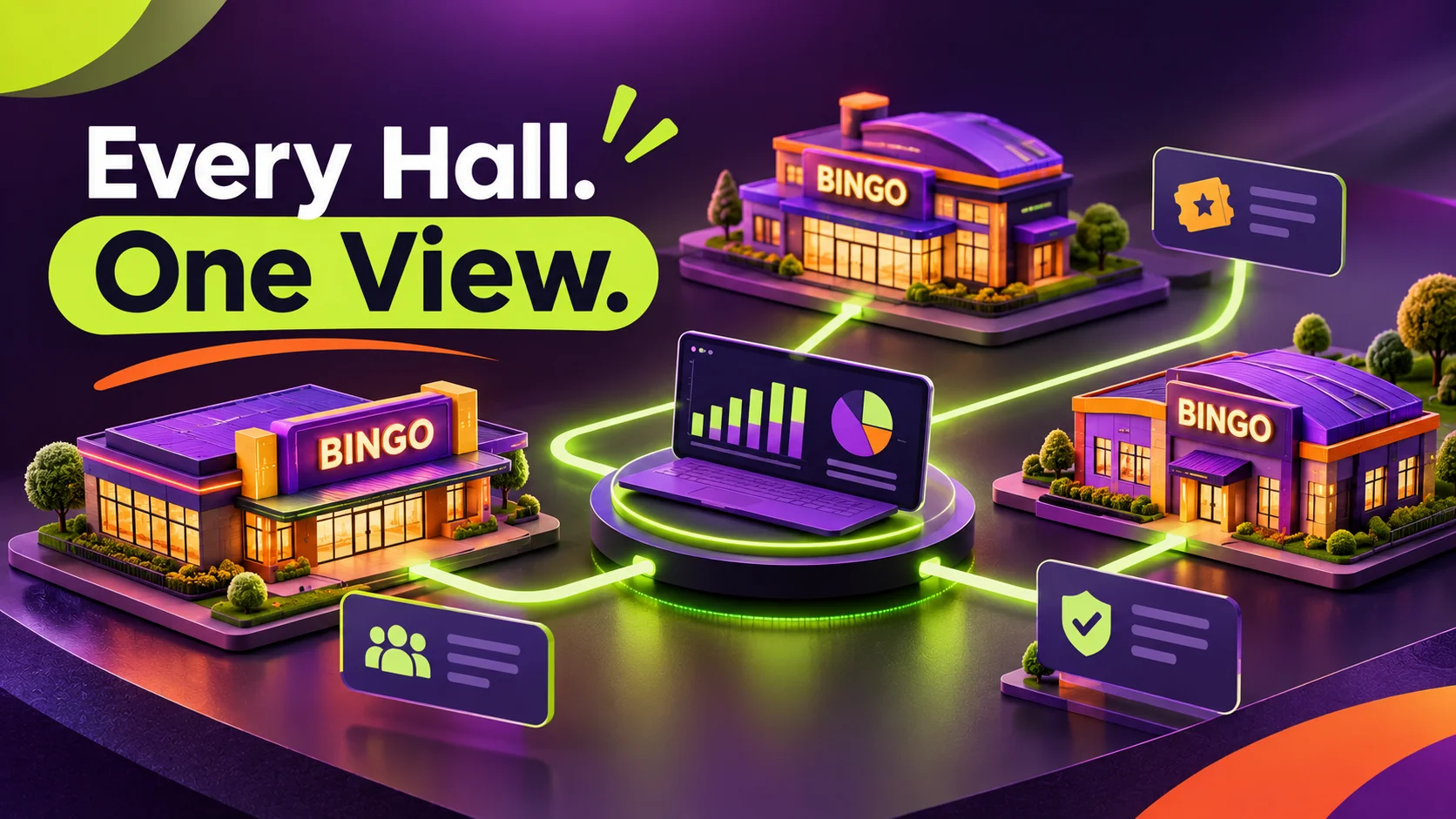
Opening a second bingo hall is a sign of growth. It can expand your reach, introduce your organisation to new communities, and create more opportunities to support charitable causes.
But growth also changes the way you need to manage the business.
With one venue, the operator can often keep a close eye on attendance, player relationships, promotions and daily activity. When a second or third location enters the picture, those responsibilities become harder to coordinate. Each hall has its own schedule, staff, regular players and local operating conditions. At the same time, management still needs a clear view of the organisation as a whole.
The challenge is no longer simply running several successful halls. It is making sure they work together without losing what makes each location effective.
That is where multi-location bingo software becomes important. It gives operators a more structured way to manage separate venues while maintaining shared visibility, consistent processes and a connected player experience.
The Second Hall Changes More Than Your Workload
It is tempting to think that managing two halls means repeating the same process twice. In practice, the difficulty comes from the connections between those locations.
Consider a charity bingo organisation with two venues:
- Hall A has a strong weekday audience and a well-established group of regular players.
- Hall B attracts more weekend visitors and runs different promotional events.
- Both locations share the same management team, but their day-to-day operations are handled by different staff.
Each hall needs enough independence to respond to its audience. However, management also needs to understand how both venues contribute to the organisation's overall performance.
Without a connected system, information can become fragmented.
One manager may maintain a spreadsheet of player contacts, another may record attendance separately, and promotional activity may be managed through individual messaging accounts. When leadership asks for a combined performance report, someone has to collect the information, check that the figures are consistent and bring everything together.
This approach may feel manageable initially. As the number of locations increases, however, the amount of coordination required can grow quickly.
The real issue is not the number of buildings. It is the absence of a shared operating picture.
The Balance Every Multi-Location Operator Needs
A successful multi-location setup should not force every hall to operate identically. It should establish common standards while allowing each venue to respond to its own audience.
That distinction matters.
A central management team may want consistent player records, reporting methods and communication standards. Individual hall managers may need flexibility over local events, session reminders and promotions.
Good multi-location software should support both levels of decision-making.
1. Central oversight without constant switching
When each venue operates through a separate system, managers can spend unnecessary time switching between accounts, checking different records and requesting updates from staff.
A central dashboard makes it easier to review multiple locations from one operator account. Managers can move between individual hall views and a broader organisational view without treating each venue as a completely separate operation.
This is particularly useful when management needs to answer questions such as:
- Which location is seeing stronger player engagement?
- Are campaigns being managed consistently?
- Which hall needs additional attention?
- How is the organisation performing across all its venues?
The aim is not to remove local management responsibility. It is to make the information needed for better decisions easier to access.
2. One player relationship across different halls
A player may attend Hall A on Tuesday and Hall B on Saturday. From the player's perspective, they are visiting the same organisation. From the operator's perspective, that activity should not become disconnected simply because it happened at another address.
Separate databases can make the same person appear as two unrelated records. This creates problems when staff try to understand visit history, communication preferences or loyalty participation.
Cross-location player tracking helps provide a more connected view of player activity.
For example, if a regular visitor starts attending a different venue because its session schedule suits them better, management can understand that their activity has shifted rather than automatically treating them as a lost player at the original hall.
This is an important distinction for attendance-based businesses. A change in location does not necessarily mean a decline in the player's relationship with the organisation.
A connected player record can help staff provide more informed service and give management a better understanding of how players interact with the wider group.
3. Shared standards with room for local campaigns
A promotion that works well at one hall may not produce the same response at another.
The venues may have different session times, player preferences, local events and attendance patterns. Copying every campaign across every location without considering those differences can result in irrelevant messages.
A central campaign system should make it possible to manage communication at two levels:
Organisation-wide campaigns: Use these when the message applies to every location, such as a major organisational announcement or a promotion running across the whole group.
Location-specific campaigns: Use these when an offer, event or session update is relevant to one particular hall.
This approach gives management control over the overall communication strategy without making every message identical.
It also reduces the administrative effort involved in recreating the same campaign separately for several venues.
What Happens When Reporting Is Not Connected?
Reporting is one of the first areas where fragmented systems become a management problem.
Imagine that the board asks for a quarterly overview of the organisation's performance. The report needs to show activity at each location as well as the combined position.
If every hall records information differently, the management team may have to spend time:
- Requesting reports from individual venue managers.
- Checking that reporting periods match.
- Reconciling differences between spreadsheets.
- Combining campaign and attendance information.
- Preparing a separate summary for leadership.
This is administrative work that does not directly improve the player experience or the operation of a hall.
Multi-location reporting provides a more organised alternative. Operators can review individual venue performance while also looking at consolidated organisational information.
The distinction between these two views is essential.
Location-level reporting tells you where to act
A combined figure can show that the organisation is performing well overall, but it may hide a problem at one particular venue.
For example, the organisation might have stable attendance across its locations, while one hall is experiencing a gradual decline in repeat visits.
A location-level view helps managers identify where attention is needed rather than relying entirely on organisation-wide totals.
Consolidated reporting helps leadership see the bigger picture
Leadership and board members need to understand how the organisation is performing as a whole.
Roll-up reporting brings information from different venues into a broader view. Depending on the reporting data available, this can help management review attendance activity, campaign performance, loyalty participation and other operational indicators across locations.
The most useful approach is to review both views together. Organisation-wide figures provide context, while individual hall reports explain where differences are occurring.
A Consistent Compliance Process Across Every Venue
When several halls operate under one organisation, record-keeping should not depend entirely on the habits of individual staff members.
Different recording methods can make it difficult to establish a consistent history of activity. Even when each venue maintains its own records, management may still need to combine them for internal reviews or other documentation requirements.
A multi-location system can help standardise how activity is recorded and organised.
JustKonnect supports separate compliance logs for individual locations, alongside consolidated reporting and export options. This gives operators a clearer way to review records at venue level or across the wider organisation.
However, software should be treated as part of a compliance process, not a replacement for it. Operators still need to confirm that their record-keeping practices meet the requirements that apply to their jurisdiction and charitable gaming activities.
A practical multi-location policy should establish:
- What information each hall is responsible for recording.
- Which staff members can access or manage specific records.
- How often managers review location-level activity.
- Who is responsible for organisation-wide reporting.
- How records are checked before they are used for formal reviews.
Standardisation makes the process easier to manage, but clear responsibility remains essential.
Giving Staff the Right Access at the Right Location
A multi-location organisation does not necessarily need every employee to have access to every venue's information.
A hall manager may need to review local activity and manage campaigns for their own location. A regional manager may need visibility across several venues. Senior leadership may require an organisation-wide view.
This is where staff permissions become an important part of the software decision.
Role-based access can help align responsibilities with the information and functions each person needs. It also reduces the risk of relying on shared logins or informal arrangements between teams.
Before introducing a system, operators should map out the main roles within their organisation.
For example:
| Role | Typical responsibility |
| Hall manager | Reviews and manages activity for their assigned venue |
| Regional manager | Oversees multiple locations and compares performance |
| Marketing team | Coordinates organisation-wide and location-specific campaigns |
| Senior management | Reviews consolidated performance and organisational reporting |
The exact permissions should reflect the organisation's structure. The important point is that access should be deliberate rather than identical for everyone.
The Player Experience Should Feel Connected, Not Complicated
Operational improvements matter, but players should also benefit from a multi-location setup.
A person who visits different halls within the same organisation should not have to experience completely disconnected engagement simply because they attend more than one venue.
A connected approach can support more consistent player recognition, loyalty management and communication.
For example, an organisation might run a shared loyalty programme across its venues while still promoting location-specific events. A player could receive information about an upcoming session at the hall they usually visit, while the organisation maintains a broader understanding of their engagement.
Operators can also decide whether a loyalty programme should be shared across locations or configured differently for individual venues, depending on the organisation's objectives.
The important consideration is clarity. Players should understand how rewards work, where they can be used, and whether the programme applies across all participating locations.
A connected system makes it easier for operators to manage these decisions without losing sight of the player relationship.
A Practical Example: One Organisation, Three Different Halls
Imagine an organisation operating three charity bingo venues.
Each location has a different attendance pattern:
- North Hall: Established weekday regulars and a strong community audience.
- Central Hall: A larger weekend audience and frequent special events.
- South Hall: A smaller venue focused on building repeat attendance.
With disconnected systems, each manager may report activity differently. Marketing campaigns may be duplicated, and management may struggle to understand whether a player attends more than one location.
With a multi-location platform, the organisation can approach the same situation more systematically.
At North Hall, the manager reviews local engagement and plans communication around the established weekday sessions.
At Central Hall, the marketing team promotes a special event to the relevant audience without sending the same message to every player in the organisation.
At South Hall, management reviews local attendance activity and considers whether additional engagement is needed.
Meanwhile, senior management can review consolidated reports and compare the three venues using a more consistent set of information.
This example is illustrative, but it demonstrates the difference between operating several disconnected halls and managing a connected organisation.
What to Look for When Choosing Multi-Location Bingo Software
Not every platform that supports multiple business addresses is suitable for bingo operations.
A generic multi-branch system may provide separate accounts or basic reporting, but that does not automatically address the way bingo halls manage players, attendance, loyalty and communication.
Before choosing software, evaluate it against the actual needs of your organisation.
| Capability | Why it matters |
| Centralised operator dashboard | Allows management to access multiple venues from one place |
| Individual location views | Helps managers understand the performance of each hall |
| Consolidated reporting | Provides a wider view for senior management and boards |
| Cross-location player tracking | Helps maintain a connected understanding of player activity |
| Central and local campaign management | Supports shared announcements and venue-specific promotions |
| Location-based staff permissions | Aligns access with individual responsibilities |
| Standardised compliance records | Makes activity easier to review and organise |
| Flexible loyalty management | Supports shared or location-specific reward structures |
It is also worth asking how the platform handles data migration, staff training, reporting exports and the addition of future locations.
A system should support the organisation you operate today while giving you a practical route to manage additional venues as you grow.
How JustKonnect Supports Multi-Location Bingo Operations
JustKonnect's Multi-Location feature is designed around the operational needs of bingo organisations managing more than one venue.
Rather than treating each hall as an isolated operation, the platform brings location management, player engagement and reporting into a more connected structure.
Operators can use the platform to:
- Access multiple halls through a central operator dashboard.
- Review individual location activity and consolidated organisational reporting.
- Manage campaigns across the organisation or target a particular venue.
- Maintain player visibility across participating locations.
- Organise compliance logs by location and export consolidated records.
- Manage staff access according to location-based responsibilities.
- Support shared or location-specific loyalty programmes.
These capabilities are particularly relevant to organisations that want to maintain consistent processes without removing the flexibility individual halls need.
The platform also connects multi-location management with wider bingo-focused tools, including Player Profiles CRM, SMS marketing, Loyalty Points and Rewards, and Analytics.
This matters because multi-location management is not just about viewing several venues on one screen. Player records, communication, loyalty activity and reporting need to work together if the organisation is going to gain a useful picture of its operations.
Growth Should Not Mean Losing Control of Your Halls
Adding another venue should create opportunities, not introduce a permanent cycle of chasing spreadsheets, requesting updates and reconciling separate systems.
The right multi-location approach gives operators a consistent way to manage the organisation while preserving the local decisions that help each hall serve its community.
It lets managers see what is happening at individual venues, leadership understand the wider operation, and players experience a more connected relationship with the organisation.
For bingo operators planning to expand, or those already managing several halls, the question is not simply whether the current system can handle another location. It is whether the system can support the organisation as it grows in complexity.
Ready to manage every hall with greater visibility and consistency?
Explore JustKonnect Multi-Location and request a demo to see how a connected platform can support your bingo organisation.
Frequently Asked Questions
1. What is multi-location bingo software?
Multi-location bingo software helps operators manage two or more bingo halls through a connected platform. It can bring together player information, campaign management, location-level reporting, organisational reporting and other operational tools.
2. Can managers view the performance of each bingo hall separately?
Yes. A suitable multi-location system should provide individual location views as well as consolidated reporting. This allows managers to assess each venue while understanding the organisation's overall performance.
3. Can a bingo organisation run campaigns across all its locations?
Yes. Multi-location campaign management can support organisation-wide announcements as well as campaigns targeted at individual halls. This helps operators coordinate communication without making every promotion relevant to every venue.
4. Can players be recognised when they visit different halls?
Cross-location player tracking can help an organisation maintain a more connected view of player activity across participating venues. This is useful when a player attends more than one hall and operators want to understand their relationship with the organisation as a whole.
5. Is multi-location software useful for charity bingo organisations?
Yes. Charity bingo organisations managing several venues often need consistent player records, campaign processes, reporting and compliance documentation. A connected platform can help reduce fragmented administration and improve visibility across the organisation.
6. What should operators consider before choosing a multi-location platform?
Operators should assess central dashboard access, location-level reporting, consolidated reports, player tracking, campaign flexibility, staff permissions, compliance records and loyalty management. They should also confirm that the platform supports the way their halls actually operate.
7. Can JustKonnect support both shared and location-specific operations?
JustKonnect's Multi-Location capability is designed to support organisation-wide management alongside individual location activity. Its feature set includes centralised campaign management, location-level and roll-up reporting, cross-location player tracking, staff permissions and shared or location-specific loyalty programmes.