A reverse raffle may look simple from the audience's perspective.
Tickets are sold. Numbers are assigned. Entries are eliminated one by one. Eventually, one ticket remains.
Behind the scenes, however, there can be a surprising amount of information to manage.
Who bought each ticket?
Which number belongs to which participant?
Which tickets have been paid for?
How many tickets are still available?
Which numbers have already been eliminated?
Who won?
What prizes need to be distributed?
And what happens when someone says their ticket number is wrong?
For a small event, staff may try to manage all of this with a spreadsheet.
One person records purchases. Another updates the ticket list. Someone else handles payments. During the event, staff cross off eliminated numbers manually.
It can work until the number of entries grows, several people start editing the information, or something changes at the last minute.
The problem isn't the spreadsheet itself.
The problem is using a general-purpose document to manage a process that requires accurate, real-time ticket information.
A Reverse Raffle Is Really an Entry-Tracking Problem
The draw is the visible part of a reverse raffle.
The underlying challenge is keeping every entry accurate from the moment it is sold until the moment the event ends.
Consider a 300-ticket reverse raffle.
Every ticket needs to have a unique number.
That number needs to be connected to the correct participant.
The sale needs to be recorded.
Payment needs to be accounted for.
The ticket needs to remain eligible until it is eliminated.
And once it is eliminated, it needs to be clearly removed from the pool.
Multiply that process across hundreds of entries, and the importance of reliable tracking becomes obvious.
A spreadsheet can contain the information.
But simply containing information is not the same as managing it.
What a Spreadsheet-Based Reverse Raffle Usually Looks Like
A typical manual setup might involve columns such as:
| Ticket Number | Participant | Phone | Payment | Status |
| 001 | Participant A | 555-0101 | Paid | Active |
| 002 | Participant B | 555-0102 | Paid | Eliminated |
| 003 | Participant C | 555-0103 | Pending | Active |
| 004 | Participant D | 555-0104 | Paid | Active |
At first, this looks perfectly manageable.
Then the event gets closer.
A participant purchases another ticket.
Someone cancels.
A ticket is transferred.
A payment is received, and the spreadsheet needs updating.
Two staff members make changes.
A number is entered incorrectly.
Someone downloads an older version of the file.
Suddenly, there are questions about which version is correct.
That is where a simple spreadsheet can become an operational risk.
The Problem With Multiple Versions of the Truth
One of the biggest issues with spreadsheet-based ticket tracking isn't the spreadsheet itself.
It's duplication.
Imagine:
Staff laptop: ReverseRaffle_Final.xlsx
Manager laptop: ReverseRaffle_Final_Updated.xlsx
Front desk: ReverseRaffle_Tickets.xlsx
Event coordinator: ReverseRaffle_Final_FINAL.xlsx
Everyone may believe they are working with the latest information.
But only one version can actually be current.
This becomes particularly dangerous shortly before the draw.
If a participant's payment, ticket assignment, or contact information was updated in one file but not another, staff may be working from conflicting information.
A reverse raffle needs a single source of truth.
Ticket Numbers Need to Be More Than a List
A ticket number is not useful by itself.
The organization also needs to know what that number represents.
For example:
Ticket 147
Who purchased it?
Was it paid?
What contact information is attached to it?
Is it currently active?
Has it been eliminated?
Was it a winning entry?
If a spreadsheet contains only ticket numbers, staff may need to cross-reference multiple records to answer these questions.
That creates unnecessary work.
A digital ticket management process can keep the relevant entry information connected instead of forcing staff to search through separate documents.
Real-Time Availability Matters Before the Draw
Ticket tracking starts before event night.
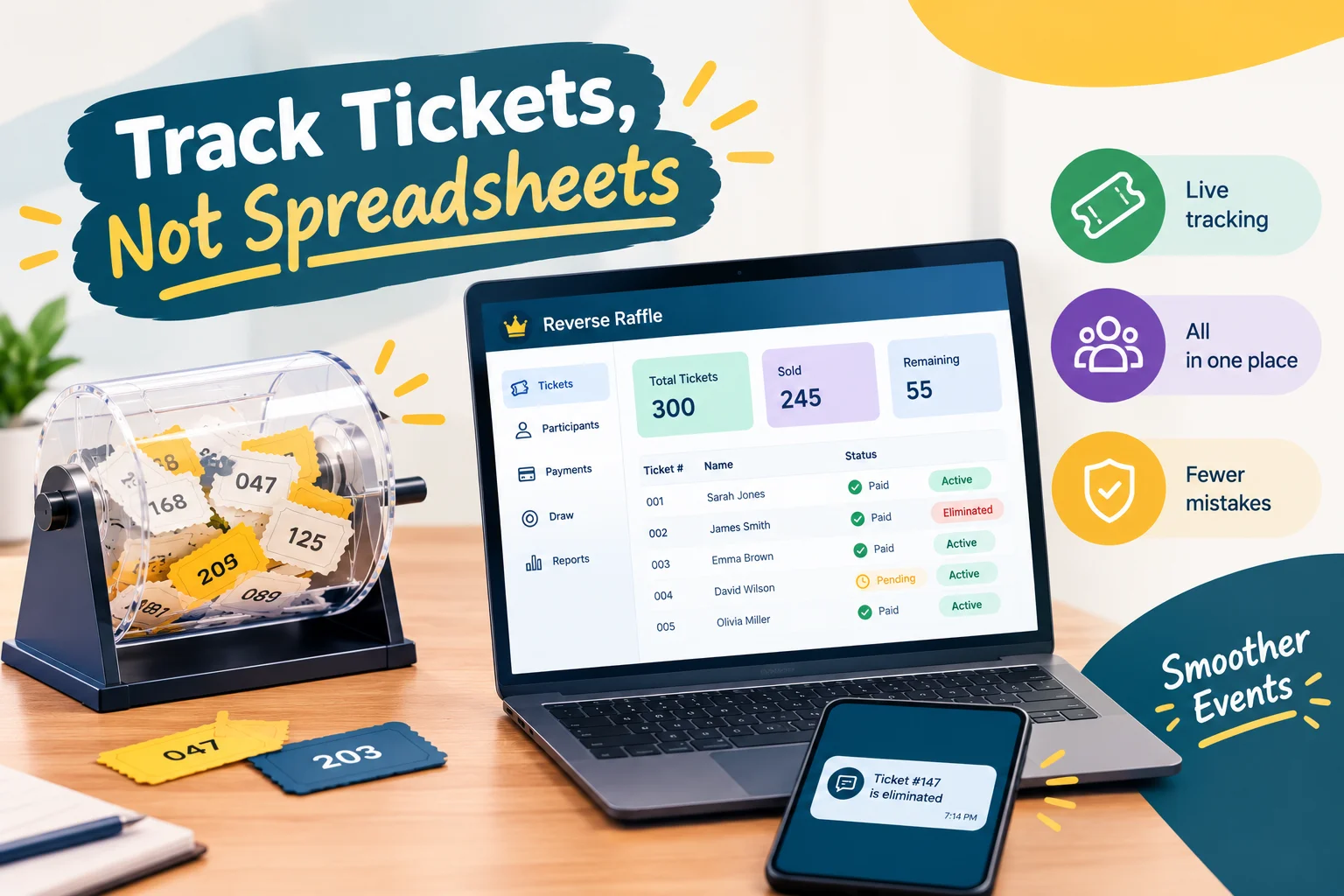
If your reverse raffle has a fixed number of entries, staff need to know how many have been sold and how many remain.
For example:
Total capacity: 300
Sold: 247
Remaining: 53
This information can affect marketing decisions.
If sales are slow, the organization may increase promotion.
If only a few tickets remain, staff can communicate genuine scarcity.
If the raffle is sold out, sales need to stop.
JustKonnect's Reverse Raffle Software provides real-time tracking of sold and available tickets, allowing operators to see the status of entries rather than relying on manual counting.
That makes ticket tracking useful for both administration and decision-making.
Keep Ticket Sales and Entry Assignment Connected
Another common manual process is separating payment from ticket assignment.
Someone takes payment.
Someone else assigns a ticket.
Another person enters the information into a spreadsheet.
The more handoffs involved, the more opportunities there are for mistakes.
A better workflow connects the transaction and the entry.
The process becomes:
Purchase → Ticket assigned → Participant recorded → Entry becomes available in the system
This is easier to reconcile later because staff isn't rebuilding the relationship between payment and ticket number from separate records.
JustKonnect supports ticket sales through an online portal, in-hall kiosk, or staff entry, with each ticket assigned a unique number and sold/available tickets tracked in real time.
What Happens When Someone Buys More Than One Ticket?
Multiple-ticket purchases create another layer of complexity.
Suppose one participant purchases five entries.
The organization needs to know:
- Which five numbers were assigned?
- Were all five paid?
- Are they all active?
- Has one or more already been eliminated?
- If one remains late in the draw, how should the participant be notified?
A spreadsheet can technically handle this.
But as the number of participants and entries increases, the relationships become harder to maintain manually.
A proper ticket-management workflow should treat each entry as a distinct record while still connecting it to the relevant participant.
That makes the draw easier to manage and the participant easier to identify.
Don't Let Last-Minute Changes Create Confusion
Reverse raffle information can change close to the event.
Someone may purchase a ticket shortly before the deadline.
A payment may be confirmed.
A participant may provide a corrected phone number.
A staff member may need to update an entry.
These changes need to reach the same system that will be used for the draw.
Otherwise, staff may have to reconcile the spreadsheet again immediately before the event.
That's exactly when teams have the least time to troubleshoot.
A central digital workflow reduces the need for repeated manual reconciliation.
The Draw Is Where Bad Data Becomes Visible
Imagine the event has started.
The first number is drawn.
The host announces it.
A participant says:
“That's my number, but I was told my ticket was 184, not 148.”
Staff now have to investigate.
Or perhaps a number appears that was never properly assigned.
Or a participant believes their entry should still be active.
Or two records contain the same ticket number.
These aren't merely administrative inconveniences.
During a live fundraising event, they interrupt the experience and place pressure on staff.
That is why ticket accuracy needs to be established before the first number is drawn.
Keep the Active Pool Updated Automatically
In a reverse raffle, the active ticket pool changes continuously.
At the beginning:
300 active entries
After several draws:
245 active entries
Later:
50 active entries
Near the end:
10 active entries
Eventually:
1 remaining entry
Manually maintaining this progression can become tedious.
JustKonnect's system displays eliminated numbers and updates remaining entries in real time during the draw.
This means staff isn't relying on a separate spreadsheet to determine which entries are still eligible.
The draw and the entry pool stay connected.
Make Elimination Status Easy to Understand
There should be no ambiguity about whether a ticket is still active.
A useful tracking system needs clear states.
For example:
Available
The number has not yet been sold.
Sold
The ticket has been assigned to a participant.
Active
The participant's number remains eligible in the draw.
Eliminated
The number has been drawn and is no longer eligible.
Winner
The final remaining number has won.
This is much easier to work with than manually changing cell colours or typing notes into a spreadsheet.
Clear status management also makes it easier for different members of the event team to understand the current state of the raffle.
Separate Ticket Management From Event Presentation
The audience doesn't need to see your entire ticket database.
They need to see the information relevant to the draw.
Staff, meanwhile, need access to the operational information required to manage participants, entries, and winners.
These are two different requirements.
A digital reverse raffle system can provide the operational side for staff while presenting the relevant draw information to the audience.
JustKonnect's Reverse Raffle Software includes a live display showing drawn numbers and remaining entries during the draw.
That separation can make the event easier to follow without exposing unnecessary administrative information.
What About Paper Tickets?
Paper tickets aren't automatically a problem.
They can be familiar and useful for certain events.
The issue is what happens to the information after the ticket is sold.
If a paper ticket is the only record of an entry, staff may have to manually transfer information into another system.
That creates another opportunity for an error.
A more structured approach can allow organizations to retain an in-person sales process while still maintaining a digital record.
JustKonnect supports ticket sales through an online portal, kiosk, and staff entry at the counter, so organizations can accommodate different sales methods while maintaining centralized entry tracking.
Build a Single Entry Record
For each ticket, think about the minimum information staff actually need.
A useful entry record could include:
- Ticket number
- Participant name
- Contact information
- Purchase status
- Payment status
- Purchase date
- Entry status
- Prize information where applicable
- Winner status
The exact fields will depend on the organization's process.
The important principle is that the information should remain connected to the entry.
Staff shouldn't have to search through three spreadsheets and a paper folder to identify the owner of one ticket.
Don't Forget Winner Management
Ticket tracking doesn't stop when the last number remains.
Now the organization needs to know:
- Who won?
- What ticket number did they hold?
- What prize are they entitled to?
- Has the prize been distributed?
- What records need to be retained?
JustKonnect's reverse raffle workflow includes winner management, with staff able to view winner information and automatic SMS/email notifications for winners.
That creates a continuation between the ticket record and the outcome.
Instead of rebuilding the winner list after the draw, the winning entry is already part of the event's digital record.
Use the Same Data for Reporting
Once the raffle is finished, staff often need to answer questions about the event.
How many tickets were sold?
How many were available?
Who won?
What prizes were distributed?
What revenue was generated?
How did the event perform?
If those records exist across spreadsheets, paper forms, payment records, and staff notes, post-event reporting can become another manual project.
JustKonnect lists reporting capabilities for sales, winners, and financial information, including exportable reporting.
That means the information collected while running the raffle can also support the reporting process afterward.
A Better Way to Think About Ticket Tracking
Instead of asking:
“How can we make our spreadsheet easier to manage?”
Ask:
“What information needs to remain accurate from ticket purchase through final payout?”
That changes the conversation.
You need to know:
Before the event
- What tickets exist?
- Which are available?
- Which are sold?
- Who owns each entry?
During the event
- Which numbers have been eliminated?
- Which entries remain active?
- Who is associated with each number?
After the event
- Who won?
- What prize was awarded?
- What records need to be retained?
- What should be included in the final report?
Once you look at the process this way, a spreadsheet starts to look less like a solution and more like one small component of a larger workflow.
When Is a Spreadsheet Still Practical?
Not every organization needs dedicated software for every raffle.
A very small event with a limited number of entries, one staff member, and a simple process may be manageable with basic tools.
The question is when the administrative risk becomes greater than the convenience.
Warning signs include:
- Multiple people editing the ticket file
- Several versions of the spreadsheet
- Hundreds of entries
- Frequent ticket changes
- Multiple ticket-selling locations
- Manual payment reconciliation
- Difficulty identifying ticket owners
- Manual elimination tracking
- Staff spending significant time preparing the draw
- Post-event reporting taking hours
When several of these appear together, it's worth reconsidering the workflow.
A Practical Digital Workflow
A structured reverse raffle can follow a straightforward process.
Step 1: Set the Ticket Structure
Define the number of available tickets, ticket price, draw date, and prize structure.
Step 2: Open Sales
Allow participants to purchase through the available channels.
Step 3: Assign Unique Numbers
Each purchased entry receives its unique ticket number.
Step 4: Track Availability
Staff can see which entries are sold and which remain available.
Step 5: Confirm the Participant Record
The ticket remains connected to the person who purchased it.
Step 6: Start the Draw
The system begins the scheduled drawing process.
Step 7: Update Eliminations
Drawn numbers are marked as eliminated while remaining entries stay visible.
Step 8: Identify the Winner
The final remaining number becomes the winning entry according to the event's rules.
Step 9: Manage the Prize
Staff can record the relevant winner and prize information.
Step 10: Report the Results
Use the recorded data to support reconciliation and post-event reporting.
The advantage isn't simply that the process is digital.
It's that the information follows the same journey as the ticket.
How JustKonnect Replaces the Spreadsheet Workflow
The purpose of dedicated reverse raffle software isn't to make a spreadsheet look more modern.
It's to remove the need to manually connect separate pieces of information.
JustKonnect describes its reverse raffle platform as covering ticket sales, entry tracking, automatic draws, winner notifications, live display, winner management, multiple prize tiers, and reporting.
That creates a workflow where:
Ticket sales feed entry records.
Entry records feed the draw.
The draw updates elimination status.
The final entry feeds winner management.
The event data feeds reporting.
The fewer times staff have to manually copy information from one place to another, the fewer opportunities there are for inconsistencies.
The Real Cost of Spreadsheet Tracking
The cost of manual tracking isn't always the spreadsheet.
It's the staff time around it.
Someone has to create it.
Someone has to update it.
Someone has to check it.
Someone has to reconcile payment information.
Someone has to prepare the final ticket list.
Someone has to mark eliminations.
Someone has to verify the winner.
Someone has to prepare the report afterward.
For a recurring reverse raffle, those tasks can become part of the organization's standard workload.
Automating the repetitive parts gives staff more time to focus on the event itself.
Frequently Asked Questions
Can I run a reverse raffle using Excel or Google Sheets?
Yes. A spreadsheet can be used to track tickets for smaller events, but manual tracking becomes more difficult as the number of entries, staff members, sales channels, and event changes increases.
What information should be tracked for each reverse raffle ticket?
At minimum, organizations generally need to associate each unique ticket number with the relevant participant and its current status. Depending on the event, additional information may include payment status, contact details, purchase date, elimination status, and prize information.
How do I prevent duplicate ticket numbers?
Use a controlled numbering process where every entry receives a unique number. A centralized digital ticket system can reduce the risk of different staff members assigning or recording the same number.
How can I track which reverse raffle tickets are still active?
The active pool should be updated as numbers are eliminated. JustKonnect's Reverse Raffle Software updates remaining entries in real time as numbers are drawn.
Can reverse raffle software handle tickets sold in person?
Yes. JustKonnect supports online ticket sales, in-hall kiosk sales, and staff-entered sales at the counter, with unique ticket numbers and real-time tracking of sold and available entries.
What happens to ticket data after the reverse raffle?
The data can be used to identify winners, manage prizes, reconcile the event, and support reporting. JustKonnect includes winner management and reporting capabilities within its reverse raffle workflow.
Move From a Ticket Spreadsheet to a Connected Workflow
A spreadsheet can tell you what is in a list.
A reverse raffle needs something more: a reliable connection between the ticket, the participant, the payment, the draw, the elimination status, the winner, and the final report.
That is where manual processes begin to become difficult.
When entries are managed across separate files and paper records, every handoff creates another opportunity for an outdated number, missing entry, duplicate record, or last-minute confusion.
A dedicated system can keep those stages connected.
If your organization is still managing reverse raffle entries manually, explore JustKonnect's Reverse Raffle Software to see how digital ticket sales, real-time entry tracking, automated drawing, live displays, winner management, SMS notifications, and reporting can bring the entire workflow together.