A charity bingo event finishes on Saturday night. The hall collected money from bingo games, sold refreshments, paid prizes, purchased supplies, and spent money promoting the event.
On Monday, someone asks a straightforward question:
How much did the event actually make?
The answer is not necessarily the total amount collected at the door, the money remaining in the cash drawer, or the amount shown in a promotional report.
Each figure describes something different. Money collected is not the same as gross revenue. Gross revenue is not net income. And an increase in attendance does not automatically prove that a marketing campaign generated additional revenue.
For charity gaming operators, these distinctions matter. Boards, finance teams, charity partners, and regulators may need different views of the same activity. If revenue and expenses are combined carelessly, a report can look impressive while failing to explain the actual financial outcome.
The solution is to establish clear categories, maintain supporting records, and separate financial reporting from marketing performance measurement.
This guide explains what operators should track, what should not be confused with revenue, and how to present the figures in a way that supports better financial oversight.
First, Understand the Four Numbers That Should Never Be Treated as the Same
Before building a revenue report, establish the difference between money received, revenue generated, expenses incurred, and the amount remaining after costs.
These figures are connected, but they answer different questions.
| Financial measure | What it represents | What it helps explain |
| Gross receipts | Money collected before deducting expenses, subject to the applicable reporting definition | How much money came in |
| Gross revenue | Revenue attributable to the relevant activity before applicable expenses | What the activity generated |
| Operating expenses | Costs associated with running the activity | What it cost to operate |
| Net income or proceeds | The amount remaining after the relevant expenses are deducted | What the activity contributed financially |
The exact accounting treatment depends on the type of activity, the organisation's structure, and the applicable jurisdiction.
For example, US tax-exempt organisations reporting gaming activity may need to distinguish gross gaming revenue, prizes, and other direct expenses. The IRS instructions for Schedule G specifically request separate reporting of gross gaming revenue and direct expenses rather than presenting only one combined figure. See the IRS Schedule G instructions.
This separation is important because a charity gaming operator may run several activities under one roof, each with different revenue sources, costs, and reporting requirements.
What Counts as Revenue in a Charity Gaming Operation?
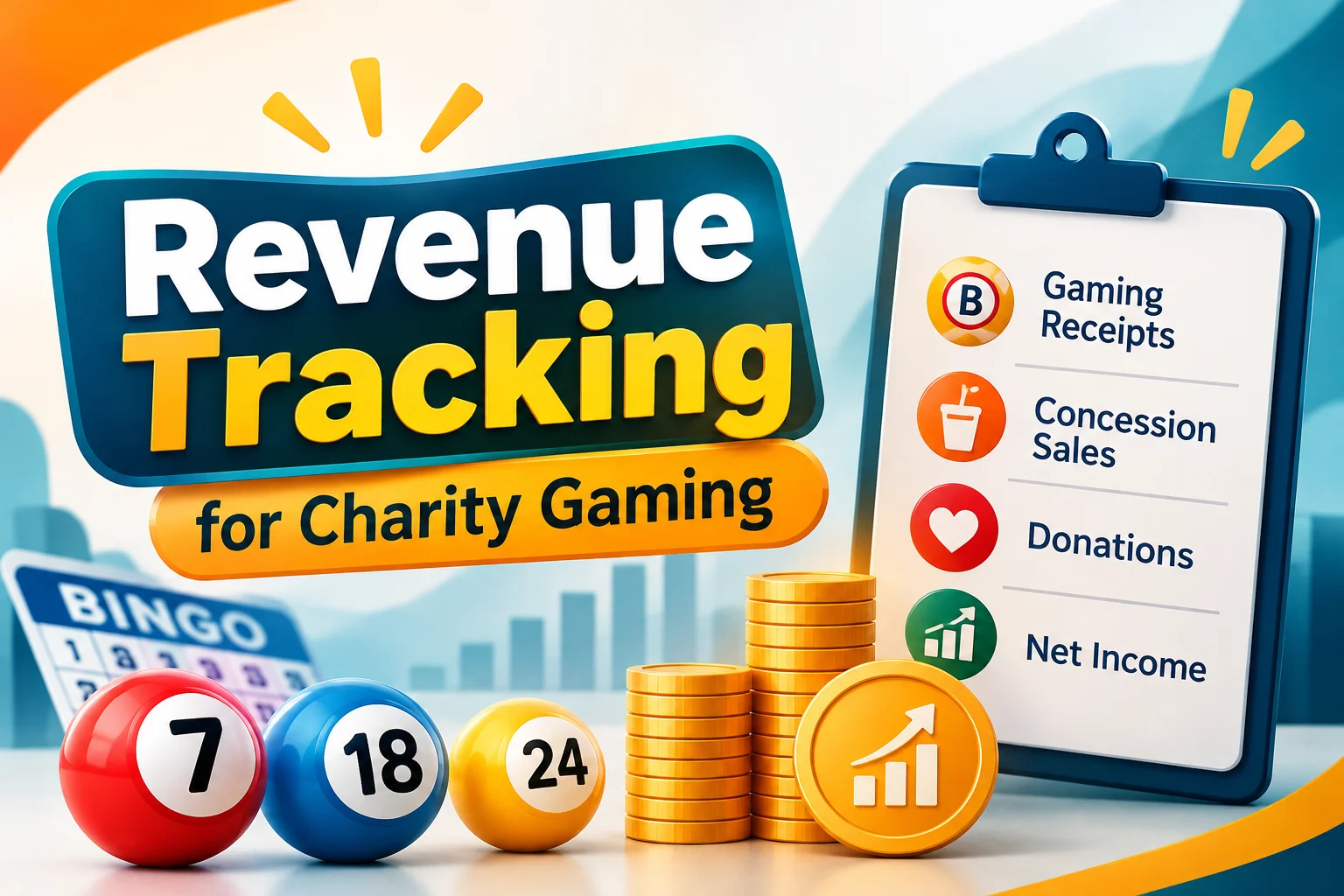
A charity gaming venue may generate money from several activities during the same operating period. The first reporting task is identifying where each amount originated.
Do not automatically combine every payment received into one gaming revenue figure.
1. Bingo and gaming receipts
Money collected through bingo games and other permitted gaming activities is an important part of the financial picture.
Depending on the game and applicable reporting rules, records may include:
- Bingo-related receipts.
- Pull-tab or instant bingo receipts.
- Other permitted gaming activity receipts.
- Applicable contributions associated with gaming activities.
- Prize payouts and other direct gaming expenses.
Each category should be identifiable rather than hidden inside one combined total.
In the United States, the IRS distinguishes gross income from gaming activities from contributions received through those activities. Its reporting guidance also requires relevant gaming income and direct expenses to be identified separately. IRS Form 990 instructions.
The operator should follow the accounting categories required for the organisation and jurisdiction rather than assuming that every type of gaming receipt receives identical treatment.
2. Concession and refreshment sales
Some bingo halls generate additional income through refreshments, snacks, and other concession sales.
These transactions should be recorded separately from gaming activity.
For example, a hall might collect money from refreshments during a bingo session. Although the sales happen inside the venue and serve the same audience, they are not automatically part of the bingo game's gross receipts.
Separating the figures makes it easier to understand the financial contribution of each activity.
It also prevents concession performance from being incorrectly attributed to gaming operations.
3. Fundraising contributions and donations
Charity gaming operators may also receive donations or contributions connected with fundraising activities.
These amounts should not automatically be classified as gaming revenue.
The distinction can be particularly important when a payment includes both a purchase and a voluntary contribution. The applicable accounting and tax rules may require the components to be identified separately.
For US tax-exempt organisations, IRS guidance distinguishes contributions from gross income generated by gaming and fundraising activities. The treatment depends on the nature of the payment and the reporting requirements. IRS Form 990 instructions.
Operators should document the source, purpose, and nature of each receipt so that finance staff can classify it correctly.
4. Other event-related income
A charity gaming venue may organise special events, raffles, fundraising activities, or other permitted programmes.
These activities can generate additional income, but their financial results should remain identifiable.
For example, a special fundraising evening may involve:
- Ticket sales.
- Sponsorship contributions.
- Refreshment sales.
- Gaming-related receipts.
- Donations.
- Event-specific expenses.
Combining all of these into a single gaming revenue number makes it difficult to evaluate the performance of the individual activities.
A better report shows each source separately and explains how the amounts are treated in the organisation's financial records.
What Should Not Be Mistaken for Revenue?
One of the most common reporting problems is confusing operational activity with financial income.
A dashboard may show that players attended, rewards were redeemed, and campaigns generated engagement. Those are useful performance indicators, but they are not automatically revenue.
Consider the following distinctions.
| Item | Why it should not automatically be reported as gaming revenue |
| Player attendance | A visit is an activity measure, not a monetary receipt |
| Loyalty points issued | Points represent programme activity, not necessarily income |
| Rewards redeemed | Redemption may create a programme cost or fulfilment obligation |
| Promotional message delivery | A delivered message is not a financial transaction |
| Campaign clicks | Engagement does not establish revenue generation |
| New player registrations | A signup indicates database growth, not money received |
| Estimated campaign value | An estimate is not verified financial income |
| Unredeemed promotional offers | An offer issued is not the same as a completed transaction |
This distinction is especially important when using software that combines player engagement, loyalty, and reporting.
A platform may help an operator understand whether a campaign encouraged visits or whether a reward attracted participation. It does not mean that every tracked interaction should be converted into a financial figure.
Report financial transactions as financial transactions, and operational activity as operational activity.
That simple rule prevents many misleading conclusions.
Expenses: The Other Half of an Honest Revenue Report
A revenue report that shows only incoming money is incomplete.
To understand the financial outcome of an activity, operators must also identify the relevant expenses.
For a charity gaming operation, these may include:
| Expense category | Examples |
| Prize expenses | Cash prizes and noncash prizes |
| Staffing | Paid gaming workers, callers, and other relevant personnel |
| Venue costs | Rent, facility costs, and utilities where applicable |
| Gaming supplies | Bingo cards, pull tabs, paper, and other game materials |
| Equipment | Rental or operating costs for gaming equipment |
| Marketing | SMS campaigns, promotional materials, and advertising |
| Technology | Relevant software subscriptions and platform costs |
| Event expenses | Decorations, event services, and other activity-specific costs |
Not every expense belongs in the same reporting category. Some costs may be direct expenses of gaming, while others may be general operating or fundraising expenses.
The organisation should apply its established accounting policies and applicable reporting requirements when allocating costs.
Why prize payouts deserve separate attention
Prize payouts can represent a substantial part of a gaming activity's financial results.
If the report shows gross receipts without clearly identifying prizes, readers may misunderstand how much remains after the game has paid its winners.
For example, consider an illustrative bingo operation:
- Gross gaming receipts: $20,000
- Cash and noncash prizes: $12,000
- Other direct gaming expenses: $3,000
The amount remaining after these listed direct expenses is $5,000.
That figure is not necessarily the organisation's final net proceeds. Additional costs, allocations, or accounting adjustments may still apply.
The purpose of the example is to demonstrate why gross receipts and the amount remaining after expenses should be reported separately.
A Practical Example: How to Present One Charity Bingo Session
Imagine a charity bingo hall preparing a financial summary for a Saturday session.
The team records the following illustrative figures:
| Activity or expense | Amount |
| Bingo gaming receipts | $20,000 |
| Refreshment sales | $1,200 |
| Voluntary contributions | $500 |
| Cash and noncash prizes | $12,000 |
| Gaming supplies and direct expenses | $1,500 |
| Event-related staffing costs | $1,000 |
| Refreshment inventory costs | $450 |
The report should not simply state that the hall generated $21,700 and stop there.
That total combines different receipt categories, while the expenses have not yet been allocated to their respective activities.
A more useful presentation separates the information:
Gaming activity
- Gross gaming receipts: $20,000
- Prize expenses: $12,000
- Other direct gaming expenses: $1,500
- Remaining amount after listed direct gaming expenses: $6,500
Refreshment activity
- Refreshment sales: $1,200
- Inventory costs: $450
- Remaining amount before other allocated expenses: $750
Contributions
- Voluntary contributions: $500
- Recorded separately according to the organisation's accounting treatment.
These are simplified illustrative calculations, not a completed financial statement. Actual classifications, allocations, and net proceeds must follow the organisation's accounting policies and applicable rules.
The advantage of this structure is clarity. A board member can see where money came from, which costs were incurred, and which amounts require separate treatment.
Revenue Tracking and ROI Are Two Different Reporting Exercises
Revenue tracking answers a financial question:
How much did the activity generate, and what remained after its relevant costs?
Return on investment (ROI) asks a different question:
Did the money and resources invested in an activity produce a worthwhile additional result?
This distinction matters when evaluating marketing campaigns, loyalty programmes, and promotional offers.
A campaign might cost $300 and be followed by an increase in attendance. That does not automatically mean it generated $300 or more in additional financial contribution.
The operator needs to understand whether the campaign influenced additional activity and whether that activity produced measurable financial value.
A simple marketing ROI example
Imagine a bingo hall spends $300 promoting a special session.
Following the campaign, attendance increases by 25 visits compared with a suitable baseline.
The hall may report:
- Campaign cost: $300.
- Additional visits observed: 25.
- Cost per additional observed visit: $12.
The calculation is:
Cost per Additional Visit = Campaign Cost ÷ Additional Visits
Example:
Cost per Additional Visit = $300 ÷ 25
Cost per Additional Visit = $12
This gives the operator an operational efficiency measure, assuming the 25 visits are reasonably attributable to the campaign.
It does not establish a financial ROI.
To calculate financial ROI, the operator would also need a defensible estimate of incremental financial contribution attributable to those visits.
For example, if finance staff determine that the campaign generated $600 in incremental contribution after relevant variable costs, the calculation would be:
ROI = (Incremental Contribution − Campaign Cost) ÷ Campaign Cost × 100
Example:
ROI = (600 − 300) ÷ 300 × 100
ROI = 100%
The 100% result is illustrative. It depends on the $600 contribution being reliably measured and attributable to the campaign.
If the hall cannot establish that contribution, it should report the attendance result and campaign cost without presenting an invented financial ROI.
How to Attribute Revenue to Marketing Without Overclaiming
One of the hardest questions in charity gaming marketing is determining whether a campaign actually generated additional financial activity.
A player may attend after receiving an SMS message, but perhaps they were already planning to attend.
A regular player may redeem a reward during a visit they would have made anyway.
A special event may produce higher attendance because of the event itself, not necessarily because of the promotional campaign.
These situations make attribution difficult.
A more disciplined evaluation begins before the campaign is launched.
Establish a baseline
Record the normal attendance or performance level for the relevant session.
Where possible, compare similar sessions and account for seasonal changes, holidays, jackpots, and other unusual circumstances.
Identify the campaign audience
Record who was eligible to receive the communication and which players actually received it.
This allows the operator to distinguish the intended audience from the wider hall population.
Track the response
Measure available campaign outcomes, such as delivery, engagement, replies, and attendance during the relevant period.
If the campaign includes a specific offer, track eligible redemptions separately.
Compare outcomes
Where practical, compare campaign recipients with a suitable group that did not receive the campaign.
A properly designed comparison can help estimate whether the campaign contributed to additional attendance.
Connect attendance to financial records
If the operator wants to report financial ROI, attendance results must be linked to a defensible financial contribution measure.
Do not multiply additional visits by an assumed revenue amount unless the finance team has approved the methodology and the data supports it.
What Charity Gaming Operators Should Include in a Financial Report
A useful report should answer the questions that management, boards, finance teams, and other relevant stakeholders are likely to ask.
It should not overwhelm the reader with unrelated operational figures.
A practical reporting structure can be divided into five sections.
1. Revenue sources
Show where the money originated.
Separate gaming activity, concessions, contributions, fundraising activities, and other relevant income categories according to the organisation's accounting treatment.
2. Direct expenses
Identify the costs directly associated with the activity.
Include prize payouts, gaming supplies, staffing, equipment, and other relevant direct expenses.
3. Net financial result
Show the amount remaining after the relevant expenses.
Explain whether the figure represents net gaming income, net event proceeds, or another defined measure. Avoid using these labels interchangeably.
4. Marketing and operational performance
Present attendance, campaign engagement, offer redemptions, and other operational indicators separately from financial results.
These measures help explain what happened during the activity but should not be treated as additional revenue.
5. Supporting documentation
Include the records necessary to support the figures.
Depending on the organisation and jurisdiction, these may include:
- Cash collection and reconciliation records.
- Game-level receipts.
- Prize payout records.
- Supplier invoices.
- Staffing records.
- Marketing invoices.
- Reward issuance and redemption records.
- Relevant bank and accounting records.
- Campaign performance summaries.
A report becomes more credible when another authorised person can trace a reported amount back to its supporting documentation.
The Reporting Mistakes That Create Problems During Reviews
Even when the underlying records are accurate, poor presentation can create confusion.
Combining all receipts into one number
Gaming receipts, contributions, and concession sales may have different reporting treatments.
Better approach: Separate income by source and apply the organisation's approved accounting categories.
Reporting only the amount left in the cash drawer
The cash balance may not reflect outstanding payments, prize obligations, bank deposits, or expenses already incurred.
Better approach: Reconcile cash and other payment records against the accounting records. Do not use a cash drawer balance as a substitute for a financial statement.
Deducting prizes without showing gross receipts
A report that only presents the amount remaining after prizes can conceal the actual scale of gaming activity.
Better approach: Present gross gaming receipts and prize expenses separately where required.
Treating every campaign-related visit as incremental revenue
A player attending after a campaign does not prove that the campaign caused the visit.
Better approach: Use a suitable baseline or comparison method and disclose limitations in attribution.
Counting issued rewards as completed financial transactions
A reward issued, a reward redeemed, and a financial cost incurred are different events.
Better approach: Track issuance and redemption separately, then recognise the related cost according to the organisation's accounting treatment.
Using software reports as a replacement for accounting records
Marketing dashboards may provide useful information, but they do not necessarily contain every transaction, liability, expense, or accounting adjustment required for financial reporting.
Better approach: Use operational software reports alongside the organisation's accounting system and supporting records.
How JustKonnect Revenue & ROI Tracking Supports Bingo Operators
Traditional revenue and loyalty tools are often designed around retail purchases, customer transactions, and point-of-sale activity.
Bingo halls operate differently. Their marketing and player relationships are closely connected to scheduled sessions, attendance, campaigns, and loyalty participation.
JustKonnect's Revenue & ROI Tracking is designed around that operating model.
The feature focuses on tracking campaign outcomes, attendance patterns, and rewards activity, with performance metrics and exportable summaries to help operators review what is working.
This can help answer practical questions:
- Which campaigns are associated with changes in attendance?
- How are players responding to promotional messages?
- Which rewards are being redeemed?
- Are engagement patterns changing over time?
- Which activities deserve further review or testing?
The platform's Analytics feature provides visibility into campaign performance, visit-frequency trends, new signups, last-visit trends, and reward redemptions.
Its Player Profiles & CRM helps operators connect attendance and engagement information with individual player records.
For charity gaming operators, the important distinction is that these capabilities support operational performance measurement. They should complement, not replace, the organisation's accounting system, financial reconciliation, or legally required reporting.
An attendance increase is an operational result. A verified net financial contribution is an accounting result. A defensible ROI calculation requires both appropriate financial data and a credible attribution method.
That separation allows operators to use JustKonnect reporting to understand player activity while keeping financial statements grounded in the organisation's actual records.
Frequently Asked Questions
What is the difference between gross revenue and net proceeds in charity bingo?
Gross revenue represents the income generated by the relevant activity before applicable expenses are deducted. Net proceeds represent the amount remaining after the relevant expenses are accounted for. The precise definitions and reporting categories depend on the organisation's accounting policies and jurisdiction.
Are prize payouts considered an expense in charity bingo reporting?
Prize payouts are generally treated as direct expenses of the relevant gaming activity under applicable reporting rules. For example, US IRS Schedule G instructions identify cash and noncash prizes as direct gaming expenses. Operators should record and report payouts separately where required.
Should concession sales be included in bingo gaming revenue?
Not automatically. Refreshment and concession sales should be identified separately from gaming receipts and classified according to the organisation's accounting policies and applicable reporting requirements.
Do loyalty points and reward redemptions count as revenue?
No. Points issued and rewards redeemed are programme activity measures, not automatically revenue. The financial cost or accounting treatment of a reward depends on the nature of the benefit and the organisation's policies.
How do you calculate ROI for a charity gaming marketing campaign?
A financial ROI calculation compares the incremental financial contribution attributable to the campaign with the campaign's total cost. Subtract the cost from the incremental contribution, divide by the cost, and multiply by 100. If additional financial contribution cannot be reliably established, report operational outcomes such as attendance and campaign cost separately rather than claiming a financial ROI.
What should a charity gaming operator include in a revenue report?
A report should identify revenue sources, gross receipts, relevant expenses, prize payouts, net results, and supporting records. Campaign performance and attendance measures can be included in a separate operational section to explain activity without confusing it with financial income.
Can JustKonnect replace a bingo hall's accounting software?
JustKonnect's Revenue & ROI Tracking is designed to help operators review attendance, campaign outcomes, and rewards activity. It should not be treated as a complete accounting or financial reconciliation system. Operators should continue using appropriate accounting records and professional financial guidance for formal reporting.
Why should charity gaming revenue and expenses be reported separately?
Separate reporting makes it easier to understand where money originated, what costs were incurred, and what financial result remains. It also supports clearer management decisions and helps organisations prepare information required by their boards, auditors, and regulators.
Make Every Financial Figure Traceable
Revenue reporting is not simply about showing how much money entered a charity gaming venue. It is about explaining where that money came from, what it cost to generate, and what remained after the relevant expenses.
Keep gaming receipts separate from other income sources. Record prizes and operating costs clearly. Distinguish campaign engagement from financial outcomes, and avoid presenting estimated attendance value as verified revenue.
Most importantly, make sure every important figure can be traced back to a reliable record.
Explore JustKonnect Revenue & ROI Tracking to see how bingo-specific campaign, attendance, and rewards reporting can help operators evaluate performance and prepare clearer operational summaries.
For formal financial statements, tax filings, and regulatory reporting, work with your organisation's finance professionals and follow the requirements of the relevant gaming jurisdiction.