As bingo associations and multi-hall gaming organizations modernize their operations, one phrase appears everywhere:
“White label loyalty platform.”
It sounds impressive.
It sounds scalable.
And increasingly, it sounds necessary.
But there’s also confusion.
Some operators assume white-label loyalty simply means:
- Adding a logo to generic software
- Launching a points system
- Creating a branded mobile app
Others believe it requires sacrificing local control or forcing every hall into identical operations.
Neither is accurate.
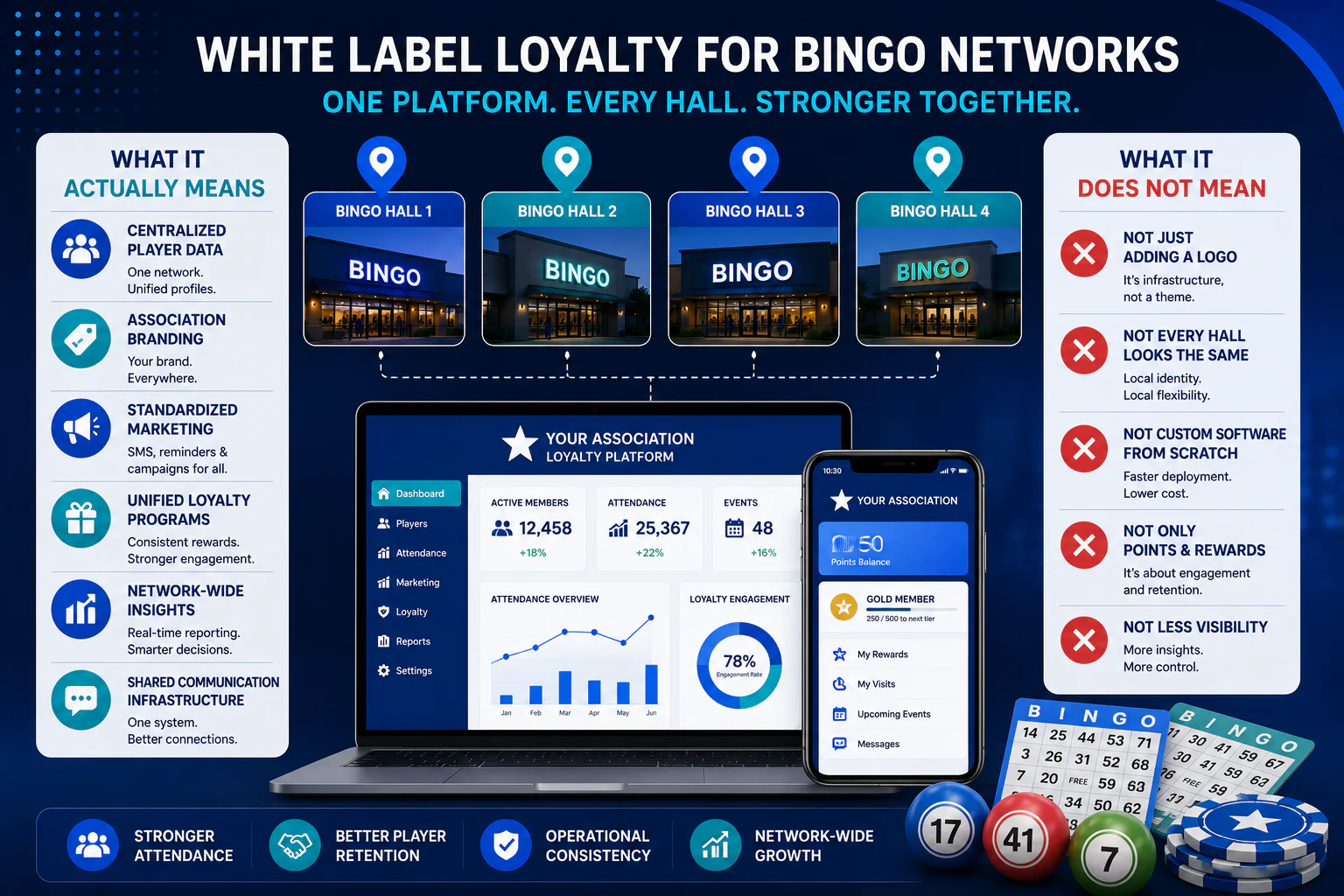
For bingo associations, a true white-label loyalty program is not just branding. It is a centralized infrastructure system that standardizes attendance marketing, player engagement, loyalty tracking, and communication across an entire network of halls.
Understanding what white-label loyalty actually means—and what it does not—is critical for associations evaluating long-term technology investments.
Why Bingo Networks Are Moving Toward Centralized Loyalty Systems
Historically, most bingo halls operated independently.
Each location managed:
- Attendance promotion
- Player databases
- Loyalty rewards
- Marketing campaigns
- SMS communication
- Reporting systems
Separately.
At a small scale, this worked.
But as associations expanded and player expectations evolved, fragmented systems created serious operational problems:
- Inconsistent attendance marketing
- Disconnected player experiences
- No centralized reporting
- Weak retention tracking
- Limited visibility across halls
Modern loyalty infrastructure solves these problems by creating a unified system across all member locations.
What a White Label Loyalty Program Actually Means
At its core, a white-label loyalty platform is:
A fully branded, centralized loyalty and engagement system that operates under the association’s identity while supporting multiple member halls from one infrastructure.
Instead of every hall running different systems, the association provides:
- Shared loyalty technology
- Standardized attendance marketing
- Unified player tracking
- Automated communication workflows
- Association-level reporting
All are branded as the association itself.
White-label loyalty systems are increasingly popular because they provide faster deployment, centralized engagement infrastructure, and scalable multi-location operations without requiring organizations to build software from scratch.
What White Label Loyalty Actually Includes
1. Centralized Player Data Across Member Halls
A true white-label system creates one unified player ecosystem.
That means:
- Shared player profiles
- Cross-hall visit tracking
- Unified attendance history
- Centralized loyalty engagement
Instead of isolated databases, associations gain a complete network-wide view of player behavior.
This is one of the biggest operational advantages of multi-location loyalty systems.
2. Association-Branded Engagement Infrastructure
White label means the platform reflects the association’s brand identity.
This includes:
- Logos
- Colors
- Messaging
- Player experience
- Communication templates
To players, the platform feels like part of the association itself—not a disconnected third-party tool.
Brand consistency is one of the primary reasons organizations adopt white-label loyalty systems.
3. Standardized Attendance Marketing
One of the most valuable aspects of centralized loyalty infrastructure is attendance marketing standardization.
This includes:
- SMS reminders
- Event promotions
- Win-back campaigns
- Loyalty notifications
- Attendance triggers
Instead of every hall inventing its own marketing strategy, the association provides proven workflows.
This creates:
- Consistent engagement
- Better attendance stability
- Improved player retention
4. Unified Loyalty Rules and Rewards
A white-label loyalty platform standardizes:
- Point structures
- Visit rewards
- Loyalty tiers
- Reward eligibility
- Engagement campaigns
Players understand the system regardless of which hall they visit.
This consistency strengthens network-wide loyalty.
5. Multi-Location Reporting and Visibility
Centralized reporting is one of the biggest operational upgrades.
Associations can monitor:
- Attendance trends
- Campaign performance
- Hall comparisons
- Loyalty engagement
- Player retention metrics
Without centralized infrastructure, this visibility is almost impossible.
Multi-location loyalty systems are specifically designed to aggregate operational data across locations while still allowing local-level insights.
6. Shared Communication Infrastructure
White-label loyalty platforms often centralize:
- SMS systems
- Email campaigns
- Event messaging
- Notifications
- Player communication history
This ensures:
- Consistent messaging
- Compliance management
- Higher communication quality
What a White Label Loyalty Program Does NOT Mean
Now for the equally important part.
There are several misconceptions about white-label loyalty systems.
1. It Does NOT Mean Every Hall Loses Its Identity
One common fear is:
“Will every hall become identical?”
No.
A well-designed white-label platform balances:
- Centralized infrastructure
- Local flexibility
Individual halls can still:
- Run local events
- Create localized promotions
- Customize schedules
- Maintain community identity
The infrastructure is standardized—not the hall personality.
Successful multi-location loyalty systems balance central control with local flexibility instead of forcing identical operations across locations.
2. It Does NOT Mean “Just Adding a Logo.”
A logo alone is not white-label infrastructure.
Generic CRM software with custom colors is not the same as:
- Multi-hall loyalty systems
- Unified attendance tracking
- Centralized player engagement
True white label platforms include operational infrastructure—not just branding.
3. It Does NOT Mean Building Custom Software From Scratch
Some associations assume “white label” means expensive custom development.
Actually, white-label platforms are popular because they eliminate the need for building proprietary software internally.
Modern white-label loyalty systems provide:
- Faster deployment
- Lower operational cost
- Scalable infrastructure
Without requiring large development teams.
4. It Does NOT Mean Only Rewards Points
Many operators reduce loyalty programs to:
“Points and discounts.”
Modern loyalty systems are far broader.
They include:
- Attendance behavior tracking
- Visit frequency monitoring
- Automated engagement
- Win-back campaigns
- Personalized communication
- Event participation
The goal is retention and attendance consistency—not just points accumulation.
Modern loyalty platforms increasingly focus on behavioral engagement and automated interaction instead of simple transactional rewards.
5. It Does NOT Remove Operational Visibility
Some halls worry that centralized systems reduce local reporting access.
In reality, modern platforms provide:
- Corporate-level visibility
- Hall-level dashboards
- Role-based permissions
This improves operational clarity at every level.
Why Generic CRM Systems Usually Fail Bingo Associations
Many associations initially attempt to use:
- Generic CRMs
- Retail loyalty apps
- Basic email platforms
But bingo operations have unique needs:
- Session attendance tracking
- Visit frequency monitoring
- Multi-hall engagement
- Charity event promotion
- Gaming-specific workflows
Generic systems struggle to support these requirements.
Purpose-built bingo association software solves these operational gaps directly.
The Strategic Advantage of White Label Infrastructure
The biggest benefit is not technology alone.
It is operational alignment.
A centralized white-label platform allows associations to:
- Scale consistently
- Improve retention
- Standardize attendance marketing
- Increase reporting visibility
- Support smaller halls
- Build stronger player relationships
This transforms fragmented hall networks into coordinated ecosystems.
How White Label Loyalty Improves Player Retention
Player retention improves because the experience becomes:
- Consistent
- Familiar
- Predictable
- Personalized
Players interact with:
- One loyalty structure
- One communication ecosystem
- One recognizable association experience
This strengthens trust and long-term engagement.
Multi-location loyalty systems can improve retention significantly when engagement and rewards are standardized across locations.
Key Features Associations Should Prioritize
When evaluating a white-label loyalty platform, associations should prioritize:
- Multi-location loyalty tracking
- Centralized reporting dashboards
- SMS marketing automation
- Attendance tracking
- Unified player profiles
- Loyalty tier management
- White label branding controls
- Automated engagement workflows
- Hall-level permissions
- Event marketing tools
These features create a scalable infrastructure for long-term growth.
Signs Your Bingo Network Needs a White Label Platform
Associations often reach this point when:
- Attendance varies dramatically between halls
- Reporting is fragmented
- Loyalty programs are inconsistent
- Communication quality differs by location
- Player retention becomes unpredictable
- Smaller halls struggle with marketing execution
These are infrastructure problems—not isolated marketing problems.
Final Thoughts
A white-label loyalty program is far more than a branded rewards app.
For bingo associations, it is a centralized engagement infrastructure that standardizes attendance marketing, loyalty management, communication systems, and reporting across an entire network of halls.
At the same time, it does not eliminate local flexibility, force identical operations, or require expensive custom software development.
The right white-label platform allows associations to unify player engagement while still supporting the unique identity of each member hall—creating stronger attendance consistency, better retention, and scalable long-term growth across the entire bingo network.