Two bingo halls can record the same number of player visits in a week and still have very different businesses.
One hall may have a dependable group of regulars, a steady stream of new members, and players who respond well to event promotions. The other may be relying on a small group of highly frequent visitors while newer members rarely return. On the surface, their attendance reports might look almost identical.
The difference becomes visible when operators look beyond the total number of people through the door.
Who is visiting? How often do they return? Which sessions attract repeat attendance? What happens after a promotional message goes out? Are players engaging with loyalty rewards, or are they simply attending their usual sessions regardless of the programme?
These questions reveal the patterns behind the numbers.
Attendance tells a bingo hall how many visits occurred. Player behavior data helps operators understand the relationships, routines, and responses that shape those visits.
That distinction matters when deciding where to focus marketing efforts, which sessions need attention, how to evaluate promotions, and what changes might strengthen long-term player engagement.
A Full Hall Does Not Always Mean a Healthy Player Base
Attendance is an essential operating metric, but the total alone can hide important changes.
Imagine that your hall records 500 visits this week and 500 visits next week. The headline figure has not changed. However, the composition of those visits may have shifted significantly.
Perhaps several regulars have stopped attending, while a successful special event has brought in a temporary wave of visitors. Alternatively, your existing members may be attending more frequently, masking a decline in the number of people returning after their first visit.
Both scenarios produce the same attendance total, but they suggest different operational priorities.
In the first situation, the hall may need to understand why established players are becoming less active. In the second, it may need to focus on helping first-time visitors develop a repeat attendance habit.
Looking only at total visits makes these situations difficult to distinguish.
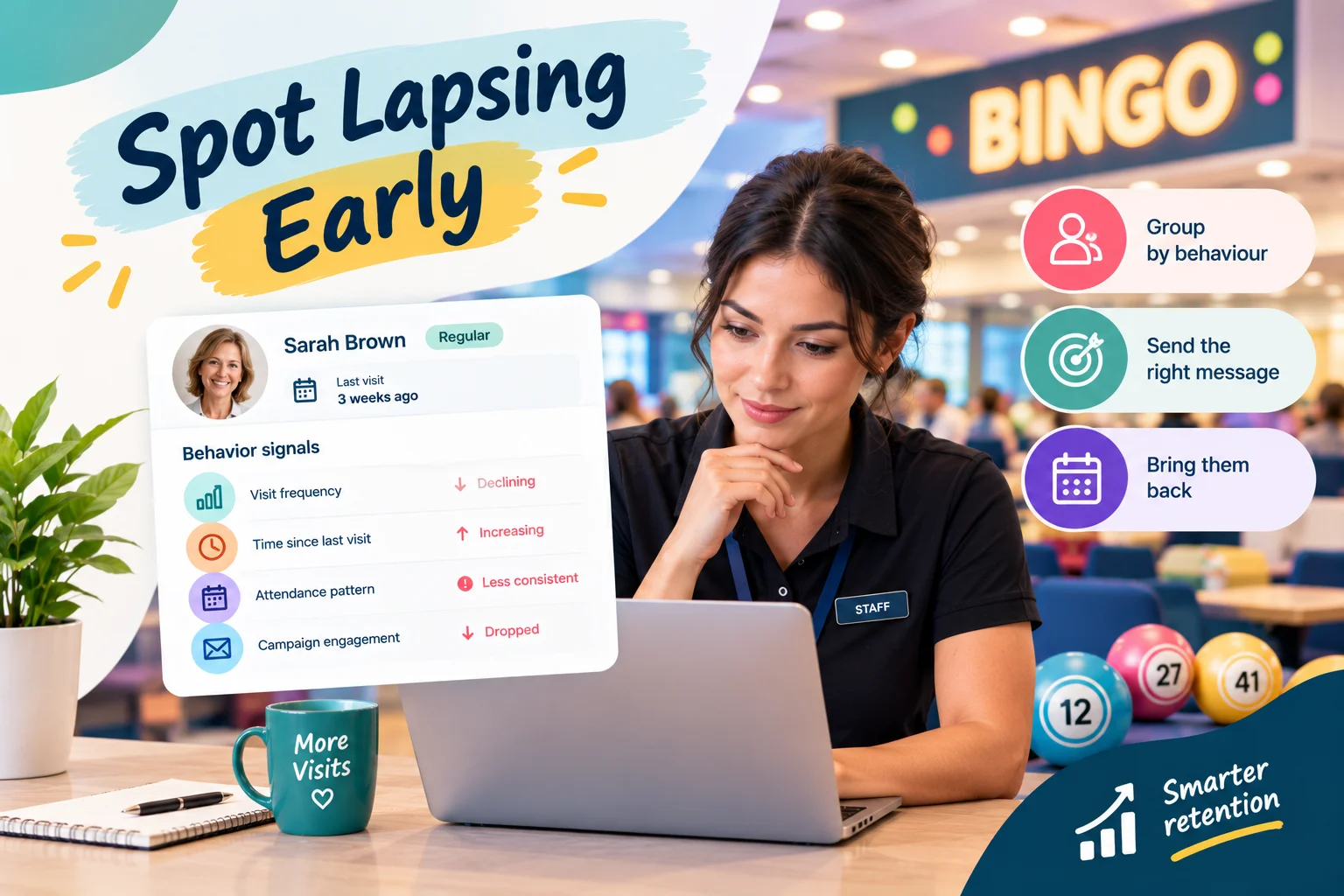
A more useful review considers attendance alongside player-level patterns, including visit frequency, last-visit dates, engagement history, and membership activity.
The purpose is not to replace attendance reporting. It is to understand what the attendance figure represents.
1. Visit Frequency Reveals Whether Attendance Is Becoming a Habit
Two players can each contribute four visits in a month while having very different attendance patterns.
One might attend every Friday. The other might visit four times in a single week and then disappear for the rest of the month.
Both have generated four visits, but the consistency of their engagement is different.
Visit frequency becomes more informative when operators examine it over time and in relation to each player's usual routine.
What frequency patterns can reveal?
A hall can use visit history to investigate questions such as:
- Which players return consistently from week to week?
- Which members attend only around special events?
- Are new players developing a regular attendance pattern?
- Are previously frequent visitors attending less often?
- Which sessions appear to support repeat visits?
These patterns help operators distinguish established habits from occasional participation.
For example, if a player attends a Tuesday session regularly, the hall may have a reason to communicate relevant Tuesday updates rather than repeatedly promoting unrelated sessions.
If another player attends only during special events, the better opportunity may be to make those events easier to discover.
Neither pattern is automatically better than the other. The point is to understand how different players engage with the venue and make marketing decisions accordingly.
Look for changes, not just categories
A label such as "regular player" provides a useful summary, but it does not tell the whole story.
A player who previously attended three times a week and now attends once a week may still qualify as a regular under a broad classification. Without reviewing the change, the hall could miss a meaningful shift in engagement.
Tracking frequency over time gives operators a more complete picture than a static category alone.
2. Visit Timing Shows Which Sessions Fit Different Player Routines
A player's attendance pattern can reveal more than how often they visit. It can also show when they tend to attend.
Some players may consistently choose weekday sessions. Others may prefer weekends, particular events, or sessions that fit around their work and family commitments.
Understanding these patterns helps halls make their communications more relevant.
Consider a hall preparing to promote a special Wednesday session. Its database includes regular Wednesday attendees, players who usually attend on Saturdays, and members who have not visited recently.
A single campaign may reach everyone, but the information each group needs can differ.
- Wednesday regulars may need a concise reminder with the event details.
- Saturday attendees may need a reason to consider a different session.
- Less-active members may benefit from a straightforward invitation to return.
This is not about assuming what every player wants. Historical attendance provides context for deciding which messages may be relevant.
Use session patterns to improve planning
Operators can compare attendance across sessions and look for recurring differences.
If a particular session consistently attracts repeat visitors, it may be worth examining what makes it appealing. If another session struggles to build a dependable audience, the hall can review its timing, event calendar, communication, and other relevant factors.
Player behavior data cannot automatically explain why a session performs differently. It can, however, help identify where further investigation is worthwhile.
The distinction is important: a pattern points to a question; it does not necessarily provide the answer.
3. New-Member Behavior Reveals Whether First Visits Are Turning Into Repeat Visits
A new signup is a useful starting point, but it is not the same as an established player relationship.
A hall may add dozens of members to its database without knowing how many return after their first visit. Sign-up totals show that the audience is growing; they do not establish whether that growth is translating into sustained participation.
Player-level behavior helps connect those two stages.
Follow the journey beyond registration
Consider three fictional members who join during the same month.
One attends again within a week and gradually establishes a routine. Another attends once more during a special event but does not return afterward. The third signs up but has no recorded subsequent visit.
A signup report counts all three as new members. An attendance-history review reveals three different engagement patterns.
That distinction can help a hall ask more useful questions:
- How many first-time visitors return within a chosen period?
- How long does it typically take for a new player to visit again?
- Which welcome communications are followed by repeat visits?
- Do particular events attract first-time visitors who later return?
- Where does the journey from signup to attendance appear to break down?
These questions help operators evaluate the quality of member acquisition, not just its volume.
Connect welcome campaigns to actual outcomes
A welcome message may be delivered successfully without leading to a visit. Similarly, a player may return without clicking a promotional link.
For that reason, campaign engagement should be reviewed alongside attendance outcomes.
If a hall sends a welcome campaign, it can establish a suitable measurement period and review how many recipients subsequently attend. Where practical, comparison groups can help assess whether the campaign contributed to those visits.
This creates a more useful feedback loop than judging success by signup counts or message delivery alone.
4. Campaign Responses Reveal Which Messages Deserve Another Look
Marketing performance is often discussed in terms of how many messages were sent, delivered, opened, or clicked.
These measures are useful, but they do not tell operators everything they need to know.
A campaign can achieve strong engagement without producing additional visits. Another may generate relatively few clicks while reaching players who attend the promoted session.
The meaningful result depends on the campaign's objective.
Separate communication activity from player behavior
Suppose your hall sends two campaigns.
The first promotes a special weekend event. Many recipients click the event link, but attendance changes very little.
The second shares information about a regular session. Fewer people interact with the message, yet attendance among the intended audience increases.
These illustrative scenarios show why a campaign should not be judged by one engagement metric alone.
Operators should examine the relationship between:
- Message delivery and engagement.
- The audience selected for the campaign.
- The event or offer being promoted.
- Attendance during the relevant period.
- Offer redemption, where applicable.
- Opt-outs and other signs of unwanted communication.
The goal is to understand what happened after the campaign, not merely what happened inside the messaging platform.
Learn from audience differences
Campaign results may vary between new members, frequent attendees, occasional visitors, and previously inactive players.
Reviewing results by group can help operators identify which approaches merit further testing.
For example, a session reminder may be appropriate for regular attendees, while a welcome campaign may be more relevant to someone who has visited only once.
A result from one audience should not automatically be applied to another. Different groups have different attendance histories, needs, and opportunities to respond.
5. Loyalty Activity Shows How Players Interact With Your Programme
Loyalty points, rewards, and membership benefits are often treated as programme outputs. But participation can also provide information about how players interact with the hall.
A player might regularly attend sessions and accumulate points. Another may engage primarily when a specific reward is available. A third may have joined the programme but rarely interact with its benefits.
These patterns can help operators understand whether their loyalty programme is reaching different types of members.
Separate programme participation from attendance
A reward redemption is not the same as an additional visit.
A player might redeem a reward during a session they would have attended anyway. Another might participate in the programme for months without redeeming anything, while continuing to visit regularly.
Without considering attendance history, operators can misinterpret programme activity.
A more complete review asks:
- How many members participate in the programme?
- How frequently do participants attend?
- Which rewards are redeemed, and by which groups?
- Do participating players change their attendance after engaging with an offer?
- Are there members who appear eligible for benefits but do not understand how to use them?
These questions help distinguish programme usage from broader engagement.
Test whether rewards influence behavior
If a hall wants to know whether a reward encourages additional visits, it needs to examine what happens after the offer.
Where feasible, compare similar audiences or use a controlled test. Consider whether participants would likely have attended anyway, and account for differences in their previous activity.
This is especially important when incentives have a cost. High redemption alone does not prove that a campaign created incremental attendance or delivered a positive return.
6. Spend Patterns Can Add Context to Attendance Data
Where a hall lawfully collects reliable spend-related information, it can provide another dimension to player behavior analysis.
Two members may attend the same number of sessions but interact differently with the venue's available products, offers, or programme options. Reviewing aggregated and appropriately managed data can help operators understand those differences.
However, spend data needs careful interpretation.
A higher recorded amount does not automatically mean a player is more loyal, more satisfied, or more likely to return. It may reflect the types of sessions attended, the offers available, or other factors that have little to do with the strength of the relationship.
For charity bingo operators in particular, the analysis should fit the venue's actual operating model and applicable rules. Data should be used responsibly, without pressuring individuals to spend more or treating spending as the only measure of player value.
Useful questions include:
- Do different session types have different spend patterns?
- How do offer redemptions relate to subsequent attendance?
- Are campaign outcomes consistent across different player groups?
- Does the available data support the decisions the hall wants to make?
Spend analysis is most useful when it answers a defined operational question. Collecting more data without a clear purpose can create complexity without improving decisions.
7. Player Groups Reveal Differences That an Overall Average Conceals
An overall average can make a hall's performance appear stable even when individual groups are moving in opposite directions.
For example, average visit frequency might remain unchanged because frequent attendees are visiting more often while occasional members are becoming less active.
The average hides both developments.
Breaking the audience into meaningful groups can reveal these differences.
A hall might review behavior by:
- New members and established members.
- Frequent attendees and occasional visitors.
- Players who typically attend different sessions.
- Members who participate in loyalty programmes.
- Recently inactive players and longer-term lapsed members.
- Campaign recipients grouped by their response or attendance history.
The aim is not to create dozens of categories for their own sake. It is to identify differences that can inform a practical decision.
If two groups respond differently to the same campaign, the operator can investigate whether their needs, timing, or message relevance differ. If a particular group is becoming less active, the hall can decide whether a more focused review is warranted.
JustKonnect's Customer Segmentation feature is relevant to this process because it is designed to help operators organise players into more useful audience groups and tailor communications accordingly.
8. Combining Behavior Signals Can Help Explain What Attendance Alone Cannot
The strongest insights often emerge when several types of information are considered together.
Imagine that a hall notices a decline in attendance at one of its regular sessions.
Attendance data establishes that the decline occurred. Looking at player behavior may help investigate possible explanations.
Perhaps new members are not returning after their first visit. Perhaps established attendees are shifting to a different session. Perhaps a recent promotional campaign attracted attention but did not translate into repeat attendance. Or perhaps the decline coincides with a schedule change.
Each possibility calls for a different response.
A useful investigation might combine:
| Data point | What it can help the hall investigate |
| Visit frequency | Whether players are attending more or less often |
| Last-visit date | How recently different groups visited |
| Session history | Whether attendance is concentrated around particular sessions |
| New-member records | Whether new signups are returning |
| Campaign engagement | Whether recipients interact with communications |
| Offer redemption | How players use eligible promotions |
| Loyalty participation | How members engage with programme benefits |
No single row explains the whole situation. Together, these data points can help operators narrow down the questions they need to investigate.
It is important not to confuse correlation with cause. If attendance declines after a campaign, the campaign may not be responsible. Other changes could have influenced the result.
Behavior data is most valuable when it helps operators ask better questions, test explanations, and make decisions based on evidence.
Turning Behavior Data Into an Operating Routine
Collecting player information is only the beginning. The hall needs a repeatable process for reviewing it and deciding what to do next.
A simple weekly routine can help.
Review the attendance picture
Start with total visits, visit-frequency trends, and last-visit patterns. Look for changes that are large enough or persistent enough to warrant investigation.
Identify the groups behind the change
Check whether the shift is concentrated among new members, regular attendees, occasional visitors, or another meaningful group.
This helps avoid applying a broad response to a problem affecting only part of the audience.
Connect the pattern to a specific question
If new members are not returning, review the first-visit journey. If campaign engagement is falling, check message relevance and contact quality. If a particular session is weakening, investigate its audience and schedule.
Choose a proportionate action
Possible actions include updating event communications, reviewing the welcome process, adjusting campaign targeting, or investigating operational changes. Not every pattern calls for another promotion.
Check what happens next
Review the relevant outcome after the action. Did attendance improve? Did the intended audience respond? Did the change make a measurable difference?
Documenting these observations helps the hall improve its approach over time instead of repeating campaigns without learning from the results.
How JustKonnect Supports a More Complete View of Player Behavior
JustKonnect brings together capabilities related to player profiles, attendance-focused reporting, campaign engagement, loyalty, and customer segmentation. These areas can help bingo operators move beyond a single attendance total and examine the patterns that influence their marketing decisions.
Its Player Profiles & CRM is designed to bring information such as visit history, contact details, and loyalty status into a player profile. This provides useful context for understanding how an individual engages with the hall.
The platform's Analytics feature describes reporting around new signups, visit-frequency trends, last-visit trends, campaign performance, offer redemptions, and list engagement. Reviewing these measures consistently can help operators connect marketing activity with attendance-related outcomes.
For deeper analysis, Customer Behavior Analytics is presented as a planned capability marked Coming Soon. Its stated focus includes visit patterns, spend behavior, churn risk, player lifetime value, and differences in campaign response.
These planned capabilities should not be confused with a guarantee that every behavior can be explained or every future visit predicted. Their practical value will depend on availability, data quality, and how insights are validated and used.
In the meantime, operators can begin with a straightforward principle: collect reliable information, review it consistently, and connect every analysis to a decision that matters to the hall.
Frequently Asked Questions
What is player behavior data for a bingo hall?
Player behavior data describes how members interact with the hall over time. Depending on the information available, it may include visit frequency, last-visit dates, session preferences, campaign engagement, loyalty participation, and relevant spend-related activity.
How is player behavior data different from attendance data?
Attendance data records visits or attendance totals. Behavior data examines patterns across those visits and may combine them with other engagement signals. This helps operators investigate how player routines, campaign responses, and programme participation change over time.
Why are attendance totals not enough to measure player engagement?
A total can remain stable even when the composition of the audience changes. For example, frequent attendees may visit more often while new members fail to return. Looking at player-level patterns helps reveal these differences and supports more focused decisions.
What player behavior metrics should a bingo hall monitor first?
Start with measures that are reliable and relevant to your goals: visit frequency, last-visit trends, repeat attendance among new members, campaign outcomes, and loyalty participation where applicable. Add other metrics when they help answer a specific operational question.
Can player behavior data show which marketing campaigns work best?
It can help operators compare campaign engagement and subsequent attendance, as well as examine differences between audiences. To estimate whether a campaign caused additional visits, use an appropriate comparison method where practical. Message clicks or reward redemptions alone do not establish incremental impact.
Does JustKonnect currently offer Customer Behavior Analytics?
The Customer Behavior Analytics page currently labels the feature as Coming Soon. It describes planned insights into visit patterns, spend behavior, churn risk, and player lifetime value. Contact JustKonnect to confirm current availability.
Better Questions Lead to Better Decisions
A weekly attendance report can tell you whether your hall was busy. It cannot, by itself, tell you whether new members are returning, whether regulars are changing their routines, whether loyalty participation is meaningful, or whether a campaign is contributing to repeat visits.
Those questions require a broader view of player behavior.
By examining frequency, timing, engagement, loyalty activity, and differences between player groups, operators can uncover patterns that headline attendance figures leave hidden. The next step is to turn those patterns into focused questions, test possible explanations, and measure the outcomes of any changes.
Explore JustKonnect Customer Behavior Analytics to learn about its planned approach to deeper player insights. For reporting available on the platform, review JustKonnect Analytics and consider how a consistent view of attendance and campaign performance can support more informed decisions at your hall.