A player used to visit your bingo hall every week.
Then they stopped.
At first, you don't notice. One missed visit becomes two. A few more weeks pass, and eventually that player becomes another inactive record in your customer database.
The difficult part is not identifying that someone hasn't visited.
The difficult part is deciding when to contact them, what to say, and how to do it without relying on staff to remember every player individually.
That is where an SMS drip campaign can change the process.
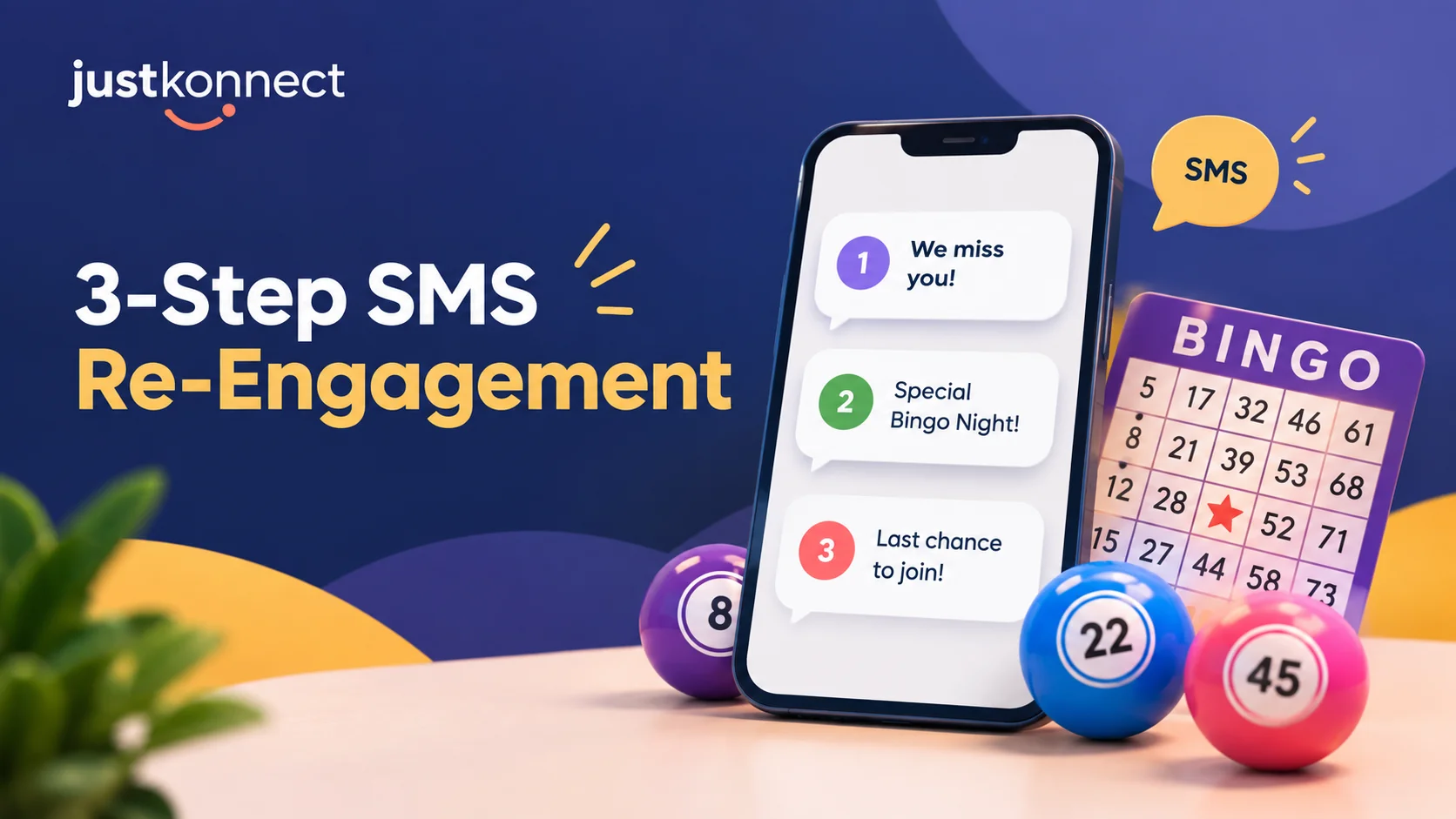
Instead of sending one large “We miss you” message to every inactive customer, a bingo hall can build a simple three-step sequence that automatically responds to inactivity and gives the player several opportunities to return.
The sequence doesn't need to be complicated.
In fact, starting with three carefully planned messages can be more useful than building a dozen automated campaigns that nobody has time to manage.
The goal is straightforward:
Identify inactivity → start communication → create a reason to return → learn from the response.
First, Define What “Lapsed” Means for Your Hall
Before creating an SMS sequence, decide when a player should be considered inactive.
There is no universal number that works for every bingo hall.
A venue with players who normally visit three times a week will probably view 30 days of inactivity differently from a venue where customers typically visit once a month.
Start with your normal attendance pattern.
For example, you might define a lapsed player as someone who:
- Has previously visited the venue
- Has not attended for a defined period
- Is eligible to receive marketing communication
- Has not already entered another relevant re-engagement journey
The important part is consistency.
Once the definition is clear, the automation has something objective to work with.
Instead of:
“I think this customer hasn't been in for a while.”
you have:
“This player has reached our inactivity threshold.”
That is much easier to automate.
The 3-Step Structure
A practical re-engagement sequence can be built around three different jobs:
Step 1: Remind the player about the venue.
Step 2: Give them a reason to return.
Step 3: Create a final opportunity to re-engage.
The messages should not feel like three copies of the same promotion.
Each one should move the conversation forward.
Step 1: Remind Them They Are Still Part of the Community
The first message shouldn't immediately feel like a hard sell.
The player already knows your venue.
They have been there before.
Your first job is simply to reopen the relationship.
For example:
We haven't seen you at the hall recently. If you're thinking about your next bingo night, we'd love to see you again. Check what's coming up this week.
The exact wording can be adapted to your venue, but the principle is important:
Don't assume the customer needs a discount before giving them a reason to think about visiting again.
There could be many reasons they haven't attended.
Their schedule changed.
They were travelling.
They simply forgot.
They found another activity.
Or they have not seen anything recently that caught their attention.
The first message gives them a reason to reconsider the venue without making the communication overly complicated.
Why the First Message Should Be Simple
A re-engagement campaign is not the place to explain your entire loyalty programme.
Avoid filling the first SMS with:
- Multiple offers
- Several event dates
- Long descriptions
- Every current promotion
- Unrelated announcements
Give the player one clear idea.
“We'd like you to come back.”
Then give them an easy way to discover what is happening.
Step 2: Give Them Something Specific to Come Back For
If the player doesn't respond to the first message, the second message should add a new reason to pay attention.
This could be:
- A special bingo night
- A charity event
- A themed session
- A loyalty reward
- A seasonal activity
- A new promotion
- A particularly relevant upcoming event
For example:
Looking for a reason to come back? Our special Friday bingo night is coming up this week. See what's planned and join us for the next session.
The difference between Step 1 and Step 2 is subtle but important.
Step 1 reconnects.
Step 2 creates an opportunity.
You are no longer simply asking the player to return.
You are showing them something specific they can return for.
Make the Second Message Relevant
A common mistake is assuming that every inactive player responds to the same incentive.
If your system contains useful player information, use it responsibly.
For example, someone who regularly attended Friday sessions may be more interested in a Friday event than a Tuesday promotion.
A former frequent visitor may respond differently from someone who only attended occasionally.
This is where CRM and player data can make SMS marketing more useful.
The aim isn't to create an elaborate personalisation strategy.
It is simply to avoid treating every inactive player as identical when your data tells you otherwise.
Step 3: Give the Player One Last Reason to Reconsider
If the first two messages haven't generated a response, the third should not simply say the same thing again.
This is your final planned touch in the sequence.
You might use a stronger event reminder, a relevant reward, or a clear invitation.
For example:
It's been a while! We'd love to welcome you back. Take a look at this week's bingo sessions and see if there's a night that works for you.
Or, if there is a genuine time-limited opportunity:
Final reminder: our special bingo event is this week. If you'd like to join us, check the details and plan your visit today.
The third message should create closure.
If the player still doesn't respond, continuing to message them repeatedly may not improve the relationship.
Sometimes the right automated action is to stop messaging for a while and allow the player to re-enter communication later based on a new qualifying event.
Put Time Between the Messages
Three messages sent within a few hours can feel like one long advertisement.
A drip sequence works because there is space between the communications.
A simple structure could look like:
Day 1: Reconnection message
Day 4: Relevant event or incentive
Day 8: Final reminder
The exact timing should depend on your normal visit cycle and the type of campaign.
If your customers normally visit several times a week, a shorter interval may make sense.
If visits are less frequent, the sequence can be spread further apart.
The important thing is to avoid creating a situation where a player receives three messages before they've had a realistic chance to respond to the first one.
Build the Sequence Around a Trigger
The biggest advantage of automation is that staff don't need to manually identify every inactive customer.
Instead, define a trigger.
For example:
No qualifying visit for X days
↓
Check communication eligibility
↓
Start re-engagement sequence
↓
Send Step 1
↓
Wait
↓
Check player activity
↓
Continue only if appropriate
This last part matters.
Suppose a player receives Step 1 on Monday and returns to the hall on Tuesday.
There is no reason to keep treating them as lapsed.
The automation should recognise the behaviour change where the platform supports that logic.
The player's action becomes more important than the original trigger.
Stop the Campaign When the Player Comes Back
This is one of the most important rules in a re-engagement campaign.
Imagine a player hasn't visited for 30 days.
They receive your first SMS.
The next day, they visit.
Then on Friday, they receive:
We haven't seen you recently. Come back to the hall!
That message is obviously out of sync with reality.
The player already came back.
A good automated journey should account for that.
The campaign logic should ideally be:
Inactive → enter sequence
but:
Visit → leave sequence
This makes automation feel much more intelligent.
It also prevents the venue from wasting messages on players who have already re-engaged.
Don't Make “Discount” the Only Reason to Return
Discounts can be useful.
But they shouldn't become the foundation of your entire re-engagement strategy.
If every inactive player receives a discount, customers can eventually learn to wait until they stop visiting before expecting an offer.
Instead, consider other reasons to return.
Experiences
Promote a themed or special event.
Community
Highlight a charity or fundraising evening.
Loyalty
Remind players about relevant rewards or progress.
Competition
Connect the visit to a challenge or gamified activity.
Convenience
Tell players about upcoming sessions that fit their usual attendance pattern.
The objective is to remind customers that something is happening at your venue worth returning to.
Create Different Sequences for Different Problems
Once your first three-step campaign works, you can make the journeys more specific.
A player who has been inactive for 14 days isn't necessarily the same as someone who hasn't visited in six months.
You could eventually have separate strategies for:
Recently inactive players
A light reminder.
Longer-term inactive players
A stronger reactivation campaign.
Former frequent players
A campaign focused on returning to their usual sessions.
Players with unused loyalty rewards
A reward-focused message.
Former event attendees
An invitation to another relevant event.
You don't need all of these immediately.
Start with one useful sequence.
Then expand based on what the data tells you.
What Should You Measure?
A drip campaign should not be judged by how many SMS messages were sent.
That's an operational metric, not necessarily a business outcome.
Instead, track what happens after the sequence begins.
Useful measurements can include:
- Number of players entering the campaign
- Delivery rate
- Engagement
- Link activity
- Return visits
- Time to reactivation
- Loyalty activity
- Reward redemption
- Conversion by message
- Percentage remaining inactive
The most important question is:
How many players became active again?
Look at Each Step Separately
Suppose 1,000 players enter the sequence.
After Step 1:
80 players return.
After Step 2:
60 additional players return.
After Step 3:
25 additional players return.
That tells you something much more useful than simply knowing that 165 players eventually came back.
Step 1 may be doing most of the work.
Step 2 may be producing a smaller but meaningful lift.
Step 3 may have limited impact.
Now you have a reason to test the campaign.
Perhaps Step 2 needs a stronger event.
Perhaps Step 3 is too late.
Perhaps Step 1 needs a different message.
That is how an automated campaign becomes an optimisation process rather than a set-and-forget workflow.
Use a Baseline Before Calling the Campaign a Success
There is another important question:
Would some of these players have returned anyway?
If 200 inactive players come back after receiving messages, that sounds positive.
But you need context.
Compare the result with:
- Previous reactivation rates
- Similar player groups
- Comparable time periods
- Other campaigns
- Your normal attendance patterns
The more consistently you measure, the easier it becomes to determine whether your SMS strategy is actually improving re-engagement.
You don't need to become a data analyst.
You just need to ask the right questions.
Watch for the Players Who Never Respond
Not every inactive customer will return.
That's normal.
The goal isn't to keep pushing messages until somebody responds.
If a player doesn't engage with the sequence, consider whether they should be paused or moved into a longer-term re-engagement strategy.
This protects the customer experience while keeping your active campaigns focused on people who are more likely to respond.
Good automation knows when to continue.
Better automation also knows when to stop.
A Three-Step Campaign You Could Build This Week
If you want to start without overcomplicating things, use this framework.
Day 1 — “We Miss You”
Purpose: Reconnect.
Tell the player that the venue has noticed their absence and remind them that there are upcoming opportunities to visit.
Day 4 — “Here's What's Happening”
Purpose: Give them a reason.
Promote one relevant upcoming event, session, loyalty opportunity, or other genuine reason to return.
Day 8 — “One More Invitation”
Purpose: Encourage action.
Give the player a final reminder and a clear next step.
Then stop the sequence if there is no response.
This is deliberately simple.
The objective is not to create the most sophisticated automation possible.
It is to create something that can run consistently and improve over time.
What Happens When the Player Returns?
The re-engagement journey shouldn't be the end of the story.
Once the player visits again, the next stage can focus on retention.
For example:
Lapsed player
↓
Re-engagement drip
↓
Returns to venue
↓
Exit re-engagement
↓
Normal loyalty journey
↓
Future event communication
That is a much stronger customer journey than repeatedly asking an inactive player to come back.
You have moved them from reactivation back into the normal player relationship.
Keep the Automation From Colliding With Other Campaigns
Bingo halls rarely run only one marketing campaign.
At the same time as your lapsed-player drip, you may have:
- A Friday event campaign
- A loyalty promotion
- A VIP campaign
- A charity fundraiser
- A seasonal promotion
- A general SMS blast
Without coordination, one player could receive several unrelated messages within a short period.
That is why centralised campaign management becomes increasingly valuable as your marketing programme grows.
The operator needs to see not just:
“Which campaign is running?”
but:
“What communication is this player currently receiving?”
Compliance Should Be Part of the Setup
Re-engagement automation should never be treated as an excuse to contact people indefinitely.
Before activating a sequence, make sure the audience meets your applicable SMS marketing requirements, including appropriate consent and opt-out handling.
Also consider what happens when someone changes their communication preferences.
An automated system should make compliance easier to manage, not create another manual process for the team.
Why Automation Changes the Economics of Re-Engagement
Without automation, a staff member might need to:
- Export inactive players.
- Filter the list.
- Check who should receive messages.
- Write the campaign.
- Send the first message.
- Wait several days.
- Recheck activity.
- Send the next message.
- Remove returning players.
- Review the results.
That process becomes increasingly difficult as the database grows.
Automation turns many of those repetitive tasks into rules.
The team can spend less time maintaining lists and more time deciding which player journeys are worth building.
Where JustKonnect Fits
For bingo halls, SMS re-engagement works best when it is connected to the rest of the player relationship rather than operated as a separate messaging exercise.
JustKonnect's SMS Drip Campaigns feature is designed to support automated communication journeys, including re-engagement workflows based on player inactivity. The wider platform connects customer data, attendance, loyalty, and communication so operators can build campaigns around what players actually do.
That distinction matters.
The objective isn't simply to automate three texts.
It's to create a repeatable process where:
Player becomes inactive → system identifies the opportunity → messages are sent automatically → player activity is checked → campaign adjusts or stops → results are measured.
That gives the bingo hall a much more practical way to manage re-engagement at scale.
Start With One Lapsed-Player Journey
You don't need to automate every customer interaction on day one.
Take one clearly defined group of inactive players.
Build three messages.
Give each message a different purpose.
Set reasonable gaps between them.
Create an exit condition for players who return.
Then measure what happens.
After the first campaign has run, look at where players responded.
If the first message generates the most returns, improve that message.
If the second message performs better, investigate why.
If almost nobody responds to the third, consider whether it should exist at all.
The point of automation isn't to remove decision-making.
It is to give you a system that executes your decisions consistently and gives you evidence for the next one.
Frequently Asked Questions
What is an SMS drip campaign for lapsed bingo players?
It is an automated sequence of SMS messages sent to players after they meet a defined inactivity condition. The messages are spaced over time and designed to encourage the player to return.
How many messages should a re-engagement drip campaign contain?
Three messages are a practical starting point. Each should have a different purpose rather than repeating the same promotion. The sequence can be expanded or shortened based on campaign performance.
How long should you wait between re-engagement SMS messages?
The timing depends on how frequently players normally visit your venue. A few days between messages can provide enough space to respond without making the sequence feel repetitive, but operators should test timing against their own attendance patterns.
Should every lapsed player receive the same SMS?
Not necessarily. Segmentation can make campaigns more relevant by considering factors such as previous attendance behaviour, event participation, loyalty activity, and other appropriate customer data.
What should happen if a player returns during the drip sequence?
Ideally, the player should exit the re-engagement sequence once they become active again. Continuing to send “we miss you” messages after a return can create an obviously disconnected customer experience.
How do you know whether a re-engagement drip is working?
Measure the behaviour that matters, particularly return visits and reactivation. Also review delivery, engagement, redemptions, loyalty activity, and the performance of each step in the sequence.
From Manual Follow-Ups to Always-On Re-Engagement
Lapsed players are easy to overlook because inactivity happens gradually.
A customer misses one session.
Then another.
Then the record sits quietly in the database.
By the time someone notices, the opportunity to reconnect may have passed.
A three-step SMS drip gives the venue a simple way to respond earlier.
It doesn't require an elaborate customer journey.
It requires a clear definition of inactivity, three purposeful messages, sensible timing, an exit condition, and a way to measure what happened.
Once that foundation is working, the same approach can be extended to other player journeys—new members, loyalty milestones, event participation, VIP progression, and more.
For bingo operators ready to move beyond manually checking inactive lists and sending one-off messages, JustKonnect's SMS Drip Campaigns feature offers a way to build those automated journeys into a broader player engagement strategy.
Don't wait until a player has been gone for months. Build the journey that gives them a reason to come back.