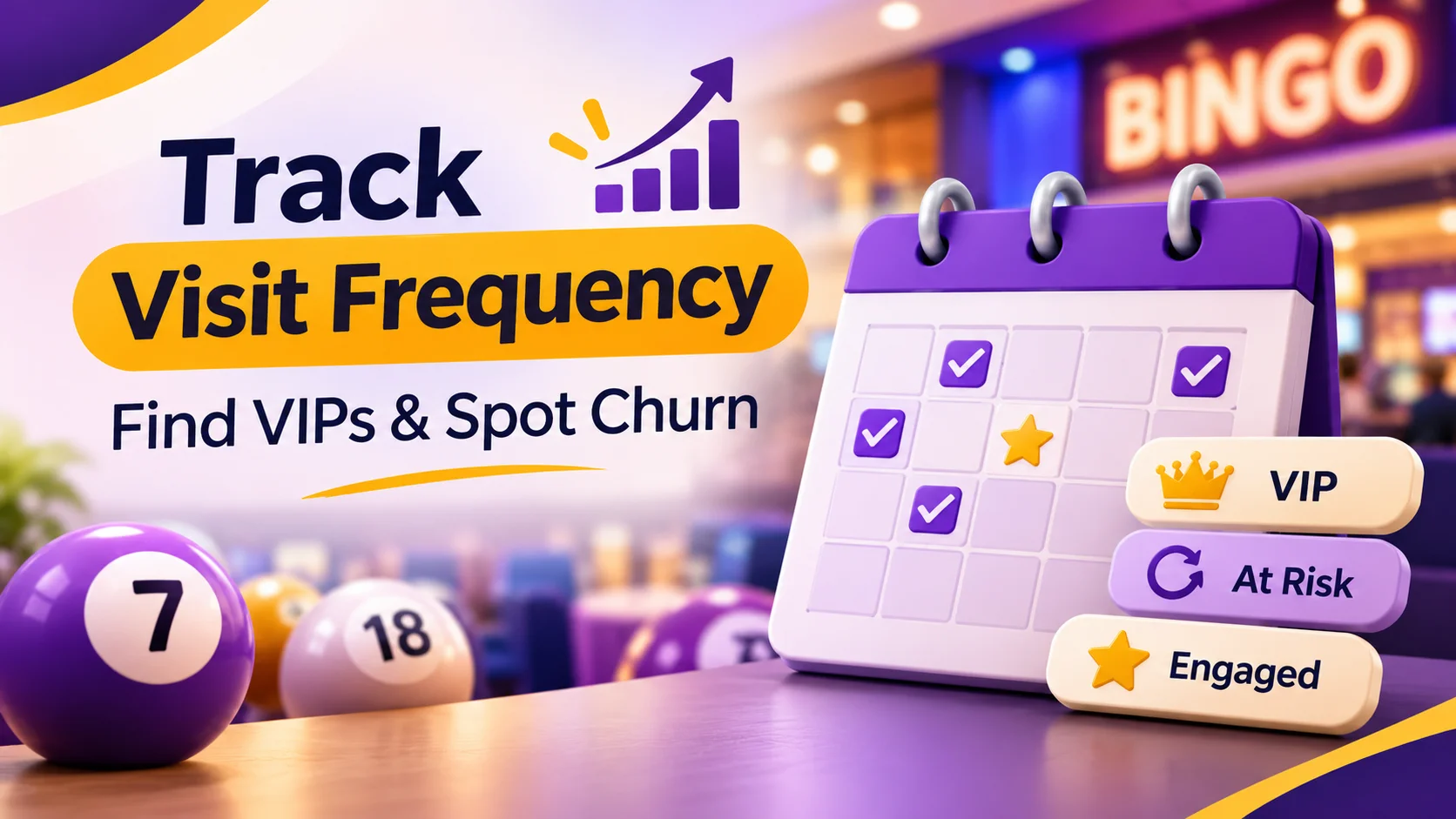
A player visits your bingo hall every Tuesday and Friday. Another comes once or twice a month. A third used to attend every week but has recently started missing sessions.
If all three appear in the same contact database, it is easy to overlook how differently they engage with your venue.
Yet their attendance histories tell three distinct stories. One has established a consistent routine. Another prefers occasional visits. The third may be moving away from a previously regular pattern.
For bingo hall operators, these differences can shape key decisions: who deserves recognition, which players may need a retention message, and when a campaign is most likely to be relevant.
This is where visit frequency tracking becomes useful.
Instead of relying on total attendance figures or manually checking player records, operators can examine how often individual members visit and how those patterns change over time.
Visit frequency is more than a count of sessions. It is a practical way to understand player habits and make better engagement decisions.
One Attendance Record, Three Very Different Player Relationships
Consider three fictional members of the same bingo hall.
Player A – Consistent Attendee
- 8 visits per month.
- Attends about twice a week and follows a routine.
Player B – Occasional Visitor
- 2 visits per month.
- Visits mainly for special events, not every week.
Player C – Declining Regular
- 1 visit this month.
- Previously attended twice a week but has recently reduced visits.
Note: These are illustrative examples, not actual customer data.
A basic attendance report might show that these players contributed 8, 2, and 1 visits, respectively. Visit frequency tracking adds the context needed to interpret those numbers.
Player A may be a candidate for recognition through a loyalty programme. Player B may need event information that matches their interests. Player C may deserve a closer look before their declining attendance becomes prolonged inactivity.
The important point is that a useful campaign decision starts with understanding the player's existing pattern.
1. Identify VIPs Through Consistent Attendance, Not Just Contact Lists
Many bingo halls have players who return regularly and contribute to a dependable audience. These members may be among the most familiar faces in the venue.
However, operators do not always have a clear way to distinguish consistent attendance from occasional participation.
A contact list tells you who has registered. A visit-frequency record helps show who actually returns.
What makes an attendance pattern valuable?
A hall can examine several factors when identifying potential VIPs:
- Number of visits during a defined period.
- Consistency of attendance from week to week.
- Length of the player's relationship with the hall.
- Participation in loyalty rewards.
- Changes in attendance over time.
For example, someone who attends twice a week for several months demonstrates a different pattern from someone who visits frequently during one special event and then disappears.
That does not automatically make the first person a VIP. The venue should define VIP eligibility through clear programme criteria, which may include attendance, loyalty status, and other legitimate requirements.
Visit frequency provides useful evidence for those decisions.
Turn attendance recognition into meaningful loyalty
Once the hall has established its VIP criteria, it can use attendance information to make recognition more relevant.
Possible approaches include:
- Acknowledging membership milestones.
- Communicating eligible VIP benefits.
- Inviting qualifying members to relevant events.
- Sharing loyalty programme updates.
- Recognising sustained participation.
Avoid assuming that every frequent visitor wants more promotional messages. Recognition should reflect the benefits your programme genuinely provides.
The objective is to make loyal players feel valued without turning their established relationship with the hall into a constant sales opportunity.
2. Spot Declining Attendance Before a Regular Becomes a Lapsed Member
One of the most useful applications of visit frequency tracking is identifying when an established routine starts to change.
Imagine a player who normally attends eight times each month. Their visits gradually fall to five, then three, and eventually one.
A simple monthly total tells you that attendance has declined. Comparing recent activity with the player's usual pattern helps explain why the change deserves attention.
Why a fixed inactivity rule can miss the early warning
A player who visits twice a week may be showing a meaningful change after two weeks without a visit.
An occasional visitor may normally go several weeks between sessions.
Applying the same inactivity threshold to both players can produce misleading results.
A more useful approach considers the player's previous frequency and compares it with recent activity.
Operators can review:
- Normal visits per week or month.
- Recent visits over the same type of period.
- The number of sessions missed compared with the usual routine.
- Whether the decline is continuing.
- Whether other available engagement signals have changed.
A decline does not prove that someone intends to stop attending. Work, family commitments, health, travel, and other personal circumstances can affect routines.
The purpose of tracking is to highlight a change that may need attention, not to assume the reason behind it.
Choose the right retention response
Different attendance patterns call for different levels of follow-up.
| Attendance pattern | What it may suggest | Appropriate response |
| Stable frequent visits | Established routine | Maintain relevant communication and recognition |
| Slight reduction in visits | Possible temporary change | Monitor before taking action |
| Sustained decline from normal frequency | Potential loss of engagement | Review the player's history and consider a relevant reminder |
| Extended inactivity | Possible lapsed status | Consider an appropriate win-back campaign |
| Return after inactivity | Re-engagement | Welcome the player back and monitor subsequent visits |
This approach helps prevent the hall from treating every missed session as a churn problem.
For more advanced follow-up, visit frequency can also work alongside Last Visit Tracking, which focuses on how recently a player attended.
3. Time Campaigns Around Actual Attendance Habits
A promotional message can contain the right offer and still arrive at the wrong time.
For example, sending a reminder about a Friday session on Saturday morning is unlikely to help someone decide whether to attend that Friday. Similarly, sending the same weekly announcement to a player who only visits for special events may not be especially relevant.
Visit frequency tracking gives operators a clearer understanding of when different players tend to attend.
Use preferred attendance patterns to guide communication
Consider a hall with three broad groups:
Tuesday regulars: These players usually attend the same weekday session. They may benefit from a concise reminder before that session or an update about a relevant change.
Weekend attendees: Their attendance is concentrated around Friday and Saturday. Campaigns can focus on upcoming weekend sessions and events.
Occasional visitors: They attend less frequently and may need information about selected events rather than routine session reminders.
The hall can use these patterns to shape the timing and subject of its campaigns.
This does not mean that historical attendance can guarantee when a player will next visit. It simply provides a better starting point than sending every campaign at the same time to the entire database.
Example: One event, three campaign approaches
Suppose your hall is promoting a special Saturday event.
Rather than sending an identical message to every member, consider how the message could differ:
| Audience | Campaign angle | Example message |
| Regular Saturday attendees | Direct event reminder | "Your usual Saturday session has a special event this week. Check the details here: [link]." |
| Weekday regulars | Invitation to try another session | "Looking for something different this week? Join us for our special Saturday event on [date]." |
| Occasional visitors | Welcoming event announcement | "We'd love to welcome you back for our Saturday event. View the schedule and details here: [link]." |
These are illustrative examples. The actual campaign should reflect the event, audience eligibility, communication permissions, and information available.
The benefit is not necessarily sending more messages. It is making the messages more appropriate for the people receiving them.
4. Find the Right Moment for Loyalty Campaigns
A loyalty programme should give players a reason to remain engaged, but the timing of its communications matters.
If a player has just visited and received a reward update, another promotional message the following morning may add little value.
On the other hand, a player approaching a meaningful membership milestone may appreciate an acknowledgement or an update about an eligible benefit.
Visit frequency helps operators understand where players are in their attendance patterns, while loyalty records provide additional context about their programme participation.
Three useful loyalty campaign opportunities
Attendance milestones
Where the programme supports them, recognise qualifying milestones such as a defined number of visits or membership anniversaries.
Consistent participation
Communicate relevant programme benefits to players who regularly engage with the hall, rather than relying exclusively on general promotional blasts.
Reduced participation
If a previously active member's attendance begins to decline, review whether a suitable loyalty reminder or event invitation might be appropriate.
A reward should have a clear purpose and transparent terms. Redemption numbers alone should not be treated as proof that a campaign increased attendance.
For more context, operators can connect attendance information with their Loyalty Points & Rewards programme.
5. Understand Which Player Groups Need Different Campaigns
Visit frequency can help operators build more useful audience groups.
Rather than treating the entire database as one audience, the hall can classify members according to their actual attendance behavior.
For example:
- High-frequency attendees.
- Consistent weekly visitors.
- Occasional event attendees.
- New members with limited visit history.
- Previously regular members with declining attendance.
- Longer-term inactive players.
These groups can support different marketing decisions.
A high-frequency attendee may qualify for VIP recognition. A new player may need a welcome journey. A declining regular may warrant a retention review. An occasional visitor may respond better to selected event announcements.
The key is to use categories that lead to an action. Creating dozens of segments without a clear communication purpose adds complexity rather than value.
JustKonnect's Customer Segmentation capability is relevant here because it is designed to help operators group players according to behavior and engagement criteria for more targeted campaigns.
6. Know Whether Your Campaigns Are Changing Attendance
One of the biggest mistakes in marketing is assuming that a successful message automatically produces a successful business outcome.
A campaign may have a high delivery rate, strong engagement, or many offer redemptions. But did the intended players actually attend?
Visit frequency tracking gives operators a way to examine attendance patterns around their campaigns.
Measure the result that matches the objective
If the campaign was designed to encourage inactive players to return, measure how many recipients attended again within the selected period.
If the objective was to encourage weekday regulars to try a Saturday event, compare attendance among the intended audience.
If the goal was to maintain engagement with VIP members, review whether their attendance patterns remained consistent.
Useful measures include:
- Visits before and after a campaign.
- Repeat attendance during a defined period.
- Attendance among targeted versus non-targeted groups.
- Changes in visit frequency.
- Redemption activity alongside actual visits.
Where practical, compare similar players who received different campaign treatments or did not receive the campaign. This helps estimate whether the promotion contributed to additional visits.
Be careful about attributing every attendance increase to marketing. Special events, seasonal patterns, and changes to session schedules can also affect results.
7. Why Manual Visit Tracking Becomes Difficult as Your Hall Grows
A small hall may initially manage player attendance through spreadsheets or manual records.
But as the database expands, the work becomes more complicated.
Staff may need to:
- Combine attendance information from different records.
- Calculate individual visit totals.
- Identify players whose frequency has changed.
- Update VIP or lapsed-player lists.
- Check whether campaign recipients have returned.
- Prepare reports for managers.
The process takes time, and inconsistent updates can create problems.
A player may qualify for a particular segment but remain on an outdated list. Another may have returned after a win-back campaign, yet still receive messages intended for inactive members.
These issues can affect both campaign relevance and the player experience.
An attendance-focused CRM can reduce the need to compile this information manually by keeping player records and visit history organised in one place.
JustKonnect's Player Profiles & CRM is designed around bingo attendance rather than retail purchase transactions. Its feature information describes player-level visit history, session attendance, automatically calculated visit frequency, preferred session patterns, and attendance-related indicators.
This gives operators a more practical foundation for understanding how individual players engage with their hall.
A Simple Visit Frequency Review for Bingo Hall Operators
You do not need to analyse every player individually every day to make visit frequency useful.
A regular review can help operators spot important changes and decide where attention is needed.
| Review area | What to check | Decision to make |
| Frequent attendees | Consistency of visits | Who qualifies for loyalty recognition? |
| New members | Visits after signup | Does the welcome journey need improvement? |
| Declining regulars | Change from normal frequency | Who needs a retention review? |
| Occasional visitors | Preferred attendance periods | Which events should they hear about? |
| Inactive members | Time since last visit | Is a suitable win-back campaign appropriate? |
| Campaign recipients | Visits after communication | Did the campaign meet its attendance objective? |
A useful review should end with a small number of clear actions.
For example, an operator might identify a group of declining regulars, prepare an appropriate event reminder, and review their attendance again after the campaign.
The aim is to make tracking part of an ongoing operating process rather than a report that nobody acts upon.
How JustKonnect Visit Frequency Tracking Supports Bingo Hall Operations
JustKonnect's Visit Frequency Tracking is designed specifically around the way bingo players attend sessions and interact with games, offers, and loyalty programmes.
Unlike retail loyalty tools that focus mainly on purchases and transactions, an attendance-focused approach helps operators understand how frequently individual members visit the hall.
The feature page describes a workflow in which operators configure messages, rewards, or rules, launch campaigns, and track outcomes using attendance-related information.
This supports several practical activities:
Understanding repeat attendance: Review player activity to identify consistent visitors and changing attendance patterns.
Supporting player recognition: Use attendance information as part of a clearly defined loyalty or VIP programme.
Planning targeted communication: Make campaign decisions using relevant player activity rather than relying only on a general contact list.
Reviewing campaign outcomes: Examine attendance patterns and reward activity to understand whether campaigns are meeting their objectives.
Reducing manual administration: Use organised tracking and reporting rather than repeatedly combining attendance information by hand.
The feature can also be considered alongside Last Visit Tracking and Analytics, which provide additional context for understanding player recency and campaign performance.
The broader value is the connection between attendance records and marketing decisions. Instead of simply knowing that a player visited, operators can better understand how frequently they return and whether that pattern is changing.
Frequently Asked Questions
What is visit frequency tracking in a bingo hall?
Visit frequency tracking records how often individual players attend bingo sessions over a defined period. It helps operators understand repeat attendance, identify consistent visitors, and notice changes in player activity.
How can visit frequency help a bingo hall identify VIP players?
Operators can use consistent attendance as one factor when defining VIP eligibility. By reviewing visits over time alongside loyalty status and programme rules, halls can identify members who qualify for recognition or specific benefits.
Can visit frequency tracking identify players who may stop attending?
It can help highlight declining attendance patterns by comparing recent visits with a player's normal routine. A decline is a warning sign rather than proof of churn, so operators should review the context before taking action.
How often should bingo halls review player visit frequency?
Weekly reviews are a practical starting point for many halls because they align with recurring session schedules and campaign planning. Operators can also review individual attendance changes more frequently when their tracking system supports it.
How does visit frequency help with campaign timing?
It shows when different players tend to attend and how regularly they return. Operators can use this information to plan relevant reminders, event announcements, and loyalty communications around established attendance patterns.
Is visit frequency the same as last-visit tracking?
No. Visit frequency measures how often a player attends over a selected period, while last-visit tracking focuses on how recently they attended. Together, the two measures provide a more complete picture of player activity.
Can visit frequency tracking show whether a marketing campaign increased attendance?
It can help operators examine attendance before and after a campaign and compare results across different player groups. However, proving that a campaign caused additional visits requires careful measurement and, where practical, a suitable comparison group.
Make Every Attendance Pattern More Useful
Some players build a dependable weekly routine. Others prefer occasional visits. Some have become familiar faces but are gradually attending less often.
Treating all of them as the same audience makes it harder to recognise loyalty, identify changing engagement, and communicate at the right moment.
Visit frequency tracking gives bingo halls a clearer way to understand these differences. It can support VIP recognition, early retention reviews, more relevant campaign timing, and better measurement of attendance outcomes.
Explore JustKonnect Visit Frequency Tracking to see how attendance-focused tracking can help your hall understand player habits and make more informed decisions about engagement and retention.