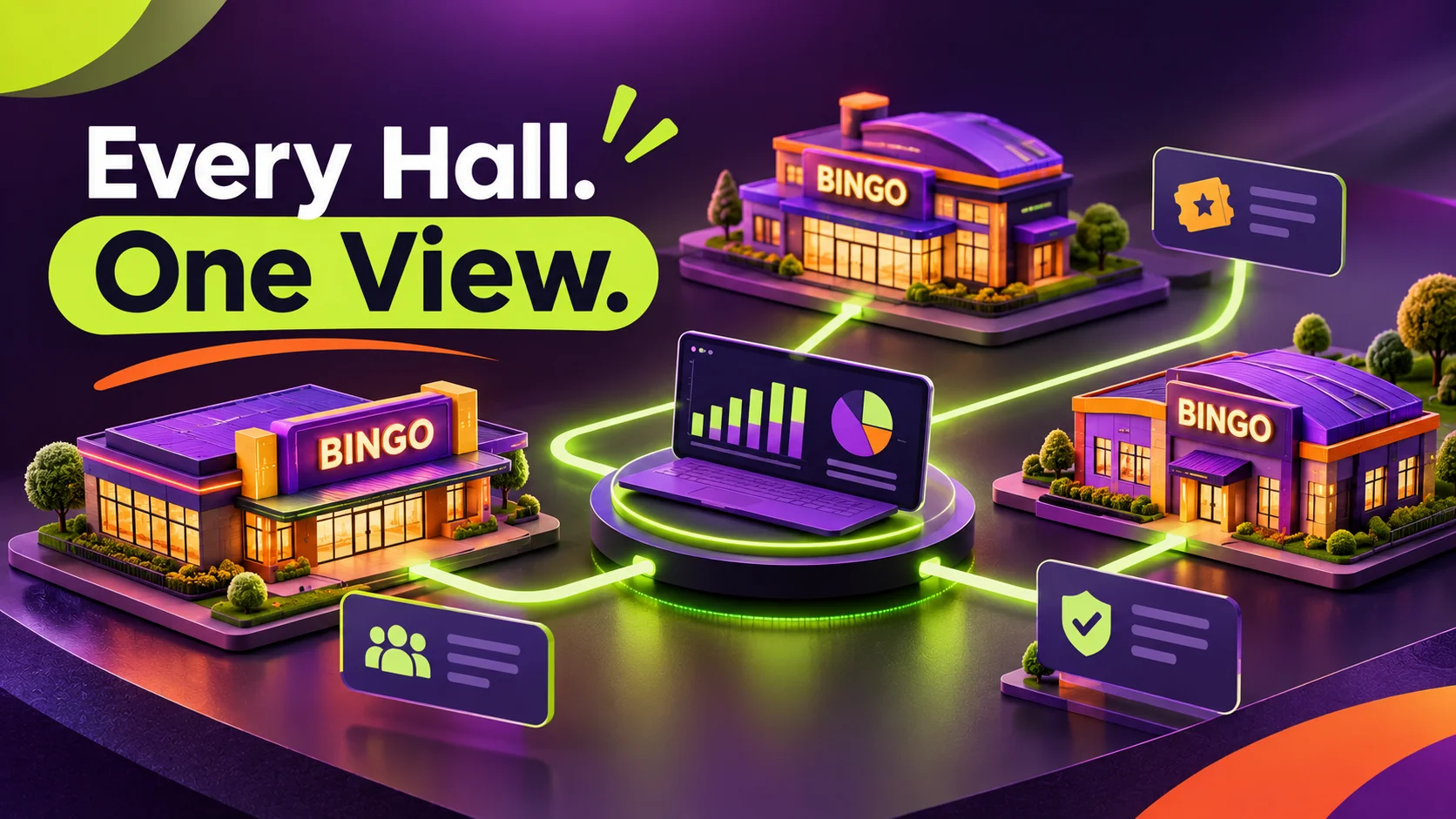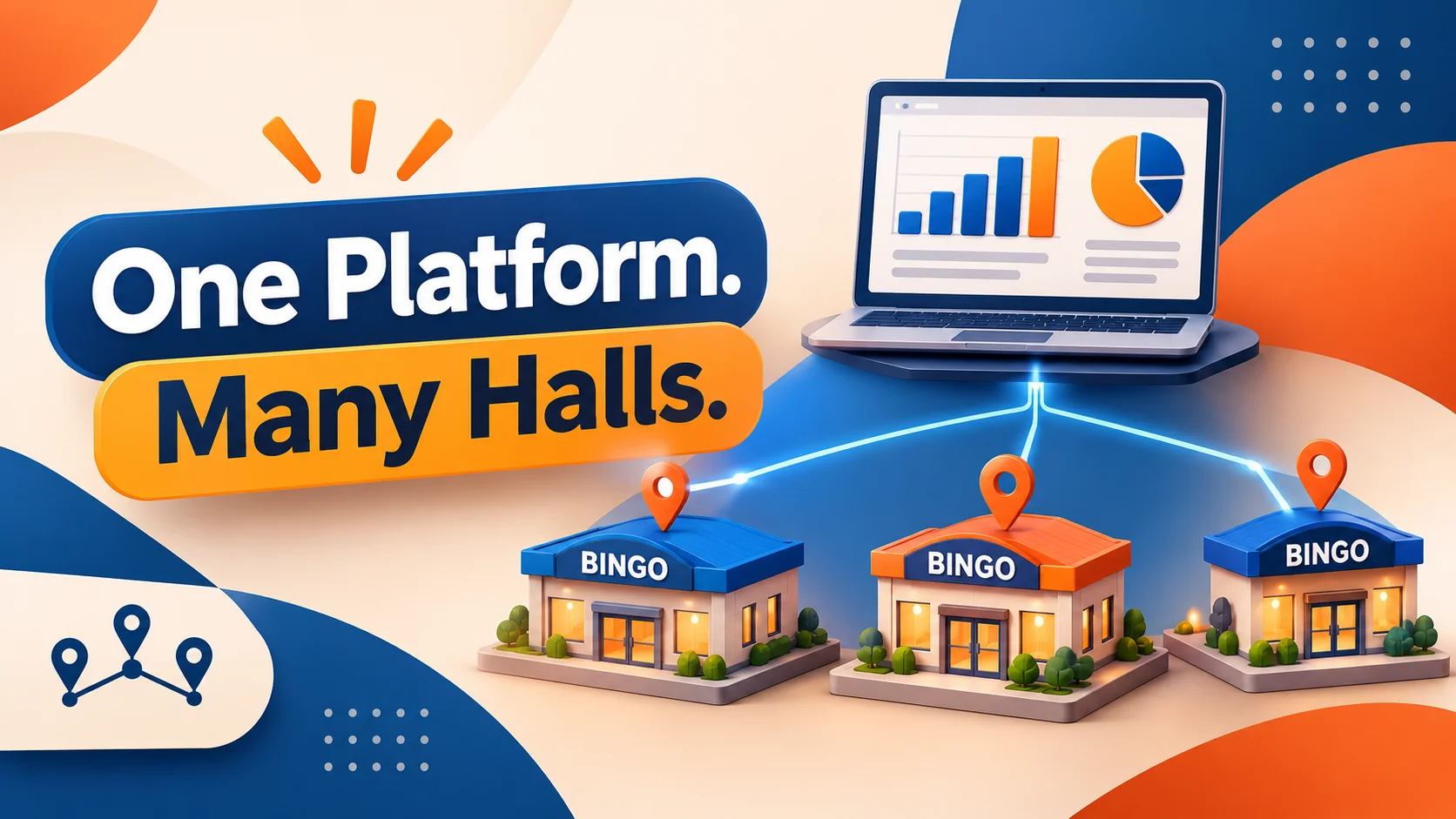
Running one bingo hall and running several bingo halls may look like the same job on a larger scale. Both involve player communication, attendance tracking, loyalty programmes, promotions, staff coordination, and operational reporting.
The difference becomes clear when information needs to move between locations.
A single-location system is generally designed to help one venue manage its own players and daily activities. A multi-location platform has a broader responsibility: it must help an organisation coordinate several venues without losing sight of what is happening at each hall.
That distinction matters. Adding another location does not simply increase the number of records in a database. It introduces new questions about shared player information, management oversight, campaign consistency, staff responsibilities, reporting, and organisational control.
For bingo operators planning to expand, understanding this difference is essential before choosing software.
One Hall and Several Halls Are Two Different Operating Environments
A single-location bingo hall usually has a relatively straightforward management structure. Staff work within one venue, promotions are planned for one audience, and management reviews activity from one operational environment.
The software needs to support that environment efficiently.
When an organisation operates multiple halls, however, the same tasks become more complicated.
Consider an operator managing three locations:
- Hall A runs its busiest sessions during the week.
- Hall B attracts more players on weekends.
- Hall C has a different local audience and promotional calendar.
Each venue needs to retain its own operational identity. At the same time, the organisation needs a reliable way to understand overall performance.
If every hall uses a completely separate system, managers may have to switch between accounts, combine reports manually, and repeat campaign setup. If everything is placed into one shared environment without proper location separation, local information and responsibilities can become difficult to manage.
A genuine multi-location platform needs to address both sides of the problem: central oversight and individual hall management.
The Real Difference Is in How Information Is Managed
The most important distinction between single-location and multi-location software is not the number of dashboards. It is the way information is organised, accessed, and used.
A single-location platform can provide a complete view of one hall. A multi-location platform needs to make information useful at two levels:
The location level: What is happening at this particular hall?
The organisational level: What is happening across all the halls combined?
Both views serve different purposes.
A local manager may need to review attendance, player engagement, and campaign activity at their venue. An operations director may need to compare those same measures across the organisation.
Without a structured multi-location approach, these questions often require separate reports and manual consolidation.
1. Player Records Must Work Across Locations
Player information becomes more difficult to manage when members visit different halls.
Imagine a player who regularly attends Hall A but occasionally visits Hall B. If both locations maintain completely separate player databases, the organisation may struggle to understand that these visits belong to the same person.
This can lead to fragmented engagement histories and inconsistent communication.
A multi-location platform should support cross-location player recognition, allowing operators to understand activity across participating halls while retaining the ability to review individual location activity.
This is particularly useful for:
- Identifying players who visit more than one venue.
- Understanding how attendance is distributed across locations.
- Maintaining a more complete engagement history.
- Avoiding unnecessary duplication of player records.
- Supporting more relevant communication and loyalty activity.
A bingo-focused player CRM provides the foundation for organising player information around attendance and engagement rather than treating every interaction as an isolated contact record.
2. Campaign Management Needs Both Central Control and Local Flexibility
A single-location hall can usually plan its promotions around one calendar and one audience.
A multi-location organisation has more decisions to make.
Should an announcement go to every hall? Should a promotion apply only to one venue? Should each location use the same message but promote different session times?
These are not simply marketing questions. They are operational decisions that affect communication accuracy and staff workload.
A true multi-location platform should make it possible to manage campaigns at the appropriate level.
For example, an organisation might want to announce a special fundraising event across all its halls. In another situation, only Hall B may need to promote an additional Saturday session.
The important distinction is that the operator should not have to rebuild the entire communication process for every venue.
A centralised campaign structure can support:
- Organisation-wide announcements.
- Location-specific promotions.
- Consistent campaign planning.
- More organised audience targeting.
- Better visibility into campaign activity.
This gives management a consistent framework without forcing every hall to run identical promotions.
3. Reporting Must Show the Individual Hall and the Entire Organisation
Reporting is where the limitations of single-location software often become especially noticeable.
A report from one venue can tell management how that venue is performing. It cannot automatically explain how the wider organisation is performing.
Multi-location operators need both perspectives.
| Reporting requirement | Single-location software | Multi-location platform |
| Individual hall activity | Reviews one venue | Reviews each venue separately |
| Organisation-wide reporting | Usually requires additional consolidation | Provides a combined organisational view |
| Hall comparisons | Limited or manual | Supports location-to-location comparison |
| Campaign performance | Reviews one hall's campaigns | Reviews activity by location and across the organisation |
| Management oversight | Focuses on one venue | Supports local and central review |
For example, suppose total attendance increases across an organisation over a particular reporting period. That figure is useful, but it does not explain where the improvement came from.
One location may have experienced significant growth while another remained unchanged.
A combined report should therefore not replace location-level reporting. Management needs to understand both the overall result and the differences behind it.
With bingo hall analytics and reporting, operators can use campaign activity, attendance patterns, and engagement information to make more informed decisions.
What Happens When Every Hall Operates Independently?
Separate systems are not necessarily a problem when an organisation has only one venue. The difficulty appears when the business grows and the same processes must be repeated across several locations.
The following examples show how operational friction can develop.
Duplicate Work Becomes Part of the Routine
When each hall has its own account and processes, staff may need to create similar campaigns multiple times, maintain separate player lists, and prepare individual reports.
The problem is not that these tasks are impossible. It is that the organisation repeatedly spends time completing work that could be coordinated centrally.
As the number of venues grows, the administrative burden can increase.
Management Loses a Consistent View of Performance
Different locations may use different reporting periods, campaign labels, or methods of recording activity.
This makes comparisons less reliable.
For instance, if one hall reports campaign results weekly and another reports monthly, management cannot make a straightforward comparison without adjusting the information first.
Standardised reporting helps create a more consistent basis for reviewing performance.
Players Can Experience an Inconsistent Programme
A player who visits multiple venues may encounter different communication practices, reward rules, or levels of recognition.
Some differences may be intentional because each hall serves its own local audience. Others may happen simply because the organisation lacks a shared operating structure.
A multi-location approach helps distinguish between the two.
The organisation can maintain common standards while allowing approved local variations.
Compliance Records Become Harder to Consolidate
Record-keeping also deserves attention.
When operational records are held in separate systems, management may need to collect and reconcile information from several locations before an internal review or reporting request.
A centralised platform with location-specific records can make this process more organised.
For charity bingo operators, the distinction is important: central visibility should not mean losing the ability to identify which activity belongs to which venue.
The organisation needs clear, attributable records that can be reviewed at the appropriate level.
The Architecture a Multi-Location Bingo Operator Should Look For
Not every product described as multi-location software provides the same operational capabilities.
Some systems allow users to create multiple venue profiles but leave the underlying management processes separate. Others provide shared access without meaningful location-level reporting.
Operators should look beyond the feature name and evaluate how the platform handles the following areas.
A Central Management Environment
Management should be able to access the locations they oversee without maintaining a collection of disconnected accounts.
A central environment makes it easier to review activity, coordinate campaigns, and understand the organisation's overall position.
Separate Location-Level Visibility
Centralisation should not remove local accountability.
Managers still need to identify which hall generated a particular attendance result, campaign response, or operational record.
The platform should preserve the distinction between individual locations while making combined reporting possible.
Appropriate Staff Access
Not every employee needs access to every venue or organisational function.
A multi-location system should provide an appropriate approach to staff roles and permissions, so responsibilities can be organised around the operator's management structure.
Before selecting a platform, ask how location-level access is configured and whether staff responsibilities can be separated where required.
Shared or Location-Specific Loyalty Rules
An organisation may want players to receive consistent recognition across all its halls. Alternatively, certain rewards may be specific to individual venues.
The software should support the programme structure the organisation actually wants to operate.
A shared loyalty programme can create continuity for players who visit multiple halls, while location-specific rules can accommodate local events and promotions.
Organisation-Wide and Location-Level Reporting
This is a core requirement rather than an optional convenience.
Operators should be able to review individual venue activity and understand combined performance without relying on manually assembled spreadsheets.
Reports should also make it clear which location each record represents.
Why Generic Business Software May Not Be Enough
Some operators try to manage multiple venues using a collection of general-purpose CRM, email marketing, spreadsheet, and loyalty tools.
These products may provide useful individual functions, but they are not necessarily designed around the way charity bingo halls operate.
A retail CRM, for example, may focus on purchases, transaction value, and product history. Bingo operators also need to understand visits, session attendance, player engagement, and repeat participation.
The difference affects how information is collected and how campaigns are planned.
A useful comparison looks like this:
| Software approach | Main strength | Potential operational limitation |
| Single-location bingo software | Supports one hall's daily activities | May not provide organisation-wide visibility |
| Separate systems for each hall | Allows independent venue management | Creates fragmented information and repeated work |
| Generic multi-branch CRM | Provides shared customer management | May not reflect bingo attendance and session patterns |
| Bingo-focused multi-location platform | Connects player engagement and venue management | Should still be evaluated against the operator's specific requirements |
The right solution is not necessarily the one with the longest feature list. It is the one that supports the organisation's actual operating model.
How JustKonnect Supports Multi-Location Bingo Operations
JustKonnect's Multi-Location platform is designed to help bingo operators coordinate player engagement, communication, loyalty, and reporting across multiple halls.
Rather than treating every venue as an unrelated operation, the platform supports a central management approach while preserving location-level visibility.
Its multi-location capabilities are intended to help operators:
- Access multiple halls through a central management environment.
- Review location-level and combined organisational reporting.
- Manage campaigns across the organisation or target individual venues.
- Maintain player activity visibility across participating locations.
- Support shared or location-specific loyalty programmes.
- Organise records and reporting by location.
This approach is particularly relevant to organisations that have outgrown the processes used by a single hall but still need local flexibility.
For example, management could coordinate an organisation-wide announcement while allowing an individual venue to communicate a separate session update. Leadership could review combined performance while local managers remain focused on their own hall's activity.
The objective is not to make every venue operate identically. It is to give the organisation a more consistent way to manage the parts of its operation that need to work together.
When Should a Bingo Organisation Move to Multi-Location Software?
There is no fixed number of halls at which an operator must change systems. The better indicator is the amount of coordination required.
A two-location organisation may already need central reporting and shared player records. Another operator with several venues may have relatively independent operations and different requirements.
Look for these signs that the existing setup is becoming restrictive:
Management is combining reports manually. If someone regularly collects spreadsheets from different halls to prepare an organisation-wide report, the reporting structure may no longer be suitable.
Players are appearing in separate databases. If the same member can have disconnected records at different venues, the organisation may lack a complete view of player engagement.
Campaigns are repeatedly recreated. If staff must manually reproduce the same announcement across several accounts, campaign management may be creating unnecessary work.
Local and central responsibilities are unclear. If managers are unsure who can update player records, change promotions, or review information, access and permission structures need attention.
Growth is increasing administrative pressure. When adding a venue also means adding another set of disconnected systems and reporting processes, expansion becomes harder to manage.
These signs do not automatically mean that the current software is unsuitable. They indicate that the organisation should evaluate whether its systems can support the next stage of growth.
Questions to Ask Before Choosing a Multi-Location Platform
A software demonstration should show how the platform handles real operational situations, not just how its dashboard looks.
Use questions such as these when evaluating a solution:
- Can management access all participating halls from one account?
- Can reports be viewed by individual location and across the organisation?
- Can the same player be recognised when visiting more than one hall?
- Can campaigns be sent to all locations or selected venues?
- Can loyalty programmes be shared or configured for individual locations?
- Can staff access be organised according to location and responsibility?
- Can operational and compliance records be reviewed by venue?
- Can the system support additional locations as the organisation grows?
Ask the provider to demonstrate the workflows using realistic examples. A platform may advertise multi-location support, but the details of reporting, player records, campaign controls, and permissions determine whether it is genuinely useful.
Frequently Asked Questions
What is the difference between single-location and multi-location bingo software?
Single-location software is designed to manage one venue's player information, communication, loyalty, and reporting. Multi-location software adds the ability to coordinate several halls through a shared management structure while retaining individual location visibility.
Can a multi-location bingo platform manage different campaigns for different halls?
A suitable platform should support both organisation-wide communication and location-specific campaigns. This allows operators to coordinate shared announcements while promoting individual sessions or events at selected venues.
Why is cross-location player tracking important?
Players may visit more than one hall within the same organisation. Cross-location tracking helps operators understand this activity as part of a broader engagement history rather than treating each visit as an unrelated record.
Should every bingo hall use the same loyalty programme?
Not necessarily. Some organisations prefer a shared programme that recognises players across all locations. Others need location-specific rewards. The best structure depends on the organisation's objectives and how its venues operate.
Is multi-location software suitable for an organisation with only two bingo halls?
Yes. The need for multi-location software depends more on operational requirements than the number of venues. Even two halls may benefit from shared player visibility, central campaign management, and consolidated reporting.
Does multi-location software remove the need for local hall managers?
No. Local managers remain important for venue-level decisions, player relationships, and daily operations. Multi-location software helps connect their work with the wider organisation; it does not replace local management.
Manage Every Hall With a Clearer Operational Structure
Expanding from one bingo hall to several changes how an organisation manages information, people, and communication.
Separate systems may continue to function, but they can make coordination increasingly difficult. A genuine multi-location platform brings the organisation's operations into a more connected environment while preserving the information each venue needs to manage its own activities.
For operators reviewing their current setup, the important question is not simply whether the software supports multiple locations. It is whether it can help those locations work together without losing local visibility and control.
Explore JustKonnect's Multi-Location capabilities to see how a bingo-focused platform can support central management, location-level reporting, and more coordinated player engagement across your halls. You can also request a demo to discuss the needs of your organization.