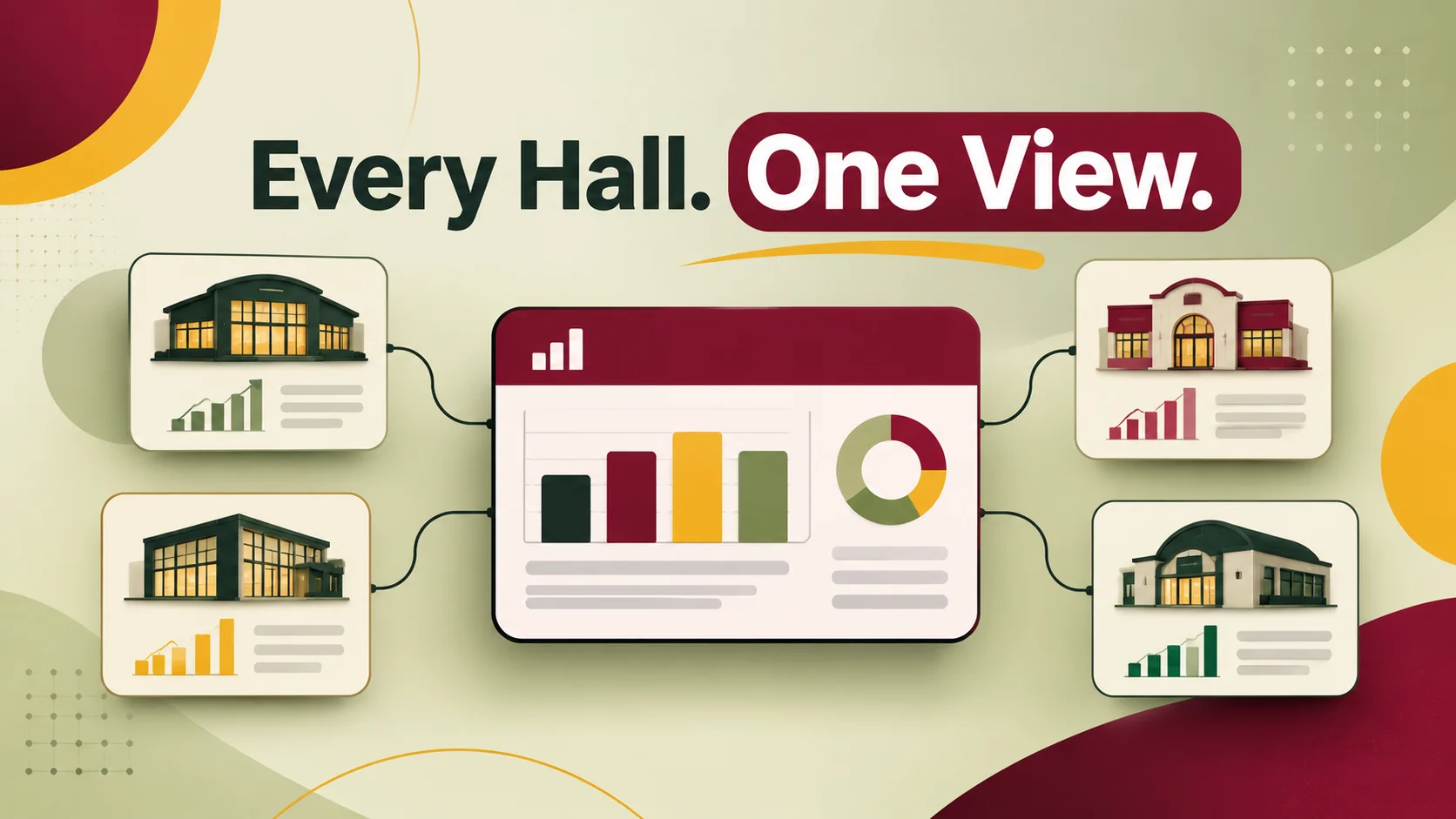
Managing several bingo halls creates a reporting challenge that becomes more complicated as the organization grows.
One location may be reporting strong attendance. Another may be seeing fewer repeat visits. A third may have an active loyalty programme but limited campaign engagement. Each manager can explain what is happening locally, but leadership still needs to understand the performance of the entire operation.
That is difficult when every hall has its own reporting system, spreadsheets, campaign records, and player information.
The problem is not necessarily a lack of data. It is the absence of a shared view.
Roll-up reporting brings information from multiple locations into a consolidated organizational picture while preserving the ability to examine each hall separately. For bingo operators, this makes it easier to understand overall performance, identify differences between venues, and decide where management attention is needed.
The Difference Between Knowing Each Hall and Understanding the Whole Organization
Imagine an operator managing four bingo halls.
Each location produces its own information:
- Hall A reports an increase in new player registrations.
- Hall B has consistent attendance but weaker campaign engagement.
- Hall C is seeing more players redeem loyalty rewards.
- Hall D has experienced a decline in repeat visits.
All four reports may be accurate. However, reading them separately does not automatically explain how the organization is performing.
Leadership must still answer broader questions:
- Are total player registrations increasing across all locations?
- Which halls are contributing most to overall activity?
- Are loyalty programmes being used consistently?
- Is campaign engagement improving across the organization?
- Which locations may need additional support?
- Are there operational practices worth sharing between halls?
Without consolidated reporting, answering these questions requires collecting information from different systems and manually putting it together.
A roll-up report changes the starting point. Instead of assembling four separate reports before understanding the organization, management begins with a combined view and investigates individual locations when necessary.
What Roll-Up Reporting Should Actually Show
A consolidated report should do more than add together numbers from several locations. It should help management understand both organizational performance and the contribution of individual halls.
For a multi-location bingo operation, several reporting areas are particularly useful.
1. Overall player activity
Player registrations and attendance-related trends help operators understand whether the organization is attracting and retaining an active audience.
A consolidated view can provide context that individual hall reports cannot show on their own.
For example, registrations may increase across the organization while one location experiences a decline. The combined figure might still look positive, but the location-level breakdown reveals where attention is needed.
2. Location-by-location performance
A useful reporting structure should allow managers to move from the organizational view to individual hall results.
This helps answer two different questions:
- What is happening across all locations?
- What is driving the results at a particular hall?
The distinction matters because an organization-wide total can hide local problems, while individual reports can make it difficult to recognize wider trends.
3. Campaign performance
Multi-location operators often promote events, special sessions, offers, and loyalty activities across several halls.
Reporting should help management understand how campaigns perform at different locations, rather than treating every message sent as a successful outcome.
For example, an organization-wide campaign may receive strong engagement overall, but the response may vary considerably between halls.
That difference could relate to audience composition, event timing, local preferences, or the relevance of the offer. The report identifies where to investigate; it does not automatically explain why the results differ.
4. Loyalty and reward activity
Reward participation can reveal how players interact with a loyalty programme.
When reporting is available across multiple locations, operators can examine overall reward activity while checking whether participation differs between halls.
This is especially useful when the organization operates a shared loyalty programme. Management can assess whether the programme is being used consistently and whether individual locations need better promotion or staff guidance.
5. Compliance and operational records
Multi-location reporting can also support a more organized approach to reviewing records.
Each hall may need to maintain its own operational and compliance information, but leadership may also need a consolidated view for internal oversight.
The reporting structure should preserve the distinction between individual location records and organization-wide summaries. Combining information should not remove the ability to identify which hall a particular record belongs to.
Why Combined Numbers Can Be Misleading Without Location Context
A consolidated report is useful, but it can create the wrong impression when operators interpret totals without examining the underlying locations.
Consider this fictional example:
An organization manages three bingo halls. Its combined player activity improves over a reporting period.
At first glance, the organization appears to be moving in the right direction. However, a closer review shows that two locations improved while the third experienced declining activity.
If management looks only at the overall figure, the third hall's situation may receive little attention.
This is why roll-up reporting should support comparison and investigation, not replace local reporting.
There are three principles worth following.
Keep the reporting period consistent. Comparing one hall's full-month results with another hall's partial-month results can produce misleading conclusions.
Use consistent metric definitions. If locations count registrations, visits, or campaign outcomes differently, the consolidated figures may not be comparable.
Preserve individual hall visibility. An organization-wide improvement does not mean every location is improving. Managers need access to the underlying results before deciding what action to take.
The goal is not to make every hall perform identically. Different locations may have different schedules, audiences, and attendance patterns. The goal is to understand those differences using information that can be reviewed consistently.
From a Consolidated Report to a Management Decision
A roll-up report becomes valuable when it helps leadership decide what should happen next.
Rather than reviewing every metric with equal attention, operators can use the consolidated view to identify areas that deserve investigation.
Here are four practical examples.
When one location is outperforming the others
Suppose one hall shows stronger campaign engagement than the rest of the organization.
Management can examine its campaign timing, audience selection, message content, and promotional approach. If the approach is suitable for other locations, the team can consider adapting it.
The purpose is to identify a repeatable practice, not assume that copying the same campaign will produce identical results everywhere.
When overall activity looks stable, but one hall is declining
An organization-wide total may remain steady because stronger locations offset weaker results elsewhere.
A location-level comparison helps management identify the hall that needs attention.
The next step could involve reviewing attendance patterns, checking recent campaign activity, discussing local operating conditions, or examining changes in the event schedule.
When loyalty participation differs between halls
If one location has considerably stronger reward participation, operators can investigate how its programme is communicated and managed.
Staff awareness, reward visibility, player communication, and the relevance of offers may all deserve review.
When leadership needs an organization-wide update
Owners, senior managers, and relevant stakeholders may need a consolidated view rather than several separate operational reports.
A consistent roll-up report can make those discussions easier by presenting the same reporting period and comparable measures across locations.
It also gives management a clearer starting point for questions about performance, resource allocation, and operational priorities.
Why Multiple Logins and Spreadsheet Consolidation Create Unnecessary Work
Some organizations begin with separate tools because each hall operates independently. That approach may work while the organization is small.
As more locations are added, however, the reporting process becomes harder to maintain.
A manager may need to:
- Sign in to one hall's system and export its report.
- Repeat the process for every other location.
- Check that all reports cover the same period.
- Reconcile differences in spreadsheet formats.
- Combine the figures into a master report.
- Investigate missing or inconsistent information.
- Repeat the process for the next reporting cycle.
Every manual step creates another opportunity for delays or inconsistencies.
There is also a management problem: leadership may be working with information that was accurate when it was exported but has since become outdated.
A centralized reporting environment reduces the need to move between separate location accounts just to understand the broader operation.
It also creates a more consistent starting point for reviewing individual halls and the organization as a whole.
What to Look for When Choosing Multi-Location Reporting Software
Not every reporting platform designed for businesses is suitable for bingo operators.
A general business dashboard may focus on sales transactions, inventory, or retail customer activity. Bingo operators need reporting that reflects how their halls actually operate.
Before selecting a platform, consider the following requirements.
One central operator view
Managers should be able to access multiple locations through a centralized environment instead of maintaining separate logins for each hall.
The platform should make it practical to review the organization as a whole and move into individual location views when required.
Both consolidated and individual reports
A useful system should not force operators to choose between organization-wide visibility and local detail.
Both views matter. Consolidated reports help leadership understand the wider operation, while location-level reports help managers investigate specific results.
Comparable reporting across locations
The reporting structure should make it easier to compare the same types of information across different halls.
Consistent reporting periods, metric definitions, and location identification are important for meaningful comparisons.
Attendance-focused reporting
Bingo operations depend heavily on player attendance and repeat visits.
Reporting should therefore help operators understand player activity, visit patterns, campaign outcomes, and loyalty participation rather than relying exclusively on conventional retail measurements.
Exportable summaries
Management may need to share reports with owners, boards, senior staff, or other relevant stakeholders.
Exportable summaries can support internal reviews and make it easier to retain reporting records without manually rebuilding the same information.
Appropriate location access
Different staff members may have different responsibilities.
A regional manager may need visibility across all halls, while an individual location manager may primarily need information about their own venue.
Role-based access and location-specific permissions can help organizations maintain an appropriate reporting structure.
How JustKonnect Supports Multi-Location Bingo Reporting
JustKonnect's multi-location capabilities are designed for bingo operators managing more than one hall.
The platform provides a centralized operator environment where managers can access individual location views or review consolidated organizational information without repeatedly logging in and out of separate accounts.
Its multi-location reporting approach covers two important levels:
Location-level reporting: Review activity and operational information for an individual hall.
Roll-up reporting: Examine consolidated information across the organization to understand overall performance.
The wider multi-location environment also supports side-by-side hall comparisons, cross-location player tracking, centralized campaign management, and compliance reporting across locations.
This matters for operators who want to manage their halls as part of one organization without losing visibility into the circumstances of each venue.
Relevant JustKonnect capabilities include:
- Multi-Location Reporting for consolidated and location-level performance visibility.
- Analytics for reviewing attendance-related trends, campaign performance, new signups, reward redemptions, and other operator KPIs.
- Exportable Reports for sharing performance summaries and supporting internal reviews.
- Player Profiles & CRM for maintaining player information and understanding activity across the player relationship.
Together, these capabilities help operators move away from disconnected reporting processes and toward a more consistent view of their multi-location operation.
The specific reporting views, available metrics, and access arrangements should be confirmed during a JustKonnect demonstration based on the organization's structure and requirements.
A Practical Reporting Structure for Multi-Location Operators
Before introducing a new reporting platform, it helps to decide how leadership will use the information.
A simple structure can make the reporting process more useful.
| Reporting level | Main purpose | Questions it should answer |
| Organization-wide | Understand overall performance | Is the organization improving across its locations? |
| Regional or group-level | Review a group of halls | Are there common trends or differences within this group? |
| Individual location | Investigate a specific hall | What is happening at this venue? |
| Campaign-level | Evaluate promotional activity | Which campaigns are receiving the intended response? |
| Player activity | Understand engagement patterns | Are players visiting and participating consistently? |
Not every operator will need a separate regional reporting layer. A smaller organization may only need organization-wide and individual hall views.
The important point is to establish a reporting structure that matches how decisions are made.
A report should have a clear audience, a defined purpose, and an agreed review schedule. Otherwise, even a centralized system can become another place where information is stored but rarely used.
Frequently Asked Questions
What is roll-up reporting in a bingo operation?
Roll-up reporting combines information from multiple bingo halls into an organization-wide view. It allows operators to review overall performance while retaining the ability to examine individual location results.
How is multi-location reporting different from a standard analytics dashboard?
A standard analytics dashboard may focus on the performance of one hall or account. Multi-location reporting adds an organizational layer, allowing management to review consolidated results and compare activity across multiple locations.
Can operators still see individual hall performance when using roll-up reports?
Yes. A useful multi-location reporting system should provide both consolidated organizational summaries and individual location views. This allows managers to investigate specific results without losing the wider picture.
Why should bingo operators compare locations instead of reviewing combined totals alone?
Combined totals can hide differences between individual halls. Comparing locations helps operators identify where activity is improving, where performance needs attention, and which operational practices may be worth adapting elsewhere.
Are spreadsheets enough for managing reports across multiple bingo halls?
Spreadsheets can work for small operations with limited reporting requirements. However, as locations increase, collecting, formatting, reconciling, and updating separate reports can become time-consuming. A centralized reporting platform can make the process more consistent.
What information should a multi-location bingo report include?
Depending on the platform and reporting configuration, useful information may include player registrations, attendance-related trends, campaign performance, loyalty participation, reward redemptions, and relevant operational or compliance records.
Give Every Hall a Place in the Bigger Picture
Managing several bingo halls requires more than knowing what happened at each location. Leadership needs to understand how the locations perform together, where their results differ, and which issues deserve attention.
Without a shared reporting view, that understanding depends on collecting information from separate systems and manually connecting the numbers.
Roll-up reporting gives operators a more organized way to review the wider operation while keeping individual hall performance visible.
For bingo organizations looking to simplify multi-location oversight, JustKonnect brings centralized management and location-level reporting together in a platform designed around bingo operations.
Explore JustKonnect Multi-Location Reporting and request a demo to see how consolidated reporting can support your organization's management process.