A player reaches 10 visits.
They receive their points, redeem their reward, and start again at zero.
For a traditional loyalty programme, that may be the end of the story.
But what if the player also unlocked a 10-Visit Champion badge?
Now something different has happened.
They haven't just earned something they can spend. They've reached a milestone that represents their relationship with the venue.
That distinction matters.
Points are valuable because they can usually be exchanged for something. Badges can be valuable because they represent progress, recognition, identity, and achievement.
For bingo halls, that makes milestone badges an interesting way to encourage consistent attendance—even when the immediate financial value of another reward becomes less important.
Why Points Eventually Become Ordinary
Points are one of the most familiar tools in loyalty marketing.
A customer earns them.
The balance increases.
They eventually redeem them.
Then they start earning again.
There's nothing wrong with this model. Points provide a clear and measurable incentive.
But over time, the psychological impact can become weaker.
A player with 2,000 points may not feel significantly different from a player with 2,200 points.
The numbers accumulate, but the achievement isn't always memorable.
A milestone can feel different.
10 visits.
25 visits.
50 visits.
100 visits.
Those numbers tell a story.
The player can look at them and think:
"I've actually done that."
A Badge Turns a Number Into an Achievement
Consider these two messages:
You've earned 500 loyalty points.
You've unlocked your 25-Visit Champion badge.
Both recognise customer activity.
But they communicate different things.
The points represent value.
The badge represents accomplishment.
That makes milestone badges particularly useful for attendance-based businesses where the goal isn't always to increase spending.
Sometimes the objective is simply:
Get players to come back consistently.
People Like Seeing Progress
One reason achievement systems work is that they make progress visible.
Imagine a player has attended 8 of 10 required sessions.
They can see:
8/10 visits completed
Two more visits remain.
The next achievement is within reach.
That creates a small psychological pull toward completion.
The player isn't necessarily thinking about the monetary value of the badge.
They're thinking:
"I'm almost there."
This is one reason progress-based systems can complement traditional loyalty points.
The "Almost There" Effect
Imagine two customers.
Player A
Has earned 40 points toward an unspecified future reward.
Player B
Has completed 4 of 5 visits needed to unlock a milestone badge.
Player B has a much clearer immediate objective.
They know exactly what remains.
One visit.
That clarity can make the next action feel easier to justify.
For bingo halls, this can be especially useful when trying to encourage repeat or specific attendance patterns.
Milestones Can Create a Sense of Identity
A badge can communicate something about the player.
Consider names such as:
Bingo Regular
Midweek Master
Community Champion
50-Visit Club
These aren't just descriptions of activity.
They can become part of how customers see themselves within the venue.
A long-term player may take pride in being recognised as a regular.
A community-focused player may value a badge connected to charity events.
Someone who enjoys challenges may want to complete every available achievement.
The badge gives the customer a visible representation of their relationship with the venue.
This Is Particularly Relevant to Bingo Halls
Bingo is not purely transactional.
People visit for entertainment, but also for social interaction, community, routine, and shared experiences.
That makes identity particularly relevant.
A customer may think of themselves as:
"Someone who comes here every week."
An achievement system can reinforce that identity.
Instead of simply recording attendance, the venue can recognise it.
That can make loyalty feel more personal.
Don't Make Every Achievement About Spending
If milestone badges are based exclusively on money spent, they become another version of a traditional loyalty programme.
Attendance-based badges can be much more interesting.
For example:
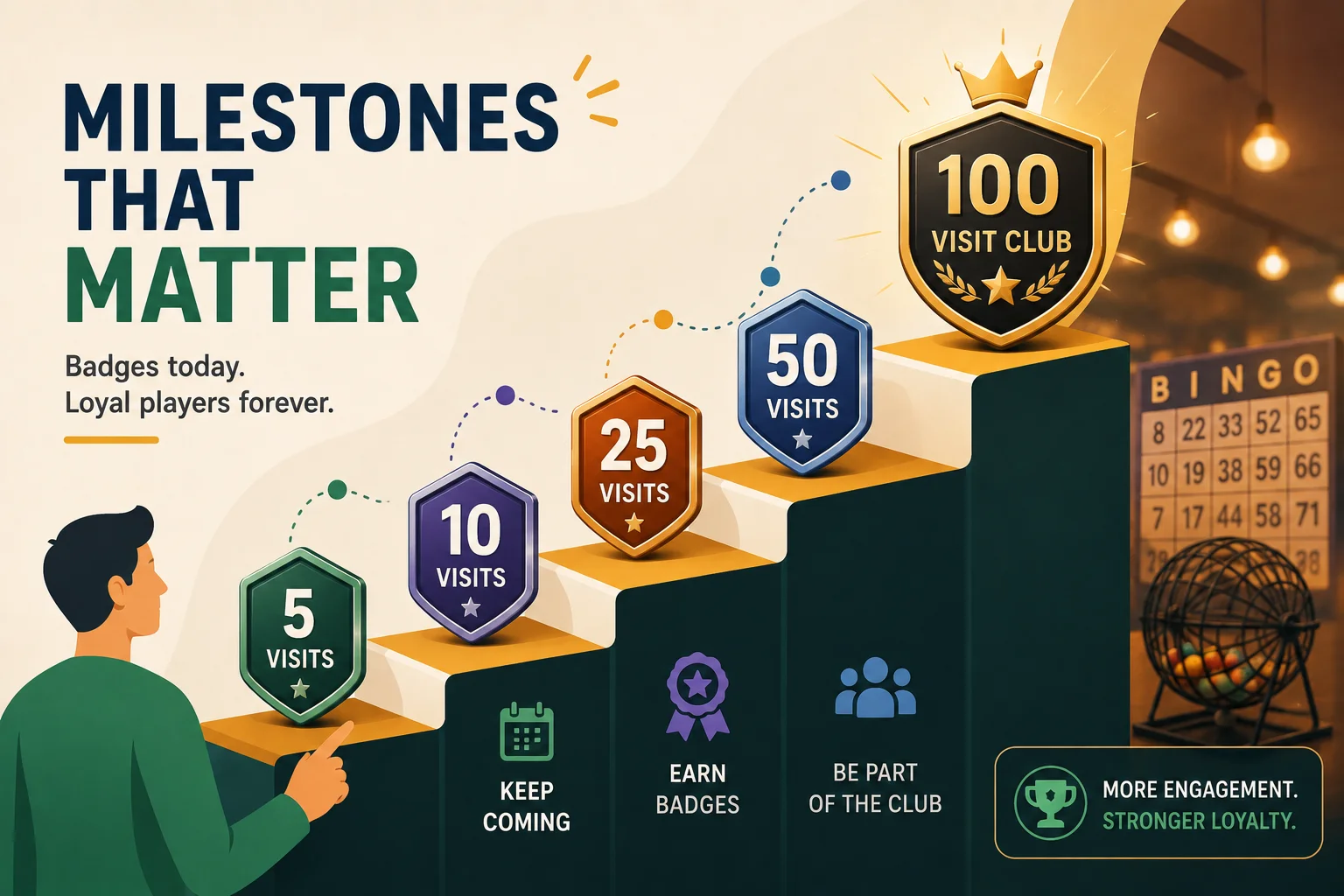
Visit Milestones
- 5 visits
- 10 visits
- 25 visits
- 50 visits
- 100 visits
Consistency Achievements
- 4 consecutive weeks
- 8 consecutive weeks
- 10 midweek sessions
Community Achievements
- 3 charity events
- 5 fundraising nights
- 10 community events
Exploration Achievements
- Attend three different session types
- Participate in five special events
- Try a new themed night
These achievements encourage behaviours that may be valuable to the venue without turning every interaction into a spending calculation.
A Badge Can Give Quiet Nights a Purpose
One of the biggest practical opportunities is encouraging attendance when demand is lower.
Suppose Tuesday nights are consistently quieter than Friday and Saturday.
The venue creates a Midweek Master achievement:
Attend five Tuesday sessions to unlock the badge.
A regular player who already attends Friday might see the challenge and decide to add Tuesday visits.
The badge has effectively created a reason to change behaviour.
The venue doesn't necessarily need to discount the entire Tuesday programme.
It has introduced a goal.
The Reward Doesn't Have to Be Expensive
This is where milestone badges can be useful from an operational perspective.
Recognition doesn't necessarily require a large financial incentive.
The badge itself can be the achievement.
Additional benefits could be reserved for selected milestones.
For example:
5 visits: Digital badge
10 visits: Badge + loyalty points
25 visits: Badge + special reward
50 visits: Badge + VIP recognition
This allows the venue to create a sense of progression without making every achievement expensive.
Make Milestones Visible
An achievement only has motivational value if the player knows it exists.
That means progress should be easy to see.
A customer might see:
25-Visit Champion
18/25 visits completed
7 more visits to unlock.
This is much more engaging than hiding the achievement somewhere inside an account menu.
Operators can also use SMS or other communication channels to remind players when they are close to completing a milestone.
For example:
"You're only two visits away from unlocking your 25-Visit Champion badge."
The message gives the customer a specific reason to return.
The Moment of Achievement Matters
Unlocking a badge should feel like an event.
A simple notification can create a moment of recognition:
Achievement Unlocked
You've completed 25 visits and earned the 25-Visit Champion badge.
That is more memorable than silently adding another batch of points to an account.
The customer has something they can see and understand immediately.
Let Players Collect Achievements
Once a player has earned several badges, the system can become a collection.
They might have:
- First Visit
- 10-Visit Champion
- Weekend Regular
- Charity Champion
Now the player isn't working toward a single reward.
They're building a history.
This can be especially effective for customers who enjoy completion and progression.
The programme starts to resemble a personal record of their venue experience.
Avoid Making the System Too Complicated
The psychology behind achievement systems works best when the rules are obvious.
A player shouldn't need to study a manual to understand how to earn a badge.
Good examples are easy to explain:
Attend five times.
Visit three charity nights.
Complete 10 midweek sessions.
Reach 25 total visits.
The objective should be immediately understandable.
Complexity creates friction.
Clarity creates momentum.
Use Different Achievement Paths
Not every player will be motivated by the same milestone.
One customer might care about visit frequency.
Another might enjoy special events.
Someone else might be highly engaged with community fundraising.
Creating different achievement categories allows customers to build their own progression.
For example:
Attendance Path
5 → 10 → 25 → 50 visits
Community Path
1 → 5 → 10 charity events
Event Path
3 → 5 → 10 special events
The player chooses which identity they want to develop.
What Happens When the Points Stop Mattering?
This is where milestone badges can have a particularly interesting role.
Imagine a long-term player who has accumulated enough points to redeem the rewards they normally want.
The immediate financial incentive becomes less important.
But they may still care about:
- Reaching 100 visits
- Completing an achievement collection
- Maintaining a consistency streak
- Earning a special status badge
- Being recognised as a long-term member
The motivation has shifted.
They're no longer participating only for the reward.
They're participating because the progress itself has become meaningful.
A Practical Bingo Hall Scenario
Imagine a venue introduces a milestone system with three simple achievements.
10 Visits — Regular
25 Visits — Dedicated Player
50 Visits — Hall Champion
A player reaches 23 visits.
They receive a message:
"You're two visits away from unlocking Dedicated Player."
They attend twice more and receive the badge.
The venue then presents the next goal:
50 Visits — 25 visits remaining.
The customer now has a longer-term target.
The loyalty programme has created a progression that can continue even when the customer isn't particularly motivated by another small points reward.
Measure Behaviour, Not Just Badge Unlocks
A venue shouldn't assume that badges work simply because players are earning them.
The important question is whether achievements influence behaviour.
Track metrics such as:
- Visits before and after badge introduction
- Badge completion rates
- Repeat attendance
- Progress toward milestones
- Midweek attendance
- Event participation
- Retention after milestone completion
- Engagement with achievement-related messages
For example, if customers approaching a milestone show a measurable increase in visit frequency, that's evidence that the achievement is influencing behaviour.
How JustKonnect Supports Achievement-Based Engagement
Milestone badges work best when they are connected to the rest of the customer engagement system rather than operating as an isolated feature.
JustKonnect Achievement Badges gives venues a way to recognise player milestones and create gamified goals around customer activity. For bingo halls, achievement-based engagement can be used to recognise visits, event participation, loyalty milestones, and other behaviours that matter to the venue.
The feature can become even more useful when combined with loyalty points, VIP tiers, SMS marketing, CRM, coupons, and analytics.
For example, a player could receive an SMS telling them they're one visit away from a milestone. Their next visit completes the achievement. The badge is unlocked, loyalty points can be awarded, and the player continues progressing toward another goal.
The result is a loyalty experience where points provide tangible value while achievements provide recognition and progression.
Frequently Asked Questions
Why can badges motivate players when points become less important?
Points are primarily transactional, while badges can represent progress, recognition, and identity. A player may continue working toward a meaningful milestone even after the immediate value of another points reward becomes less motivating.
What milestones work well for bingo halls?
Visit counts, consecutive attendance, charity events, special events, midweek sessions, and long-term membership milestones are all potential achievement categories.
Should every badge come with a financial reward?
No. Some badges can provide recognition on their own, while larger milestones can include loyalty points, vouchers, VIP benefits, or other rewards.
Can badges encourage attendance on quieter nights?
Yes. Venues can create achievements around specific behaviours, such as completing five Tuesday visits, giving players a reason to attend sessions they might otherwise skip.
How many badges should a bingo hall offer?
Start with a manageable number of meaningful achievements. Too many badges can make the system confusing and reduce the significance of individual milestones.
When the Achievement Becomes the Motivation
The most interesting thing about milestone badges is that they can change what loyalty means.
At first, the player may come for the points.
Then they notice they're close to an achievement.
They return to complete it.
The badge gives them recognition.
The next milestone appears.
Eventually, the player isn't simply accumulating rewards. They're building a record of their participation with the venue.
That's the point where gamification becomes more than decoration.
A well-designed achievement system can give players something to remember, something to complete, and something to look forward to.
Explore JustKonnect Achievement Badges to see how milestone-based gamification can complement points, loyalty programmes, VIP tiers, and customer engagement while giving players additional reasons to keep coming back.