Charity bingo halls operate very differently from traditional businesses. Between managing bingo sessions, tracking volunteers, handling pull tabs, maintaining compliance, and reporting proceeds for multiple charities, the operational complexity is unique. Yet many organizations initially turn to generic CRM software to manage these workflows — only to discover it quickly falls short.
While customer relationship management tools work well for sales teams and basic donor tracking, they lack the specialized functionality required for nonprofit gaming environments. As charity bingo operations grow, these limitations become operational bottlenecks.
This is where purpose-built charity bingo hall software becomes essential.
The Growing Complexity of Charity Bingo Operations
Modern charity bingo halls are responsible for far more than selling cards. They must manage:
- Multiple bingo sessions per week
- Different participating charities
- Volunteer scheduling
- Pull tab inventory tracking
- Cash reconciliation
- Regulatory compliance
- Revenue reporting
- Player tracking
- Hall scheduling
- Expense tracking
Generic CRM systems are not designed to handle gaming operations, financial controls, or regulatory requirements. This creates inefficiencies and increases the risk of errors.
Why Many Bingo Halls Try Generic CRM First
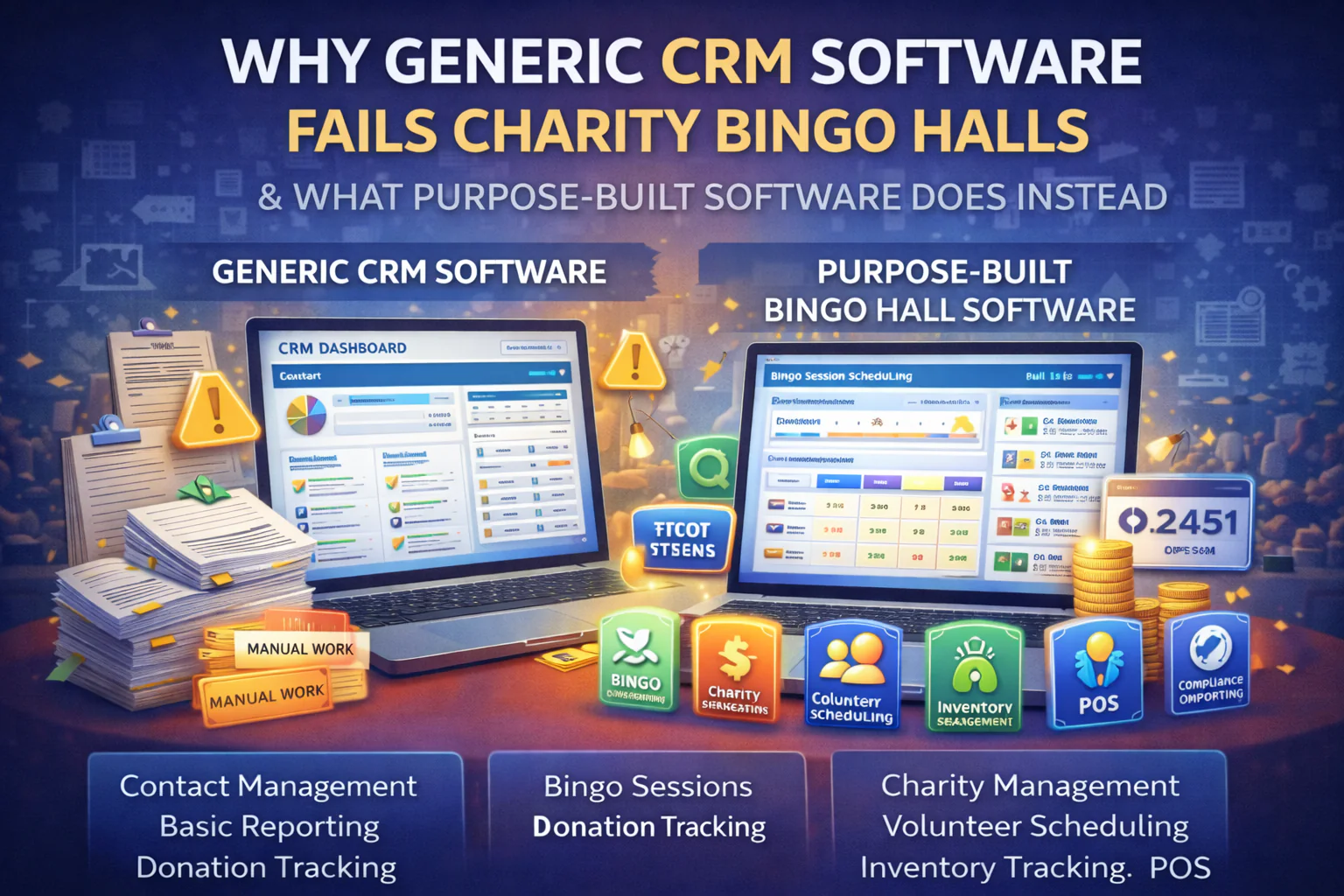
Generic CRM software seems appealing at first because it offers:
- Contact management
- Basic reporting
- Donation tracking
- Communication tools
- Scheduling features
However, these tools are designed for customer pipelines — not gaming operations. As soon as bingo halls attempt to manage sessions, inventory, or compliance, the gaps become obvious.
Where Generic CRM Software Falls Short
No Session Management
Charity bingo halls operate on structured sessions with specific games, pricing, and charities. Generic CRM tools lack the ability to:
- Schedule bingo sessions
- Assign charities to sessions
- Track attendance per session
- Record session revenue
- Manage game types
This forces halls to rely on spreadsheets and manual tracking.
No Pull Tab & Inventory Tracking
Pull tabs and bingo supplies require accurate inventory management. Generic CRM systems do not track:
- Pull tab inventory
- Box tracking
- Serial numbers
- Inventory reconciliation
- Supplier management
Without purpose-built tools, inventory errors and revenue leakage become common.
No Charity Gaming Compliance Tools
Charity gaming is heavily regulated. Organizations must track:
- Charity participation
- Session proceeds
- Expense allocations
- Volunteer hours
- Compliance reports
Generic CRM platforms cannot generate gaming-specific compliance reports, leaving halls vulnerable to regulatory issues.
Poor Volunteer Management
Volunteers are central to charity bingo operations. CRM tools are designed for employees or customers — not rotating volunteer teams.
They lack:
- Volunteer scheduling
- Role assignments
- Shift tracking
- Charity-specific volunteers
- Availability management
This leads to scheduling conflicts and administrative overhead.
No Cash & POS Integration
Bingo halls operate largely on cash transactions. Generic CRM systems do not support:
- Cash drawer reconciliation
- POS tracking
- Game sales tracking
- Session-based revenue reporting
- Payment type tracking
Manual tracking increases the risk of accounting discrepancies.
No Multi-Charity Support
Many bingo halls host multiple charities. Generic CRM software is not structured to:
- Split revenue between charities
- Track charity rotation
- Assign volunteers by charity
- Generate charity-specific reports
Purpose-built software handles this automatically.
Limited Reporting for Gaming Operations
CRM reporting focuses on contacts and sales pipelines. Charity bingo halls require:
- Session profitability reports
- Charity payout summaries
- Pull tab performance
- Attendance tracking
- Volunteer activity reports
- Hall utilization reports
Without these insights, decision-making becomes difficult.
What Purpose-Built Charity Bingo Hall Software Does Instead
Purpose-built charity bingo hall software is designed specifically for nonprofit gaming operations. It centralizes all hall management tasks into one platform.
Instead of forcing workarounds, dedicated software provides:
- Bingo session management
- Charity rotation tracking
- Volunteer scheduling
- Pull tab inventory management
- POS and cash tracking
- Compliance reporting
- Multi-hall support
- Financial reconciliation
- Real-time reporting
- Cloud access for teams
This eliminates spreadsheets, reduces errors, and improves operational visibility.
Key Features Charity Bingo Software Should Include
When evaluating software for a charity bingo hall, look for:
- Session scheduling and tracking
- Charity management tools
- Volunteer scheduling system
- Pull tab inventory tracking
- POS and sales tracking
- Cash reconciliation tools
- Compliance reporting
- Multi-charity support
- Financial reporting dashboards
- Cloud-based access
- Multi-location support
These features ensure smooth operations and regulatory compliance.
When It’s Time to Upgrade from CRM
If your charity bingo hall is experiencing any of the following, it’s time to move beyond generic CRM software:
- Too many spreadsheets
- Manual revenue tracking
- Inventory discrepancies
- Volunteer scheduling issues
- Compliance reporting challenges
- Difficulty tracking multiple charities
- Limited operational visibility
Purpose-built charity bingo hall software solves these problems and supports long-term growth.
Final Thoughts
Generic CRM software may work temporarily for small operations, but it cannot support the complexity of modern charity bingo halls. As operations expand, the lack of session management, compliance tools, inventory tracking, and reporting becomes a major limitation.
Purpose-built charity bingo hall software provides the specialized functionality needed to streamline operations, improve transparency, and ensure regulatory compliance. For organizations looking to scale and operate efficiently, dedicated bingo management software is no longer optional — it’s essential.