A player campaign can start with something as simple as a Friday night reminder.
The message is written. The audience is selected. The promotion is ready.
Then comes the part that can be much harder to see from the marketing dashboard: was the message actually appropriate to send to that player, and can the operator demonstrate why?
For charity gaming operators, SMS compliance should not be treated as a box to tick after a campaign has been created. Consent, opt-outs, sender identification, message content, delivery records, and campaign history all form part of the communication process.
That is particularly important when a hall regularly sends game reminders, jackpot alerts, event announcements, loyalty messages, fundraising promotions, or re-engagement campaigns.
A short code can provide the infrastructure for high-volume business messaging, but the number itself does not make a campaign compliant. The operator still needs a process that respects consent and handles opt-outs correctly.
The Federal Communications Commission (FCC) has established requirements around revocation of consent for covered communications, while CTIA's messaging guidance emphasizes obtaining opt-in consent before sending messages to consumers.
For a charity gaming operation, the real question is therefore bigger than:
“Can we send thousands of texts?”
It is:
“Can we send the right messages to the right players while maintaining a reliable record of why those messages were sent?”
Compliance Starts Before the First Text
The easiest mistake to make is thinking about compliance only when the message is about to be sent.
By then, several important decisions have already happened.
A player may have:
- Joined a loyalty programme
- Provided a mobile number
- Agreed to receive certain communications
- Attended a previous game
- Received a promotional message
- Asked to stop receiving marketing texts
- Changed communication preferences
Those actions need to be reflected in the messaging system.
JustKonnect's SMS policy states that SMS communications are sent to players who have opted in to communications from the relevant bingo hall and that the platform maintains opt-in records, delivery logs, and opt-out histories.
That creates a useful operational principle:
Do not treat the phone number as the permission. Treat the consent record as the permission.
A player having a valid mobile number does not, by itself, explain whether that player should receive a promotional campaign.
The Five-Part Compliance Chain
Think of every SMS campaign as a chain.
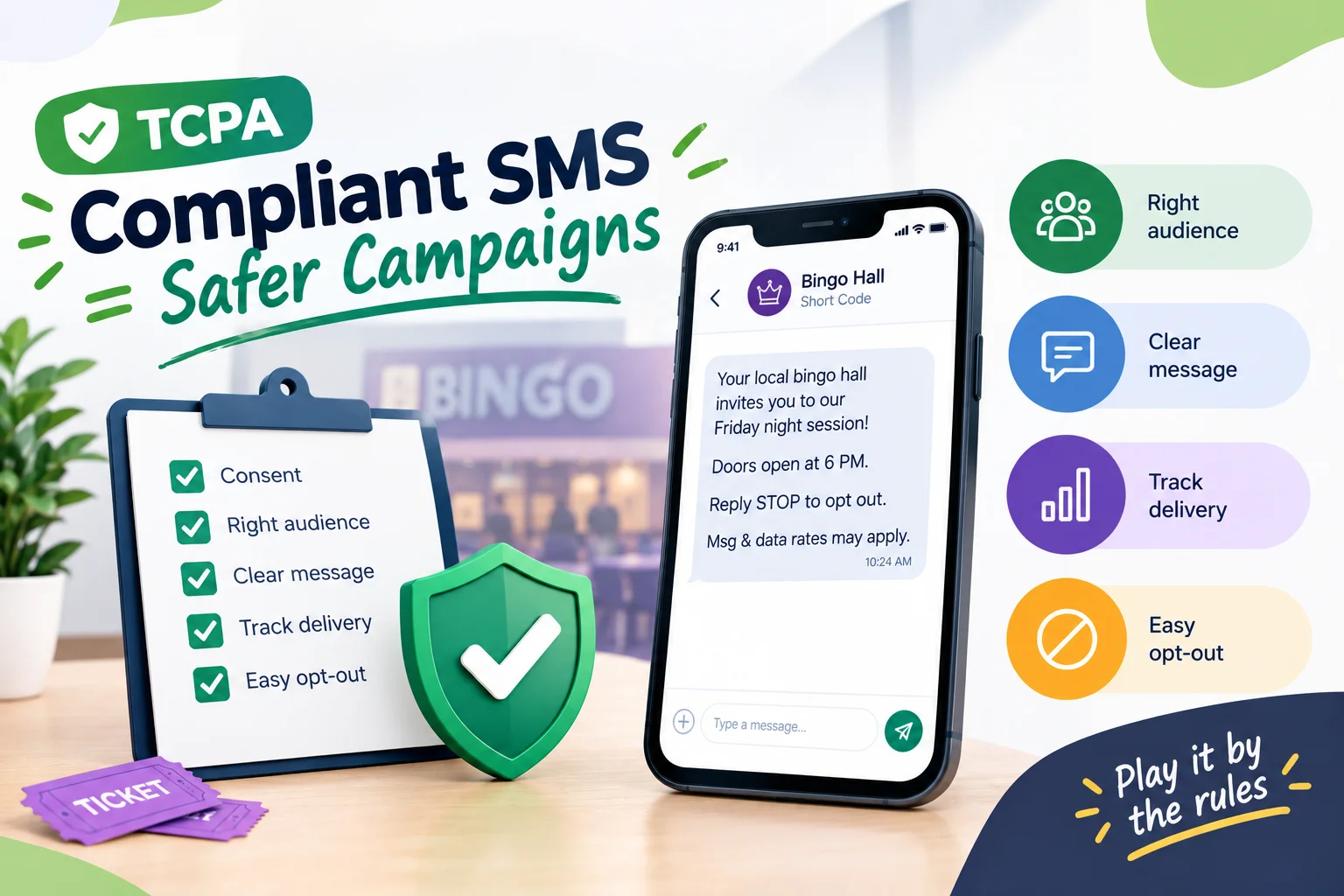
Consent → Audience → Message → Delivery → Opt-out
If one part is poorly controlled, the campaign becomes harder to defend.
1. Consent
The operator needs a clear basis for sending the applicable messages.
CTIA's messaging guidance says non-consumer senders should obtain opt-in consent before messaging consumers.
For an operator, this means avoiding assumptions such as:
“They gave us their number, so we can text them.”
A better process records what the player agreed to receive and maintains that information alongside the player record.
2. Audience
Even a properly collected opt-in does not mean every future message belongs in the same campaign.
A player might be eligible for general game reminders but not for a particular promotion.
This is where segmentation becomes important.
Instead of exporting a master phone-number list and sending the same message to everyone, operators can build audiences around relevant player information such as attendance, loyalty status, or recent activity.
JustKonnect's player CRM supports segmentation based on factors such as attendance frequency, loyalty tier, and last-seen date.
3. Message
The content itself matters.
A player should be able to understand who is communicating with them and what the message concerns.
JustKonnect's published SMS compliance requirements include identifying the bingo hall or organization, describing the nature of the messages, disclosing message frequency where applicable, including a data-rate notice, providing opt-out instructions, and linking to the relevant privacy policy.
This is very different from sending:
“Big jackpot tonight! Come in!”
A more transparent campaign gives the recipient enough context to understand the communication.
4. Delivery
Once a campaign is sent, the operator needs visibility into what happened.
Was the message delivered?
Which campaign generated the response?
When was it sent?
Which audience received it?
These records become particularly useful when operators review campaign performance or need to investigate a communication issue.
JustKonnect states that it maintains delivery logs and other messaging records for communications conducted through the platform.
5. Opt-Out
This is where a campaign can quickly become an operational problem if the process is manual.
A player who no longer wants messages should not have to repeatedly contact staff.
FCC rules address reasonable revocation of consent and specifically recognize messages such as “STOP” as a reasonable way for consumers to revoke consent in covered circumstances. The FCC also states that revocation requests made through a reasonable method must be honored within a reasonable time, not exceeding 24 hours under the cited rule.
JustKonnect's published policy says that when a player sends STOP, the number is flagged and excluded from future campaign sends, with operators unable to manually override that opt-out status.
That kind of automation matters because compliance should not depend on whether a staff member remembers to update a spreadsheet.
Why a Short Code Is More Than a Short Number
A short code is a dedicated abbreviated number used for application-to-person messaging.
The infrastructure is designed for business messaging at scale, which makes short codes relevant when a charity gaming operator needs to communicate with a large opted-in audience around a particular event or campaign.
For example, a hall might need to notify eligible players about:
- A major jackpot
- A charity fundraiser
- A special bingo session
- A holiday event
- A schedule change
- A loyalty update
- An upcoming promotion
- A last-minute event reminder
JustKonnect uses carrier-approved short codes for broadcast SMS communications and positions them as part of its bingo-focused messaging infrastructure.
But there is an important distinction:
Short code infrastructure can support compliant messaging. It does not replace the operator's responsibility for consent and campaign practices.
That distinction should be clear before choosing an SMS platform.
What Happens When Consent Is Managed Manually?
Imagine a hall collecting player numbers through several channels:
Front desk
A player writes their number on a paper form.
Loyalty programme
Another player enters their details through a digital sign-up.
Event registration
A third player provides a number while registering for a fundraiser.
Staff records
Someone updates a spreadsheet after speaking to a player.
Now imagine one of those players later says:
“Please stop texting me.”
If the opt-out is recorded in only one location, the operator has created a data-management problem.
The campaign database might still contain the number.
Another spreadsheet might contain it.
An automated campaign could have a separate audience.
A staff member may know about the request but another member of the team may not.
This is why SMS compliance becomes an operational systems issue, not simply a marketing issue.
The Danger of the “Master SMS List”
Many operators naturally want one list containing every player who has ever provided a mobile number.
It feels efficient.
But a master list can hide important differences between players.
Consider these records:
| Player | Mobile Number | Marketing Status | Recent Activity | Campaign Eligible? |
| Player A | Recorded | Opted in | Regular visitor | Potentially |
| Player B | Recorded | Opted out | Regular visitor | No |
| Player C | Recorded | Consent unclear | Recent visitor | Needs review |
| Player D | Recorded | Opted in | Lapsed | Potentially |
| Player E | Recorded | Opted in | Event participant | Depends on campaign |
The important column is not simply Mobile Number.
It is the communication status and the information surrounding it.
A compliance-conscious SMS system should make those distinctions easier to manage.
Why “They Are Already Our Player” Is Not Enough
Existing relationships can make SMS marketing feel informal.
A player has visited the hall for years.
They know the staff.
They regularly attend Friday bingo.
They may even belong to the loyalty programme.
That does not eliminate the need for appropriate messaging practices.
A relationship with the player and permission to send a particular category of electronic communication are not necessarily the same thing.
This is especially important when an operator moves from operational messages into promotional communications.
For example:
Operational-style communication
“Tonight's scheduled bingo session begins at 7 PM.”
Promotional communication
“Join us Friday for our special charity event and promotional offer.”
The distinction matters because operators should understand what their players agreed to receive and structure campaigns accordingly.
Make Opt-Outs Automatic, Not Administrative
One of the strongest reasons to integrate compliance into the SMS platform is simple:
People make mistakes.
A busy hall may have staff working across multiple shifts.
One employee may receive a player's request to stop messages.
Another employee may prepare the next campaign.
A third may manage the loyalty database.
If the opt-out process depends on all three people communicating correctly, the system has unnecessary points of failure.
Automation can reduce that dependency.
JustKonnect's published policy says STOP requests are recorded in the system and excluded from future campaign sends, while HELP instructions are available through SMS.
That changes the workflow from:
Player asks → Staff remembers → Spreadsheet updated → Campaign list cleaned
to a much more controlled process:
Player opts out → System records status → Future campaign eligibility changes
The second model is easier to manage at scale.
Compliance Records Matter After the Campaign
The campaign itself may take seconds to send.
The record of that campaign can matter much longer.
Operators should be able to answer basic questions such as:
- Who received the campaign?
- What message was sent?
- When was it sent?
- What consent information applied?
- Which players had opted out?
- Which messages were delivered?
- What happened after the campaign?
These records can also help operators investigate complaints, review internal procedures, and demonstrate how their messaging process operates.
JustKonnect says its platform maintains time-stamped activity records and supports exportable compliance documentation for charity gaming operations.
That is an important difference between an SMS tool and a broader player communication platform.
Compliance Should Not Kill Your Marketing
Compliance is sometimes presented as the part of SMS marketing that makes campaigns slower and more complicated.
It does not have to work that way.
The goal is not to stop operators from communicating with players.
The goal is to make communication more controlled.
A compliant campaign can still be timely.
It can still promote a major jackpot.
It can still remind players about an event.
It can still re-engage an inactive audience.
It can still support fundraising.
The difference is that the campaign operates within a defined communication framework.
That framework can actually improve marketing quality because operators become more deliberate about:
Who receives the message?
Why are they receiving it?
What are they being told?
What action can they take?
How can they stop future messages?
Those are good marketing questions as well as compliance questions.
The Real Problem With Generic SMS Tools
A generic SMS platform may let an operator upload contacts and send messages.
That solves one problem.
It does not necessarily solve the operational problem around those contacts.
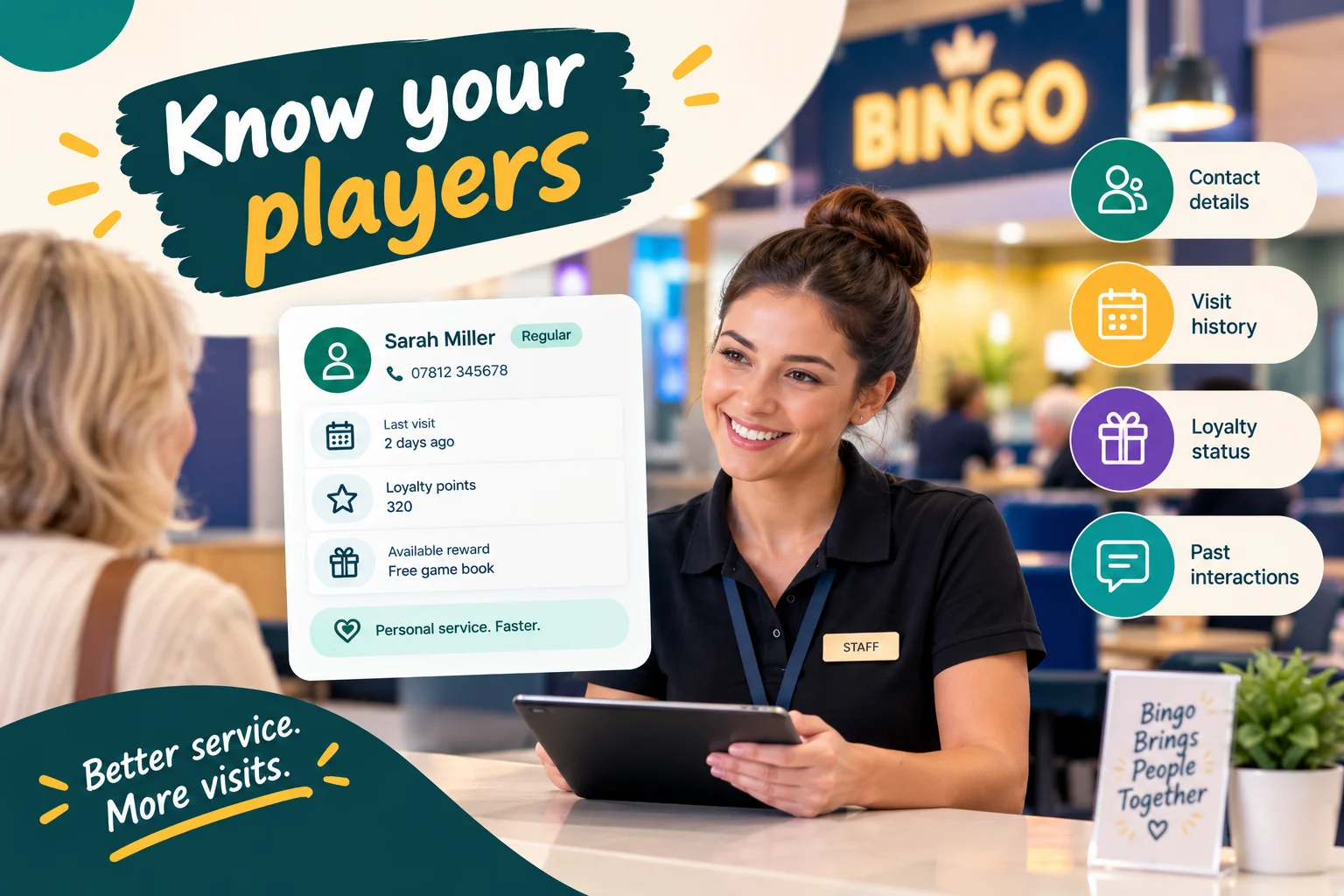
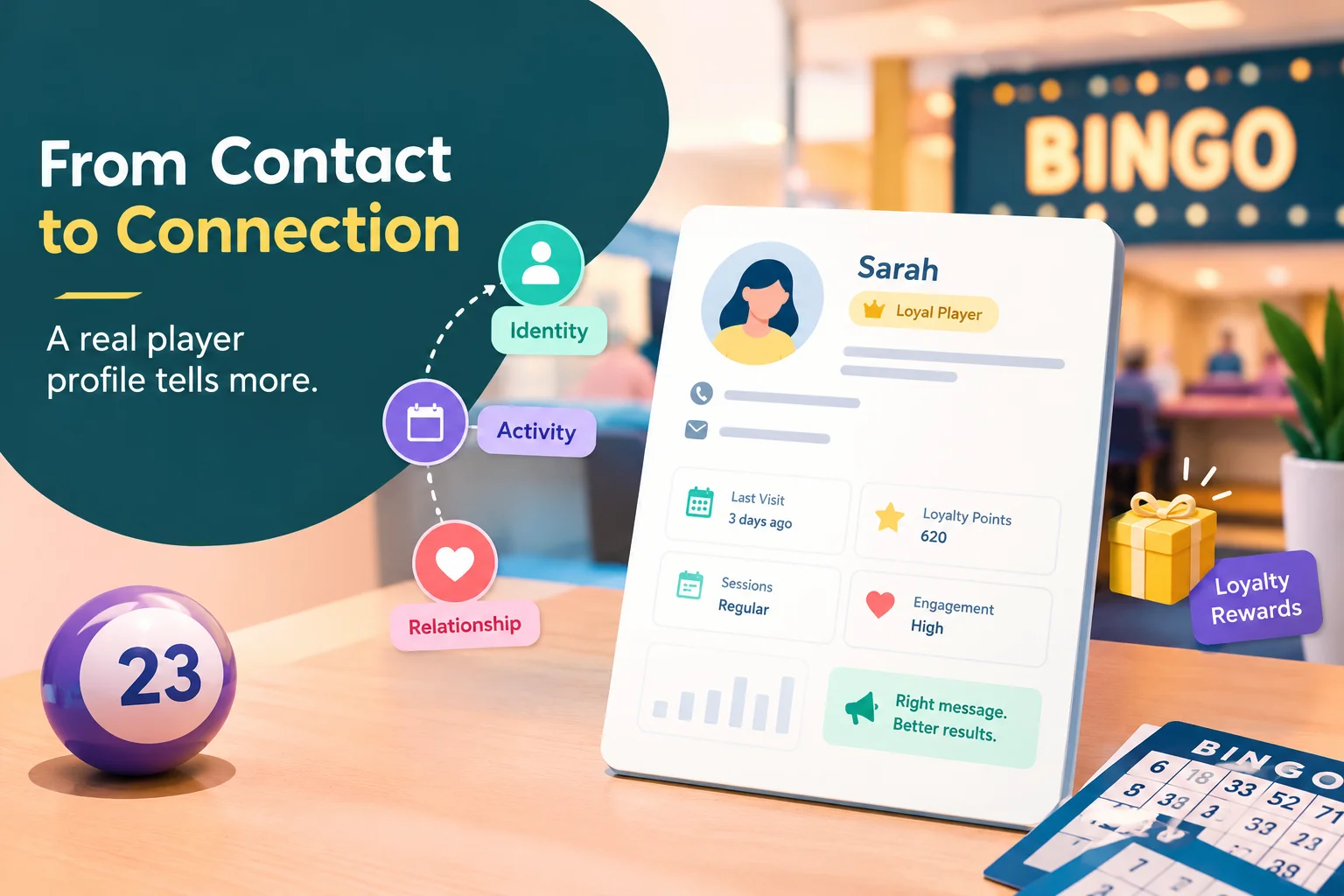
Charity gaming operators often need messaging to work alongside player profiles, attendance, loyalty, campaign history, and compliance records.
JustKonnect combines player CRM, SMS marketing, loyalty, analytics, and compliance logging within a platform designed specifically around charity bingo operations.
That matters because player communication rarely exists in isolation.
A player receives a game reminder.
They attend.
Their visit is recorded.
They earn loyalty activity.
They may receive another targeted communication later.
The communication history and player activity can therefore become part of the same operational picture.
A Better Way to Audit Your SMS Process
Before your next major player campaign, ask your team to trace one player from beginning to end.
Start with the phone number.
Then ask:
Where did we obtain it?
Where is consent recorded?
What types of messages did the player agree to receive?
How does the system decide whether they belong in this campaign?
What happens if they reply STOP?
How quickly is that status applied?
Can staff override it?
Can we see what was sent to this player?
Can we produce the relevant record later?
If your team has to search through multiple spreadsheets, inboxes, paper forms, or disconnected systems to answer those questions, the process has unnecessary compliance risk and operational friction.
If the answers are visible within the same platform, the workflow becomes easier to control.
Common SMS Compliance Mistakes in Charity Gaming
Treating every collected number as a marketing contact
A phone number is contact information. It is not automatically a blanket permission for every type of promotional communication.
Keeping opt-outs in a spreadsheet
Manual suppression lists can become outdated or accidentally bypassed.
Sending from personal staff numbers
Using individual mobile numbers for mass player communication can make sender management, recordkeeping, and campaign control more difficult.
Forgetting consent language during signup
If the opt-in process does not clearly explain what players are signing up for, the resulting records may be difficult to interpret later.
Mixing too many purposes into one message
A campaign should have a clear purpose. Combining unrelated promotions can make the communication less transparent and less useful.
Ignoring campaign records after sending
Delivery and consent records are not only useful when something goes wrong. They can help operators understand and improve the entire communication process.
What a Compliance-Ready SMS Workflow Looks Like
A practical workflow can be straightforward:
1. Capture consent
Record the player's communication permission during an appropriate signup process.
2. Maintain the player record
Keep communication status connected to the player's profile.
3. Segment the audience
Select players based on relevant eligibility and campaign purpose.
4. Prepare transparent messaging
Identify the sender and provide appropriate disclosures and opt-out instructions.
5. Send through approved infrastructure
Use a business messaging system designed for application-to-person communications at the required scale.
6. Process opt-outs automatically
Ensure STOP and other valid revocation requests affect future campaign eligibility.
7. Preserve the record
Keep campaign, delivery, consent, and opt-out information available for review.
8. Measure the result
Look beyond delivery. Review engagement, attendance, redemption, and other relevant outcomes.
This turns compliance from a final checkpoint into part of the campaign architecture.
How JustKonnect Fits Into This Workflow
JustKonnect's short-code SMS capability sits within a wider bingo-focused platform rather than operating as an isolated texting tool.
The platform supports short-code SMS campaigns alongside player CRM, segmentation, automated messaging, analytics, loyalty, and compliance logging.
Its published compliance policy also describes opt-in records, delivery logs, opt-out histories, STOP handling, and carrier-approved short-code infrastructure.
For operators, the practical benefit is having the communication workflow connected to the player data that informs it.
Instead of asking:
“How do we send a text to our list?”
the better operational question becomes:
“How do we manage player communications from consent through campaign delivery and follow-up?”
That is a much bigger requirement.
And for charity gaming operators running frequent player campaigns, it is one worth building into the system from the start.
Frequently Asked Questions
Does using a short code automatically make an SMS campaign TCPA compliant?
No. A short code is messaging infrastructure, not a substitute for compliant campaign practices. Operators still need to consider consent, message content, identification, opt-out handling, recordkeeping, and other applicable requirements. JustKonnect describes its short-code messaging as operating alongside consent and compliance controls.
Is a player's mobile number enough to send promotional SMS?
Not necessarily. Operators should distinguish between having a player's contact information and having appropriate consent for the applicable category of messages. CTIA guidance emphasizes opt-in consent for non-consumer senders messaging consumers.
What should happen when a player texts STOP?
The request should be processed as a revocation of consent where applicable, and the player should be removed from future covered messages within the required timeframe. The FCC specifically addresses reasonable revocation methods, including STOP replies. JustKonnect states that STOP requests are recorded and excluded from future campaign sends.
Should charity gaming operators keep SMS consent records?
Maintaining clear records is an important part of managing a defensible messaging process. JustKonnect states that its platform maintains opt-in records, delivery logs, and opt-out histories for SMS activity.
Can compliant SMS still be used for promotions and fundraising events?
Yes. Compliance does not mean abandoning SMS marketing. Operators can use SMS for appropriate player communications such as event announcements, reminders, jackpot alerts, loyalty messages, and other campaigns when the applicable consent and messaging requirements are satisfied. JustKonnect specifically supports these bingo-focused SMS use cases.
Why use a bingo-focused SMS platform instead of a generic texting tool?
The difference is the surrounding workflow. A bingo-focused platform can connect messaging with player profiles, attendance, segmentation, loyalty, campaign activity, and compliance records. JustKonnect is designed around those connected charity bingo operations rather than treating SMS as an isolated bulk-messaging function.
Build Compliance Into Every Player Message
The strongest SMS process is not the one where someone remembers to check compliance immediately before pressing Send.
It is the one where the system has already built the important controls into the workflow.
Consent is recorded.
Audiences are managed.
Messages are transparent.
Opt-outs are respected.
Campaign activity is logged.
Performance can be reviewed.
That gives charity gaming operators something more valuable than another way to reach players: a more controlled communication process that can scale without relying on manual checks at every step.
If your hall is sending player campaigns through SMS, explore JustKonnect's Short Code SMS feature to see how carrier-approved short-code messaging can fit into a broader player CRM, marketing, and compliance workflow.